
Nanonets-OCR-s Turns Messy Documents Into Structured Markdown on a Single GPU
A 3B parameter vision-language model turns messy documents into clean, LLM-ready markdown with semantic tags for tables, equations, signatures, and checkboxes.
Takeaways
- Nanonets released Nanonets-OCR-s, a 3B open-weight VLM fine-tuned from Qwen2.5-VL-3B for image-to-markdown OCR.
- Semantic tagging covers LaTeX equations, tables, signatures, watermarks, checkboxes, and image descriptions.
- Runs on a single 16GB GPU via Transformers, vLLM, SGLang, or Docker Model Runner.
- Ships with the docext toolkit for on-premises PDF and image workflows.
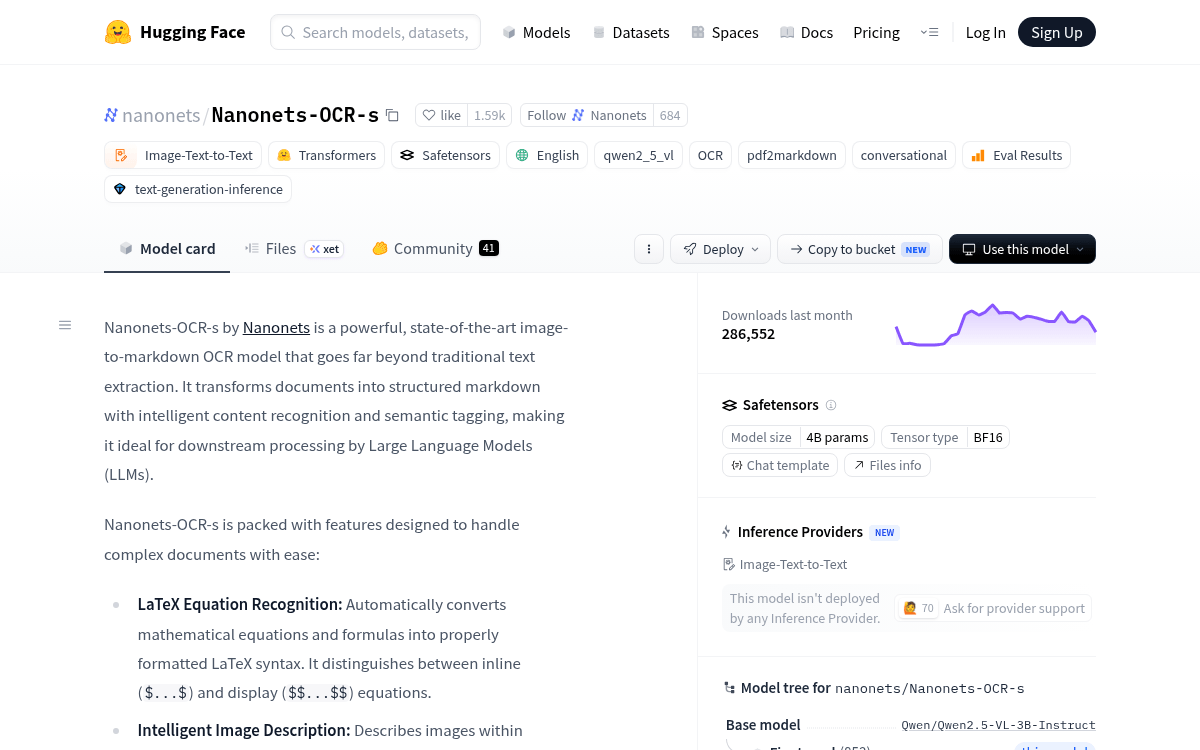
- Roughly 287K downloads and 1.6K likes on Hugging Face signal strong developer uptake.
- Superseded by Nanonets-OCR2, which adds visual question answering and multilingual support.
Traditional OCR spits out a blob of text and calls it a day. Nanonets has released an open-weight vision-language model that treats a document more like a structured object, tagging equations, tables, signatures, watermarks, and checkboxes as it reads. The Nanonets-OCR-s model is small enough to run on a single consumer GPU, and its output drops straight into an LLM pipeline without a second cleanup pass.
A document as a structured object
Nanonets-OCR-s is a 3.75B parameter multimodal transformer based on Qwen2.5-VL-3B, fine-tuned by Nano Net Technologies for image-to-markdown OCR. Rather than emitting raw characters, it produces markdown with semantic wrappers around each element type. That covers ordinary body text alongside the parts that normally break downstream parsing.
The feature list from the model card is where this gets interesting:
- LaTeX equations: Inline math is wrapped in
$...$and display math in$$...$$, so equations survive the trip into a RAG index. - Image descriptions: Charts, logos, and figures are described inside
<img>tags so an LLM can reason about them without the pixels. - Signatures and watermarks: