
NVIDIA's Llama-Nemotron-Rerank Quietly Hits 1M Downloads Beating Cohere in 26 Languages
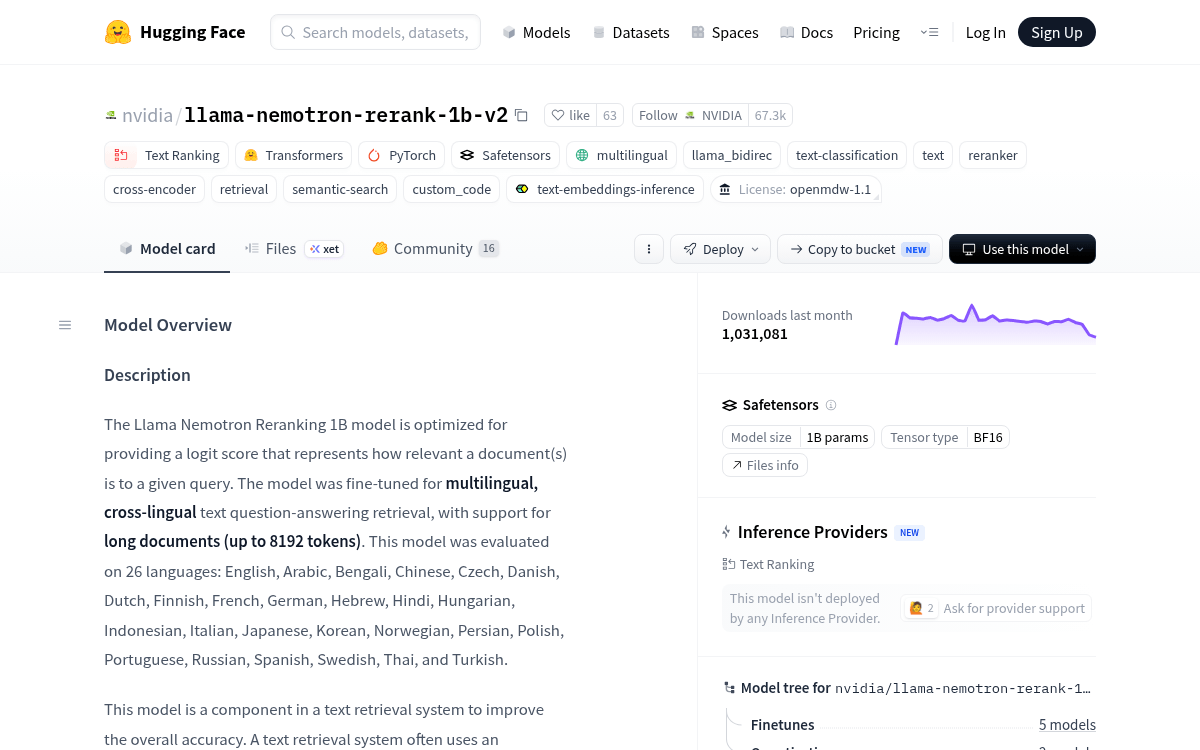
NVIDIA released a 1B parameter multilingual cross-encoder reranker built on Llama 3.2, covering 26 languages and 8192-token contexts for commercial RAG pipelines.
Takeaways
- NVIDIA released llama-nemotron-rerank-1b-v2, a 1B cross-encoder reranker fine-tuned from Llama 3.2.
- Supports 26 languages, cross-lingual queries, and up to 8192-token documents.
- Licensed under OpenMDW-1.1 and marked ready for commercial use.
- Boosts MLQA cross-lingual Recall@5 from 79.86% to 86.83% over embedding-only.
- Deployable via Hugging Face Transformers, vLLM 0.14+ with a
/rerankendpoint, or hosted NVIDIA NIM. - Roughly 3.5x smaller than nv-rerankqa-mistral-4b-v3 with competitive accuracy.
NVIDIA has quietly shipped llama-nemotron-rerank-1b-v2, a lightweight cross-encoder reranker built for the second stage of retrieval pipelines. It fine-tunes Llama 3.2 1B into a scoring model that takes a query and a candidate passage, then returns a logit representing relevance. The model has already crossed a million downloads on Hugging Face, a signal of how hungry RAG builders are for a small, commercially usable reranker.
Where it fits in a retrieval stack
A typical retrieval system uses an embedding model or lexical search index to pull candidate passages, then a reranker reorders those candidates. The key advantage of a cross-encoder reranker is cross-attention: bi-encoders compress queries and documents independently, but a cross-encoder sees both simultaneously and catches fine-grained matches that embedding similarity alone misses.
The tradeoff is computational cost. Cross-encoders cannot run over an entire corpus, so they sit behind an embedding model or BM25 and rescore only the top few dozen or few hundred candidates. NVIDIA pairs this model with their llama-nemotron-embed-1b-v2 embedding model as a reference pipeline.
Multilingual by default, long context by design
The model supports multilingual and cross-lingual question-answering retrieval across 26 languages: English, Arabic, Bengali, Chinese, Czech, Danish, Dutch, Finnish, French, German, Hebrew, Hindi, Hungarian, Indonesian, Italian, Japanese, Korean, Norwegian, Persian, Polish, Portuguese, Russian, Spanish, Swedish, Thai, and Turkish. Cross-lingual means the query and document can be in different languages, the scenario where most rerankers still stumble. Maximum context is 8192 tokens.