
Ornith-1.0 Beats Qwen3.5-35B on Coding Benchmarks at 5.63 GB
A 9B GGUF build of Ornith-1.0 is live on Hugging Face, offering an open agentic coding model that runs on a single GPU.
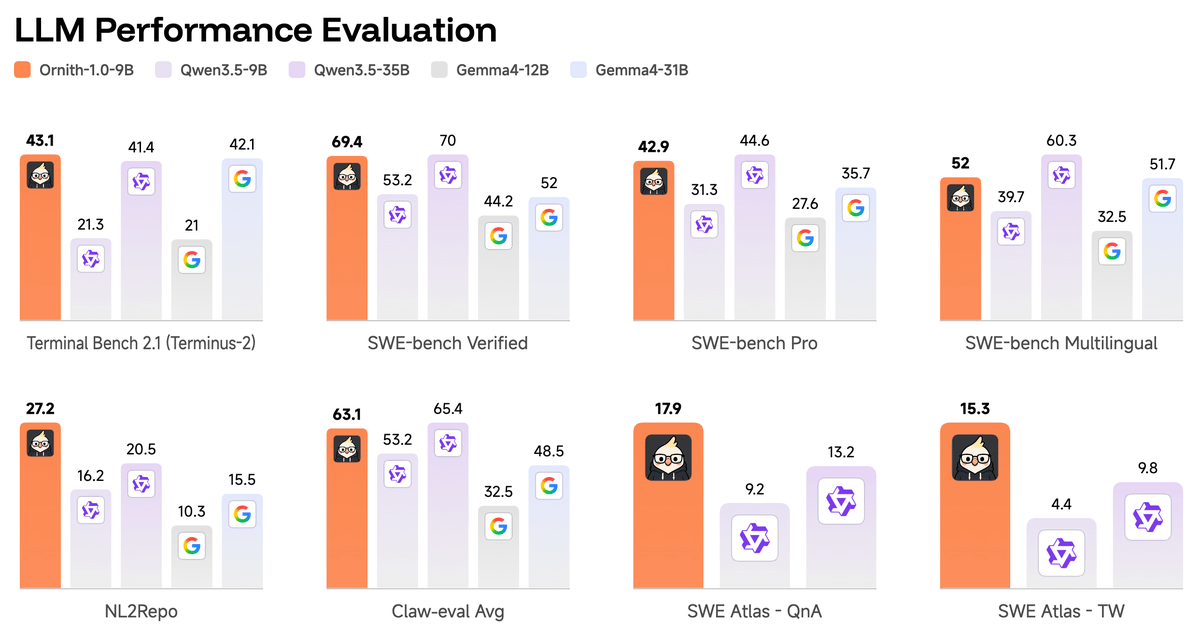
Takeaways
- Ornith-1.0-9B GGUF is available on Hugging Face, MIT licensed, post-trained on Qwen 3.5
- Reported 43.1 on Terminal-Bench 2.1 and 69.4 on SWE-bench Verified, beating similarly sized open models
- Trained with RL that jointly optimizes the agent scaffold and its solution rollouts
- Q4_K_M build is 5.63 GB; full family spans 9B dense up to 397B MoE
- Ships an OpenAI-compatible endpoint via vLLM, SGLang, llama.cpp, or Ollama with 262K context
- Emits reasoning inside think tags plus Qwen3-style tool calls for agent harnesses like OpenHands and OpenCode
A quantized GGUF build of Ornith-1.0-9B has landed on Hugging Face, giving anyone with a laptop-class GPU a runnable copy of the smallest member of the Ornith family. The model card frames Ornith-1.0 as a self-improving family of open-source models built for agentic coding, with the 9B checkpoint positioned as the entry point for single-GPU deployment. The GGUF drop collapses the setup story from a multi-GPU vLLM recipe down to a one-line ollama run or llama-server command.
What's in the box
The ornith-ai/Ornith-1.0-9B-GGUF repository packages the 9B checkpoint in the GGUF container format used by llama.cpp and its downstream tools. Ornith-1.0-9B is a dense ~9B model (≈19 GB in bf16), so it serves comfortably on a single 80GB GPU, but the quantizations shrink that footprint dramatically. The card lists five precisions you can pull directly:
Q4_K_Mat 5.63 GB, the default four-bit build most tools reach forQ5_K_Mat 6.47 GBQ6_Kat 7.36 GBQ8_0at 9.53 GBBF16at 17.9 GB, effectively the full-precision reference
The listing shows an MIT license, a qwen35 architecture tag, and a heavy download count on the repo, putting it among the larger-scale open coding-model releases circulating right now.
Agentic coding at a size you can actually run
The headline claim on the card is that Ornith-1.0 targets state-of-the-art performance among open-source models of comparable size on coding benchmarks such as Terminal-Bench 2.1, SWE-Bench, NL2Repo and OpenClaw. The wider family covers 9B-Dense, 31B-Dense, 35B-MoE and 397B-MoE variants, all post-trained on top of Gemma 4 and Qwen 3.5 base models.