
Parrot Paraphraser on T5 Hits 1.34M Downloads Solving a Problem LLMs Handle Poorly
An open source T5 paraphraser has crossed 1.34M downloads on Hugging Face, giving NLU builders a controllable augmentation tool with adequacy, fluency, and diversity knobs.
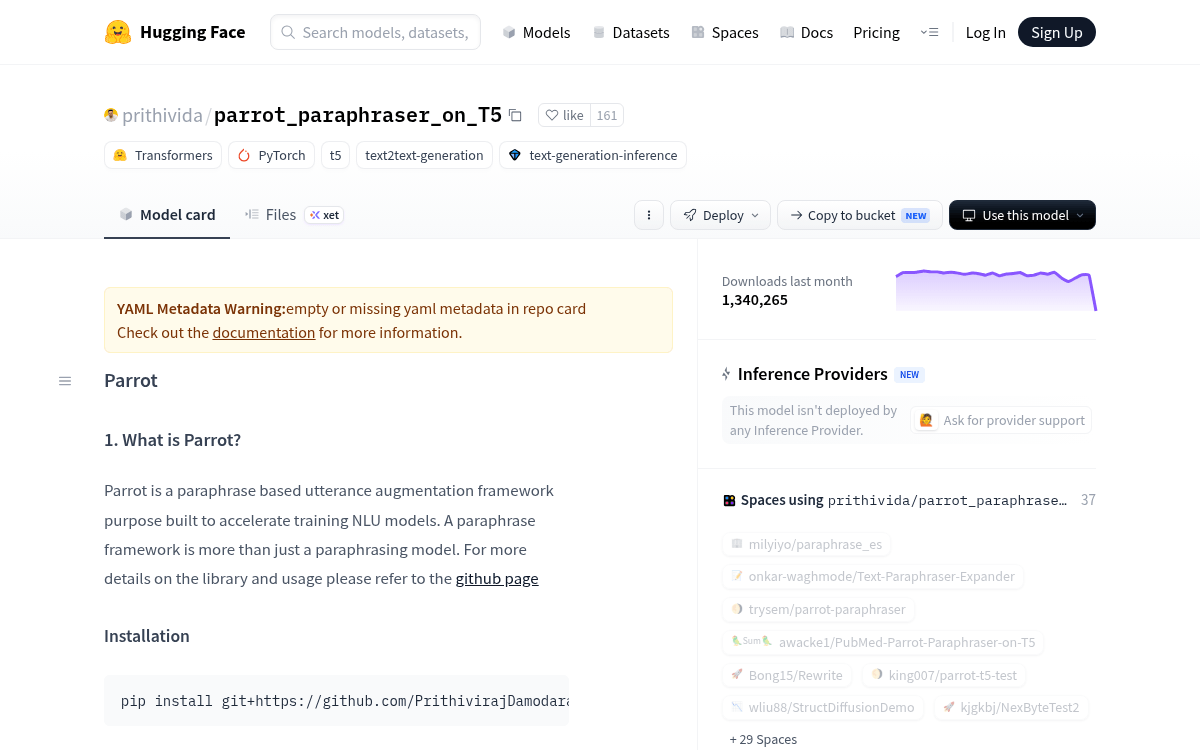
Takeaways
- Parrot Paraphraser on T5 has passed 1.34M downloads on Hugging Face
- Purpose built for NLU training data augmentation on short chatbot utterances
- Exposes explicit adequacy, fluency, and diversity thresholds instead of hidden sampling knobs
- Preserves intents and slot entities so paraphrases stay usable as labeled data
- Fine-tuned on datasets including Quora question pairs, capped at 32 token inputs
- Free, local, open source via the Parrot_Paraphraser GitHub project
A small but persistent open source project keeps quietly climbing the Hugging Face charts. Parrot Paraphraser on T5, built by Prithiviraj Damodaran, has passed 1.34 million downloads and is trending again as teams rediscover it for training data augmentation on conversational agents. Parrot is not a new frontier model, and it solves a specific problem that large LLM APIs still handle poorly and expensively at scale: generating labeled utterance variants without breaking the labels.
What Parrot actually does
Parrot is a paraphrase-based utterance augmentation framework purpose-built to accelerate training NLU models, which makes it more than a paraphrasing model. Training an intent classifier or slot tagger for a chatbot usually requires hundreds of labeled utterances per intent. Parrot lets you write a handful, then multiply them into a diverse training set while keeping the original meaning and entity spans intact.
The author frames the design around a specific definition of quality. Hugging Face lists 12 paraphrase models, RapidAPI lists 7 freemium and commercial paraphrasers like QuillBot, Rasa has discussed an experimental paraphraser for augmenting text data, Sentence-Transformers offers a paraphrase mining utility, and NLPAug offers word-level augmentation with a PPDB (a multi-million paraphrase database). Parrot's argument is that most of these focus only on meaning preservation and grammar, and skip the harder question of lexical diversity.