
Qwen's Qwen3-Coder-Next Beats 30B+ Coding Agents With Just 3B Active Parameters
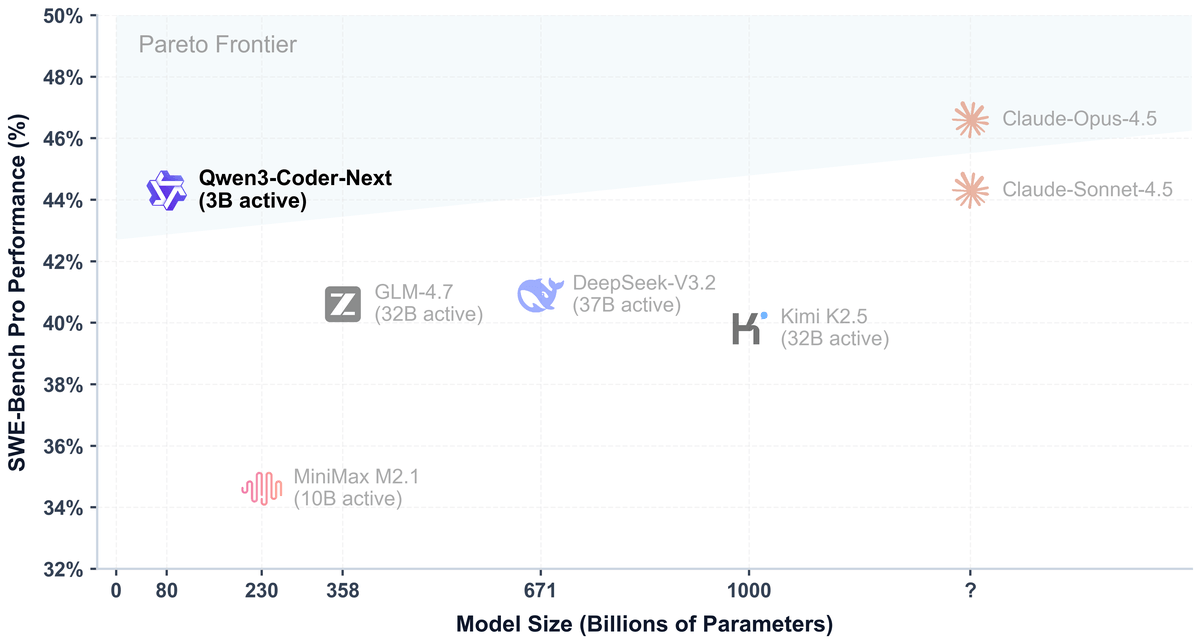
Qwen ships an 80B mixture-of-experts coder that activates only 3B parameters, hitting 70.6% on SWE-Bench Verified with a 256k context.
Takeaways
- Qwen released Qwen3-Coder-Next, an 80B-total, 3B-active MoE coder under Apache 2.0.
- Hits 70.6% SWE-Bench Verified, 44.3% SWE-Bench Pro, 36.2% Terminal-Bench 2.0.
- Hybrid Gated DeltaNet plus Gated Attention plus 512-expert MoE, 256k native context.
- Trained with reinforcement learning on synthetic, executable coding tasks with real feedback.
- Hosted API on OpenRouter at $0.12 in and $0.80 out per million tokens.
- Runs locally in ~46GB RAM at 4-bit via Unsloth GGUFs.
Qwen has released Qwen3-Coder-Next, an open-weight coding model that squeezes frontier-adjacent agent performance out of just 3 billion active parameters. It targets coding agents that plan, run tools, and recover from failures over long trajectories, and it ships under Apache 2.0 with a native 256k context window.
The sparse MoE design carries 80B total parameters but activates only 3B per token, delivering performance comparable to models with 10 to 20x higher active compute. That math matters because coding agents burn tokens aggressively, and a small active footprint translates directly into cheaper multi-step runs.
Where the numbers land
On agent benchmarks, the model runs with much larger open-weight systems. It scores 70.6% with SWE-Agent, 71.1% with MiniSWE-Agent, and 71.3% with OpenHands on SWE-Bench Verified. On the harder SWE-Bench Pro it lands at 44.3%, and on Terminal-Bench 2.0 it hits 36.2%.
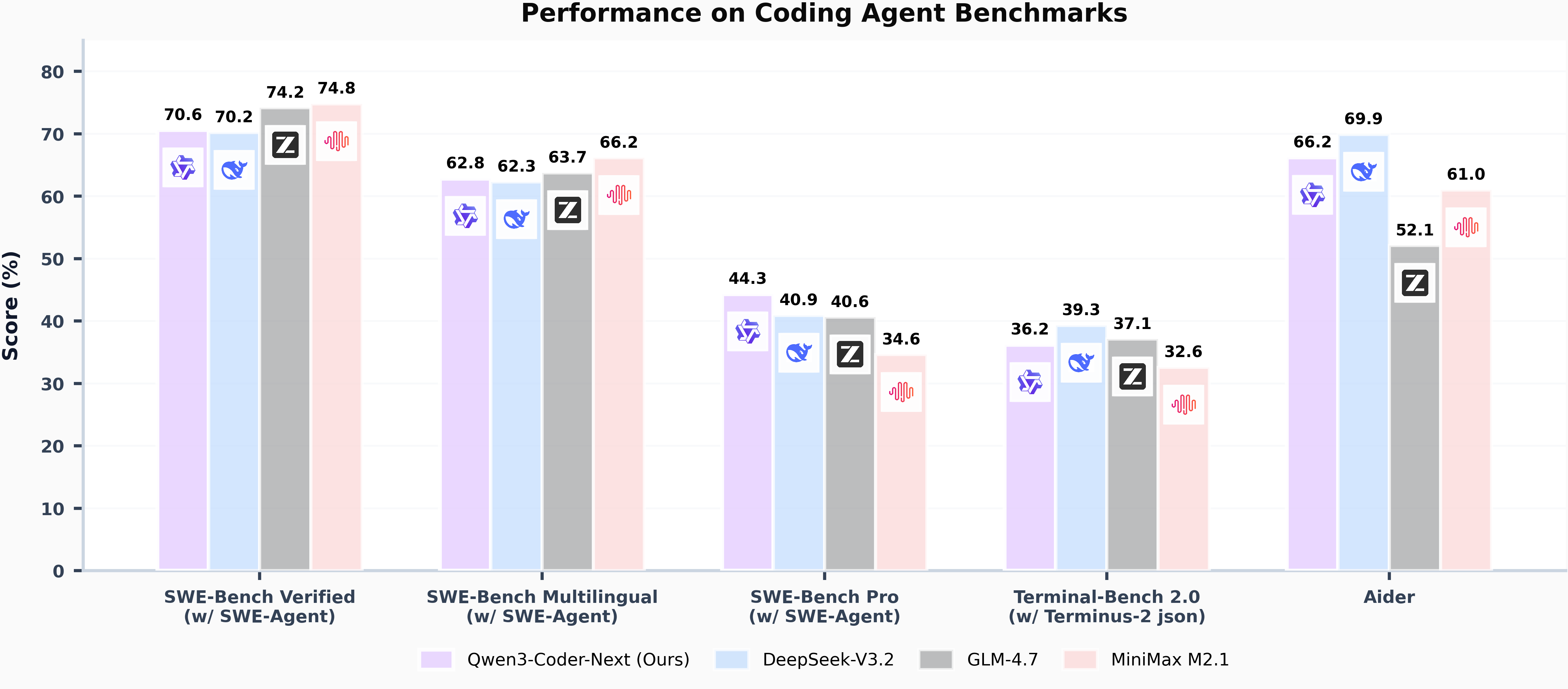
Qwen benchmarks it against Claude-Sonnet-4.5 and four top-tier open-source models: DeepSeek-V3.2, GLM-4.7, MiniMax-M2.1, and Kimi-K2.5. Qwen3-Coder-Next does not top every column, but a 3B active model is now in the same conversation as systems with 30B or more active parameters.
Inside the architecture
Qwen3-Coder-Next is based on the Qwen3-Next backbone, which mixes a linear-attention variant with standard attention and a very sparse MoE feed-forward. The layout is 48 layers arranged as 12 repeats of three DeltaNet-plus-MoE blocks followed by one Gated-Attention-plus-MoE block. The pieces: