
Qwopus3.5 Beats Qwen3.5-27B on HumanEval by Acting Before Thinking
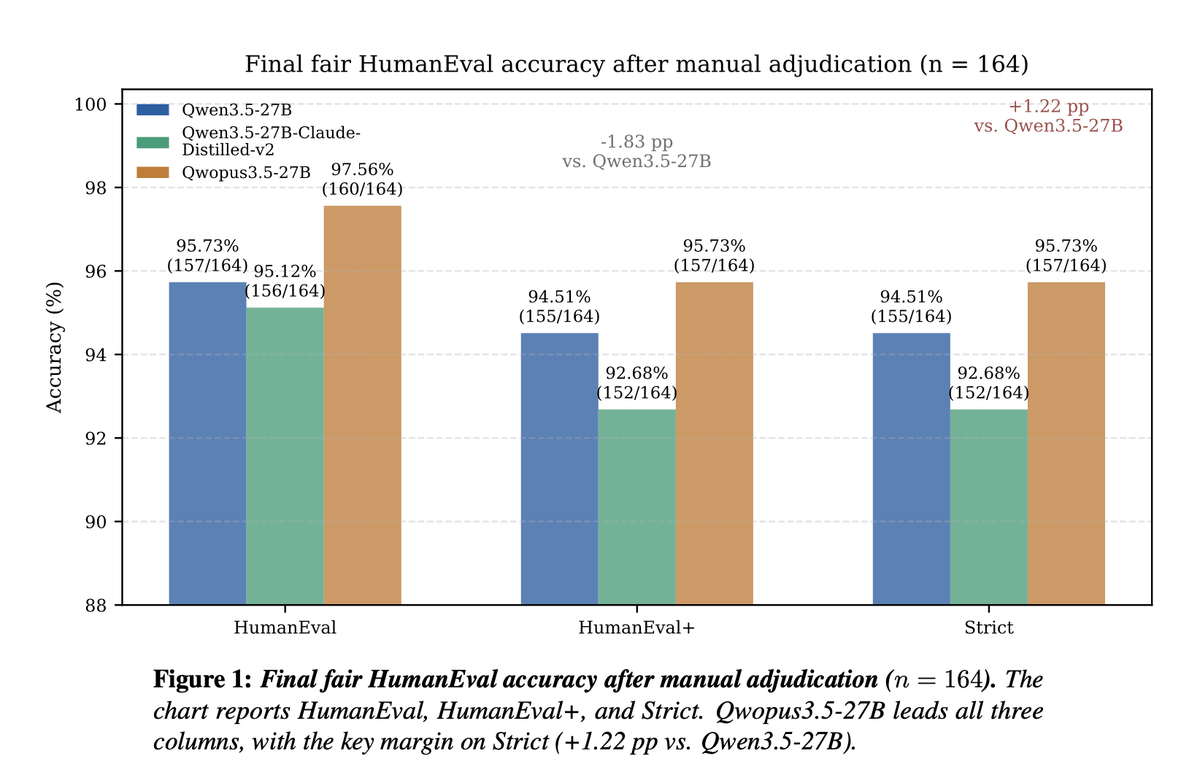
A community fine-tune of Qwen3.5-27B swaps deep pre-action reasoning for act-then-refine loops, hitting 95.73% on HumanEval Plus.
Takeaways
- Qwopus3.5-27B-v3 is a LoRA fine-tune of Qwen3.5-27B emphasizing act-then-refine over deep pre-planning reasoning.
- Scores 95.73% on strict HumanEval Plus, beating base Qwen3.5-27B (94.51%) and a Claude-distilled v2 (92.68%).
- Released as GGUF from Q3 (13.3GB) to Q8 (28.6GB), Apache 2.0, runs on llama.cpp, Ollama, LM Studio, vLLM.
- Rebuilds v2's Claude-distilled CoT data with curated verifiable reasoning chains to avoid fabricated traces.
- Independent eval on Kaitchup confirms lower token counts at matching accuracy, including MMLU-Pro gains.
- Trained with Unsloth SFT+LoRA, full notebook and PDF guide on GitHub.
A new community fine-tune called Qwopus3.5-27B-v3 is making the rounds on Hugging Face, and the pitch is unusual. Rather than pushing the base Qwen3.5-27B to deliberate harder before answering, it tries to make the model think less upfront and correct itself from feedback. The author calls it a shift from reason-then-act to act-then-refine, and the HumanEval numbers suggest the trade actually works.
Against pre-action overthinking
Most recent reasoning models double down on Chain-of-Thought and self-reflection, deliberating heavily before taking any action. Emerging evidence suggests that heavy pre-action deliberation is not always optimal for sequential decision-making, and agent performance can improve more effectively through a trial-and-error paradigm, where actions are executed early and refined based on environmental feedback.
The author leans on two papers to justify the design. Reflexion showed that agents can significantly improve decision-making by leveraging trial, error, and self-reflection, shifting the role of reflection from pre-action deliberation to post-action correction. A follow-up on post-failure reflection and retry reported +34.7% on mathematical reasoning tasks and +18.1% on function calling tasks, which becomes the empirical anchor for the whole approach.
What changed between v2 and v3
The previous version, v2, was a straight distillation from Claude-generated Chain-of-Thought traces. That turned out to be a problem. CoT traces from third-party datasets do not always faithfully reflect a model's true internal reasoning process, and after analysis, some portions may even be fabricated, meaning the traces were not actually generated by the claimed teacher model. When a student model imitates those, it tends to memorize surface patterns rather than learn generalizable reasoning.