
Tencent's Hunyuan3D 2.0 Beats Every Closed 3D Generator With Open Weights
Tencent open-sources a two-stage flow-based diffusion system that generates textured 3D meshes from a single image and beats closed-source rivals on quality benchmarks.
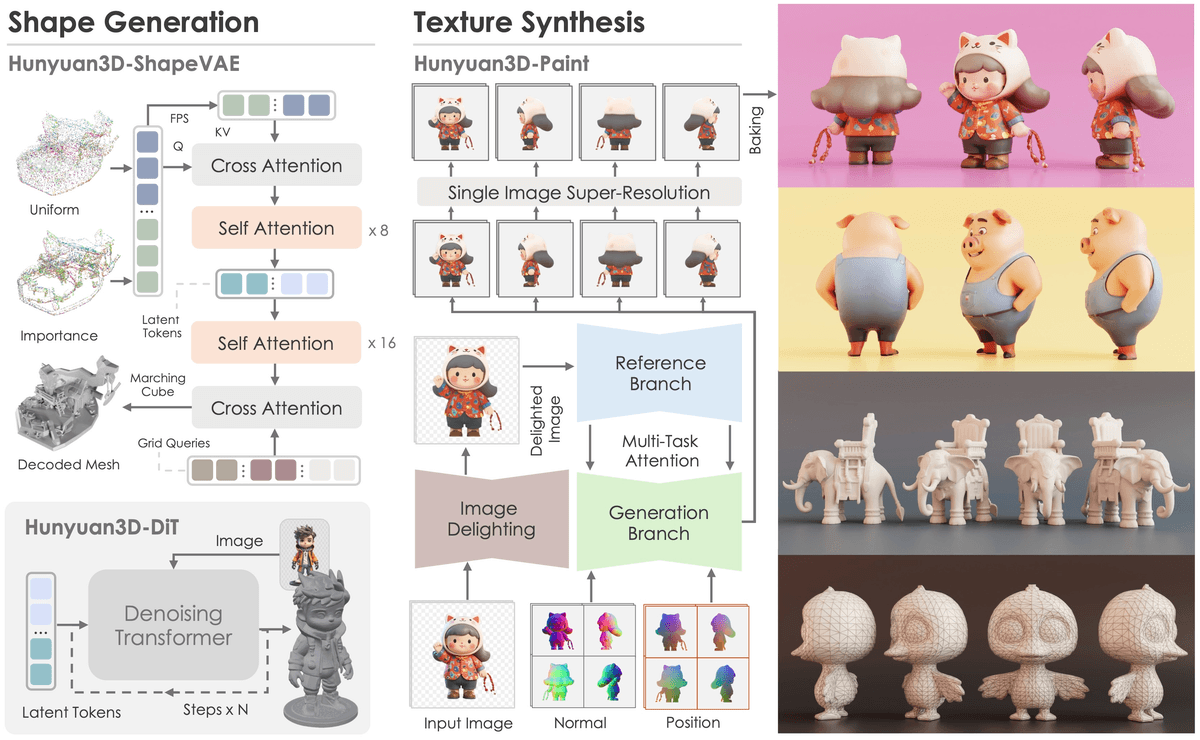
Takeaways
- Tencent open-sourced Hunyuan3D 2.0, an image-to-3D and text-to-3D foundation system with public weights.
- Two-stage pipeline: Hunyuan3D-DiT builds the mesh, Hunyuan3D-Paint synthesizes the texture map.
- Shape model uses a flow-based diffusion transformer, texture model works on generated or handcrafted meshes.
- Beats top open and closed baselines on CMMD, FID, FID-CLIP, and CLIP-score benchmarks.
- Ships with a diffusers-style Python API, Gradio app, and community ComfyUI wrapper.
- Details in the arXiv report; over 109,000 downloads on Hugging Face.
Tencent has released Hunyuan3D 2.0, an open-weights foundation system for generating high-resolution textured 3D assets from a single reference image or text prompt. It splits the problem into two specialized models, a shape generator and a texture painter, and posts benchmark numbers that edge out both open-source and closed-source competitors. The weights are on Hugging Face under a community license, and the model has already pulled in more than 109,000 downloads.
Feed it a picture of an object and you get back a textured mesh you can drop straight into Blender, Unity, or Unreal. That workflow used to take an artist hours per asset, and it is exactly the gap that has been missing from the open ecosystem while closed vendors dominated.
Two models, one pipeline
The release bundles two foundation components: a large-scale shape generation model called Hunyuan3D-DiT, and a large-scale texture synthesis model called Hunyuan3D-Paint. The shape model, built on a scalable flow-based diffusion transformer, aims to create geometry that aligns with a given condition image. The texture model, benefiting from strong geometric and diffusion priors, produces high-resolution, vibrant texture maps for either generated or hand-crafted meshes.
The architecture runs as a two-stage pipeline: produce a bare mesh, then paint a texture map onto it. Decoupling the stages has a practical payoff. Hunyuan3D-Paint can texture meshes you sculpted yourself in a DCC tool, not only the ones the DiT stage generated. A third piece, Hunyuan3D-Delight, strips baked lighting out of reference images before texturing so the resulting materials are neutrally lit.