
TrustSafeAI's RADAR-Vicuna-7B Catches AI Text Even After Paraphrasing With 905K Downloads
TrustSafeAI's RADAR detector, built on RoBERTa and trained against an adversarial paraphraser, crosses 900K downloads as a go-to AI-text baseline.
Takeaways
- TrustSafeAI's RADAR-Vicuna-7B detector has surpassed 905,000 Hugging Face downloads.
- Built on RoBERTa, trained adversarially against a paraphraser using PPO plus logistic loss.
- Research by CUHK's Xiaomeng Hu, Tsung-Yi Ho and IBM's Pin-Yu Chen, accepted at NeurIPS 2023.
- Outperforms baselines across 8 target LLMs and 4 datasets, especially under paraphrase attacks.
- Available via Transformers pipeline, a Hugging Face Space, and Azure AI Foundry.
- Non-commercial license only, inherited from Vicuna-7B-v1.1; not for production commercial use.
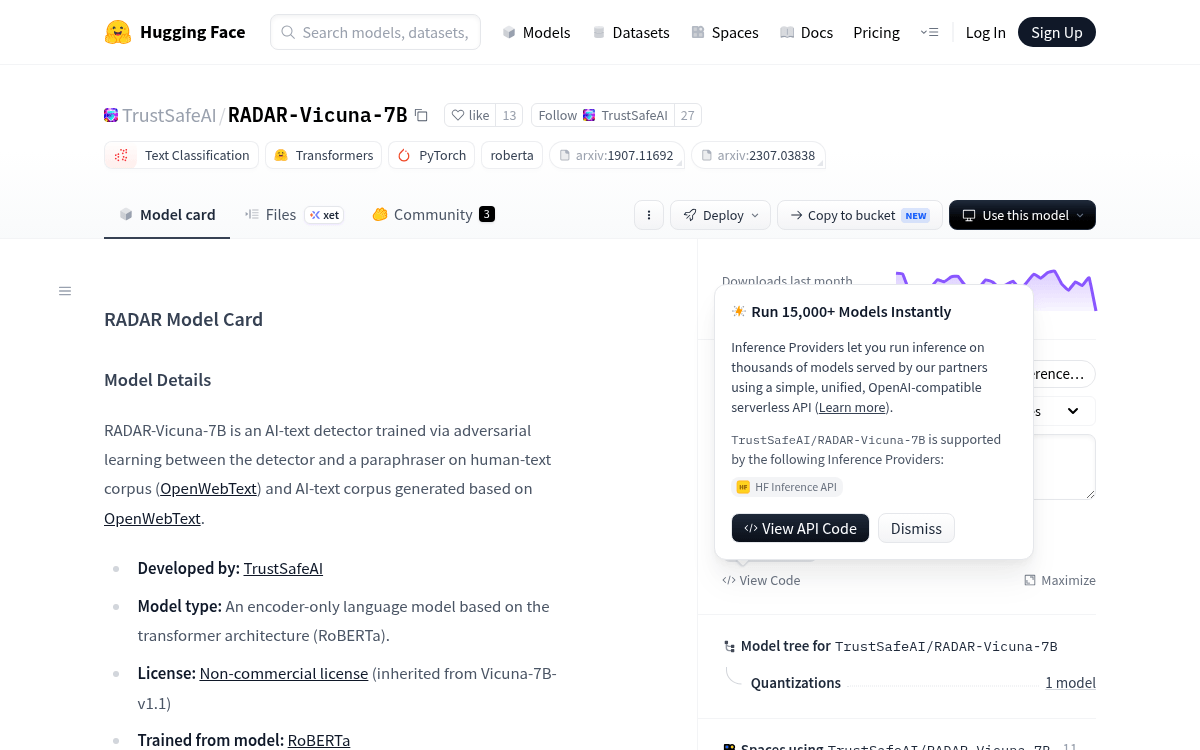
An AI-text detector originally published alongside a NeurIPS 2023 paper has quietly become one of the most downloaded classifiers on the Hugging Face Hub. RADAR-Vicuna-7B, published by TrustSafeAI, is a RoBERTa-based classifier that decides whether a passage was written by a human or by a large language model, and it has racked up more than 905,000 downloads on the model card alone.
The underlying research, RADAR: Robust AI-Text Detection via Adversarial Learning, is a collaboration between Xiaomeng Hu and Tsung-Yi Ho at the Chinese University of Hong Kong and Pin-Yu Chen at IBM Research. TrustSafeAI is the party actually shipping the weights, demo Space, and API on Hugging Face.
A detector that trains against its own attacker
Most earlier AI-text detectors collapse the moment someone runs the generated text through a paraphraser. RADAR was built specifically to close that gap by pitting a paraphraser against a detector in adversarial training: the paraphraser tries to make AI-generated text look more human, and the detector tries to keep catching it.
The training loop has three moving parts:
- Data prep uses Vicuna-7B to generate AI text by completing the prefix span of human text from OpenWebText.