
Tsinghua's Kronos Beats Top Financial Forecasting Models by 93% on Market Data
The first open-source foundation model for candlestick data, trained on 12 billion K-lines from 45 exchanges, hits 2.5M downloads on Hugging Face.
Takeaways
- Kronos is the first open-source foundation model for financial candlesticks, released under MIT and accepted at AAAI 2026.
- Pretrained on over 12 billion K-line records from 45 global exchanges using autoregressive next-token prediction.
- Two-stage design: a hierarchical OHLCV tokenizer feeds a decoder-only transformer, with four sizes from 4.1M to 499M params.
- Zero-shot results boost forecasting RankIC by 93% over the leading TSFM and cut volatility MAE by 9%.
- Ships with a
KronosPredictorAPI, batch prediction, and a Qlib-based fine-tuning pipeline for custom datasets. - The paper and tokenizer are on Hugging Face with 2.5M+ downloads; the 499M large checkpoint remains unreleased.
A team from Tsinghua University has quietly turned a niche financial forecasting project into one of the most downloaded time-series repositories on Hugging Face. Kronos, released under the NeoQuasar org, is the first open-source foundation model for financial candlesticks (K-lines), trained on data from more than 45 global exchanges and designed for the high-noise character of market data. The tokenizer alone has racked up over 2.5 million downloads, the GitHub repo sits at 37.5k stars, and the paper was recently accepted to AAAI 2026.
Treating price bars like tokens
Most time-series foundation models train on smooth, well-behaved signals such as weather, energy demand, and retail sales, then fall apart on markets. Kronos flips the framing by treating each candlestick as a discrete token in a sequence and applying the standard next-token prediction recipe borrowed from language modeling.
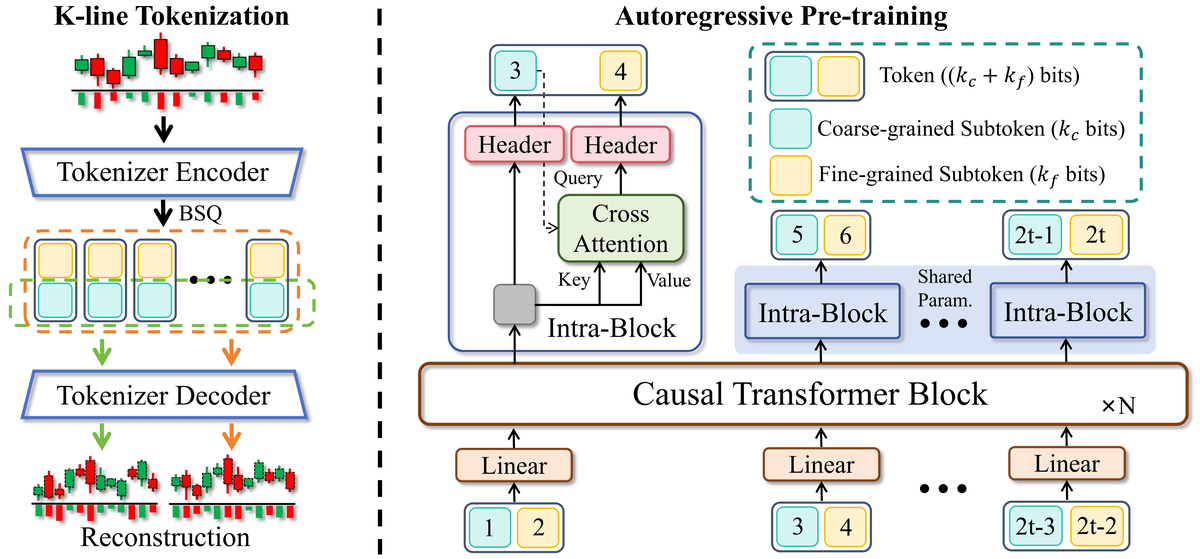
The architecture is a family of decoder-only transformers pre-trained on the "language" of financial markets, built around a two-stage framework. A specialized tokenizer first quantizes continuous, multi-dimensional K-line data (OHLCV) into hierarchical discrete tokens. A large autoregressive transformer is then pre-trained on those tokens, giving a unified backbone for diverse quantitative tasks. OHLCV refers to the open, high, low, close, and volume values that define each price bar, while "hierarchical" means the tokenizer emits a coarse token followed by a finer refinement token, keeping the vocabulary small without sacrificing precision.
Twelve billion bars from 45 markets
The pretraining corpus is what separates Kronos from the growing pile of general-purpose TSFMs. The team pre-trained on an autoregressive objective over more than 12 billion K-line records drawn from 45 global exchanges, letting the model learn nuanced temporal and cross-asset representations. That scale is what makes the zero-shot numbers interesting.