
Xiaomi's MiMo-V2.5 Matches Claude and Gemini With One Open MIT Model
Xiaomi's open MIT-licensed omnimodal MoE handles text, image, video, and audio in one 1M-token model, activating just 15B of 310B params.
Takeaways
- Xiaomi released MiMo-V2.5, an MIT-licensed omnimodal MoE with 310B total and 15B active parameters.
- Handles text, image, video, and audio in one unified architecture with a 1M token context window.
- Scores 56.1 on SWE-Bench Pro and 65.8 on Terminal-Bench 2.0, competitive with frontier closed models.
- Trained on 48T tokens in FP8 with agentic RL and Multi-Teacher On-Policy Distillation post-training.
- OpenRouter pricing is $0.119/M input and $0.238/M output tokens, roughly half frontier rates.
- Deployable via SGLang and vLLM, though it needs data-center GPUs to self-host.
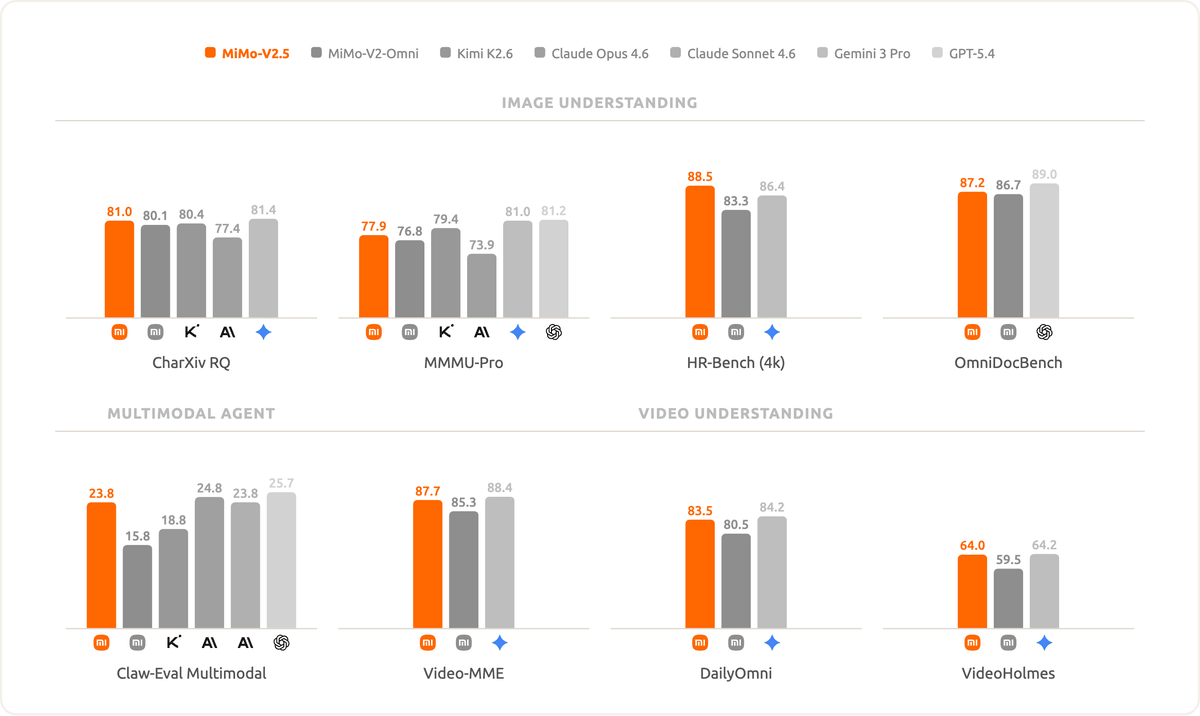
Xiaomi has released MiMo-V2.5, an open-weights omnimodal model that reads text, images, video, and audio through a single unified architecture. It ships with a 1M token context window, a Mixture of Experts backbone, and benchmark numbers that put it in the same conversation as Claude Opus and Gemini 3 Pro, all under an MIT license.
Rather than stitching together a vision model, an audio model, and an LLM, everything runs through one network with dedicated encoders feeding a shared MoE backbone. Xiaomi also positions it as agentic, with tool-calling and long-horizon task performance as first-class targets.
Under the hood
The base MiMo-V2.5 is a sparse MoE with 310B total parameters and 15B activated per token, drawing from a pool of 256 routed experts with 8 selected per token. A heftier MiMo-V2.5-Pro variant weighs in at 1.02T total and 42B activated parameters for teams that want the biggest brain available. Both share the design inherited from the MiMo-V2-Flash backbone.
The attention mechanism is where things get interesting. It interleaves Sliding Window Attention and Global Attention in a 5:1 ratio with a 128 token window, which the team reports cuts KV-cache storage by nearly 6x, while a learnable attention sink bias preserves long-context recall. That trick is what makes the 1M context window financially viable to serve.
The perception stack is purpose-built rather than bolted on:
- A 729M parameter Vision Transformer with 28 layers (24 sliding window, 4 full attention) using a hybrid row and column window pattern