
Z.ai's GLM-4.1V-9B-Thinking Beats Models 8x Its Size on 18 Benchmarks
Z.ai's open-source 9B vision-language model uses chain-of-thought reasoning and reinforcement learning to match Qwen2.5-VL-72B on 18 benchmarks.
Takeaways
- Z.ai released GLM-4.1V-9B-Thinking, an MIT-licensed 9B vision-language model with chain-of-thought reasoning.
- Matches or beats Qwen2.5-VL-72B on 18 of 28 benchmarks despite being 8x smaller.
- Trained with Reinforcement Learning with Curriculum Sampling (RLCS), giving gains up to +10.6%.
- Supports 64k context, 4K image resolution, arbitrary aspect ratios, and bilingual English/Chinese.
- Deployable via Transformers, vLLM, SGLang, Docker; AWQ and GGUF quantizations available from the community.
- Paper on arXiv 2507.01006; part of family including GLM-4.5V and GLM-4.6V.
Z.ai has released GLM-4.1V-9B-Thinking, an open-source vision-language model that competes well above its parameter count. Built on the GLM-4-9B-0414 foundation and trained with a reasoning-first approach, it goes head-to-head with models roughly eight times larger on tasks ranging from STEM problem solving to GUI agents.
The core idea: give a mid-sized VLM an explicit thinking loop plus reinforcement learning, and you can close most of the gap to frontier closed-source systems without needing a 72B checkpoint sitting on your GPUs.
What shipped
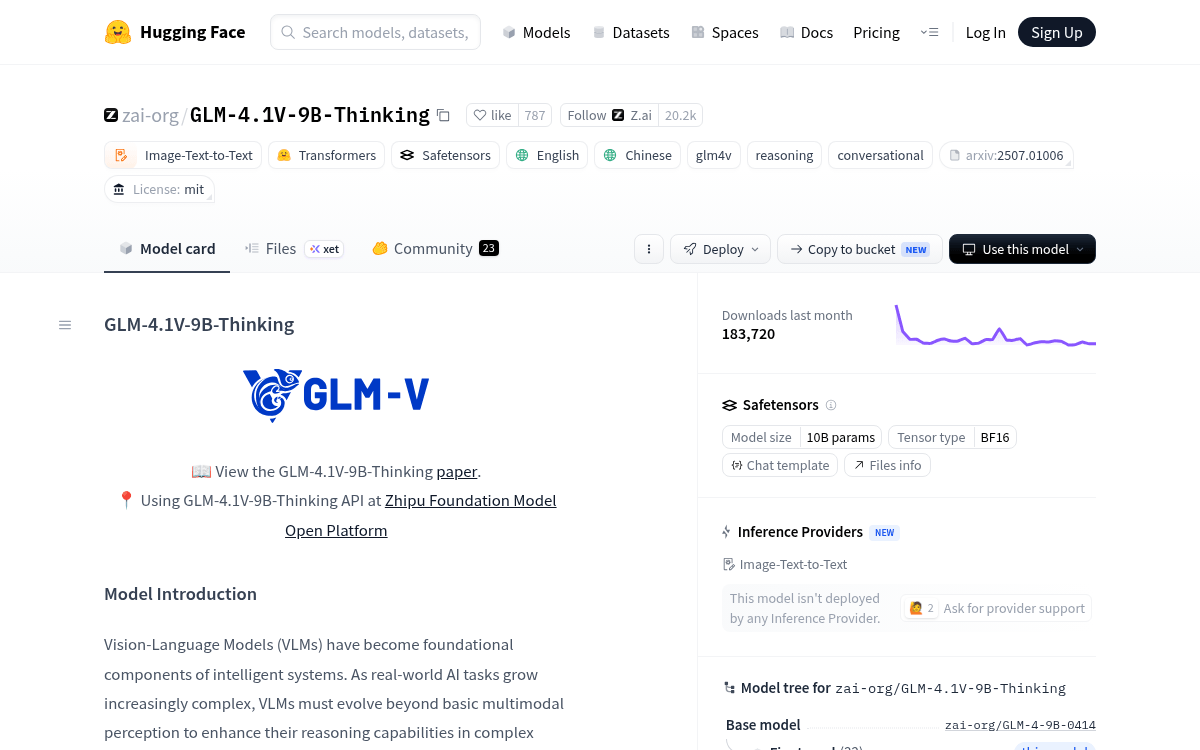
Z.ai open-sourced GLM-4.1V-9B-Thinking alongside a training method called Reinforcement Learning with Curriculum Sampling (RLCS), designed to unlock capability across STEM problem solving, video understanding, content recognition, coding, grounding, GUI-based agents, and long document understanding. The model carries an MIT license on Hugging Face, has a paper on arXiv, and ships with the base checkpoint GLM-4.1V-9B-Base for further research.
Key specs:
- 9B parameter dense VLM based on GLM-4-9B-0414
- 64k context length
- Arbitrary aspect ratios and up to 4K image resolution
- Bilingual (English and Chinese)
- Chain-of-thought reasoning traces before final answers
- MIT license, deployable via Transformers, vLLM, SGLang, or Docker