
Z.ai's GLM-4.5 Beats Closed AI Giants at a Fraction of the Cost
Z.ai's open-weights 355B Mixture-of-Experts model unifies reasoning, coding, and agent workflows, hitting 64.2% on SWE-bench Verified under the MIT license.
Takeaways
- GLM-4.5 is a 355B-parameter MoE with 32B active, MIT-licensed and open-weights.
- Scores 70.1% TAU-Bench, 91.0% AIME 24, 64.2% SWE-bench Verified; 3rd overall on aggregate benchmarks.
- Hybrid reasoning: single checkpoint switches between thinking mode and direct-response mode.
- Compact GLM-4.5-Air variant is 106B total, 12B active, LoRA-tunable on 8 GPUs.
- API pricing is $0.60 input and $2.20 output per million tokens with 128K context.
- Technical report: 23T pretraining tokens, MTP, sparse experts, shared expert routing, GQA.
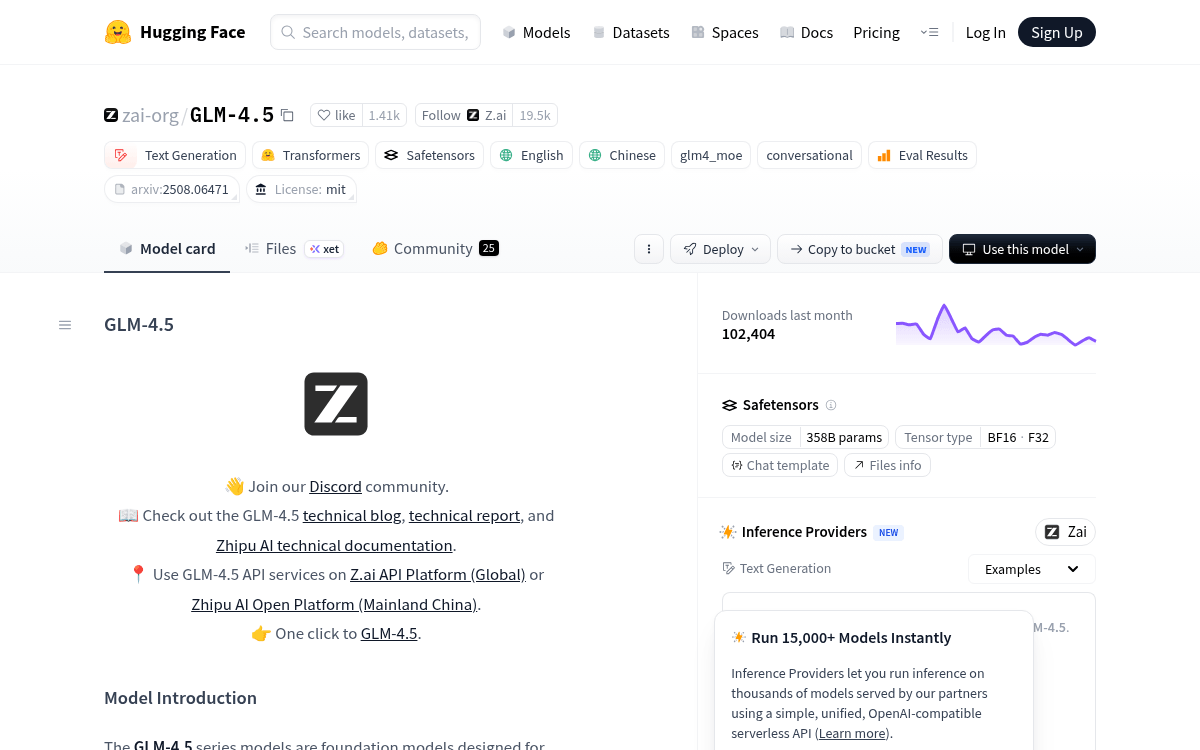
Z.ai (formerly Zhipu AI) has released GLM-4.5, a Mixture-of-Experts foundation model built for agent workloads. It ships in two sizes, comes with both base and hybrid-reasoning checkpoints, and lands under an MIT license that permits commercial use and derivative work. The target audience: teams building autonomous coding agents, tool-using systems, and long-running planners who have been priced out of frontier closed models.
The flagship carries 355B total parameters with 32B active, trained on 23T tokens with expert model iteration and reinforcement learning. It scores 70.1% on TAU-Bench, 91.0% on AIME 24, and 64.2% on SWE-bench Verified. On the aggregate leaderboard Z.ai compiled from 12 industry benchmarks, GLM-4.5 lands at 63.2 points, third overall behind only a handful of proprietary systems.
Two sizes, one agent-first design
The family covers two capacity tiers. The flagship is 355B-A32B, joined by GLM-4.5-Air at 106B total with 12B active parameters. Both share a similar pipeline: pretraining on 15 trillion tokens of general-domain data, targeted fine-tuning on code, reasoning, and agent-specific tasks, context length extended to 128k tokens, and reinforcement learning applied to sharpen reasoning, coding, and agent performance.
Both variants are hybrid reasoning models, meaning a single checkpoint exposes two inference behaviors: a slow deliberate chain-of-thought path for hard problems, and a fast direct-answer path for lightweight queries. You toggle it per request by passing extra_body={"chat_template_kwargs": {"enable_thinking": False}} when you want the model to skip the reasoning trace.
What's actually new under the hood
The architecture leans on several ideas that have been circulating in the open-weights community but rarely combined at this scale. Built on the GLM architecture, GLM-4.5 introduces sparse MoE layers, shared expert mechanisms, and Multi-Token Prediction (MTP) to improve training efficiency and inference throughput via sparse activation.