
Z.ai's GLM-Image Beats GPT Image 1 at Rendering Text Inside Images
Z.ai releases a 16B open-source hybrid autoregressive-diffusion model under MIT license, topping text rendering benchmarks against Seedream 4.5 and GPT Image 1.

Takeaways
- Z.ai released GLM-Image, a 16B hybrid autoregressive plus diffusion model under MIT license
- 9B AR generator from GLM-4-9B-0414 plus 7B single-stream DiT diffusion decoder with dedicated glyph encoder
- Tops CVTG-2K text rendering at 0.9116 word accuracy, beating Seedream 4.5 and GPT Image 1
- Handles text-to-image, editing, style transfer, and multi-subject consistency in one checkpoint
- Integrated in
diffusersandtransformers, with SGLang serving and 23GB VRAM via CPU offload - Post-trained with decoupled GRPO reinforcement learning targeting semantics and detail separately, code on GitHub
Z.ai has released GLM-Image, a 16-billion-parameter image generator that abandons the pure-diffusion recipe most open models follow. It stitches an autoregressive language model to a diffusion decoder in a single pipeline, and the result is currently the strongest open-source system for rendering readable text inside images, beating closed models like Seedream 4.5 and GPT Image 1 on standard text-rendering benchmarks.
An LLM writes the image, a diffusion model paints it
The architecture splits generation across two specialists. A 9B autoregressive model, initialized from GLM-4-9B-0414 with an expanded vocabulary that includes visual tokens, plans the image as a sequence of discrete tokens: first a compact 256-token sketch, then an expansion to 1K–4K tokens corresponding to 1K–2K resolution outputs. A 7B single-stream DiT diffusion decoder turns those tokens into pixels, with a dedicated glyph encoder pathway feeding text through separate AdaLN layers so characters land where the model intends them.
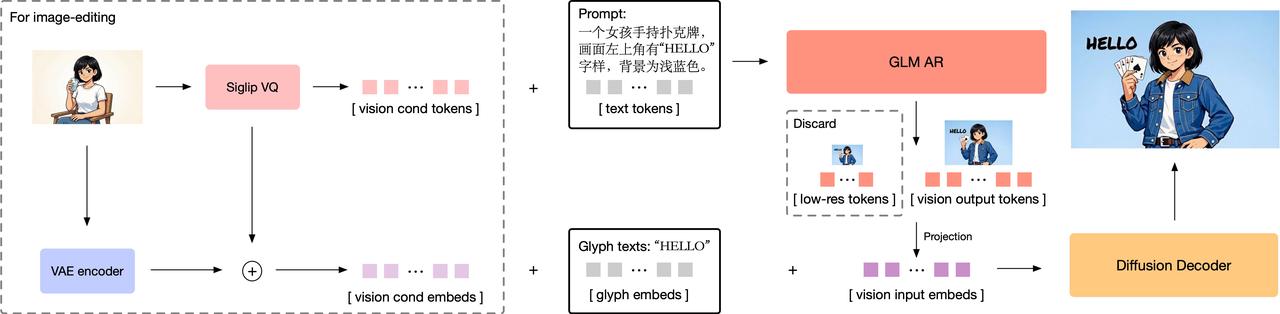
Training leans heavily on reinforcement learning through a decoupled GRPO setup. The AR module receives low-frequency feedback tuned for aesthetics and semantic alignment, while the diffusion decoder gets high-frequency feedback targeting fine detail and text accuracy. Splitting the reward signal by module lets the system chase both instruction-following and pixel-level fidelity without one objective drowning out the other.