
Z-Lab's DFlash Drafter Pushes Qwen3.6 to 3.61x Faster Without Losing Quality
Z-Lab's DFlash draft model turns Qwen3.6-35B-A3B into a much faster server by drafting blocks of tokens with a tiny diffusion model.
Takeaways
- Qwen3.6-35B-A3B-DFlash is a 0.4B block diffusion draft model for speculative decoding of Qwen3.6-35B-A3B.
- Delivers up to 3.61x speedup at concurrency 1 and 2.89x at concurrency 32 on a single B200.
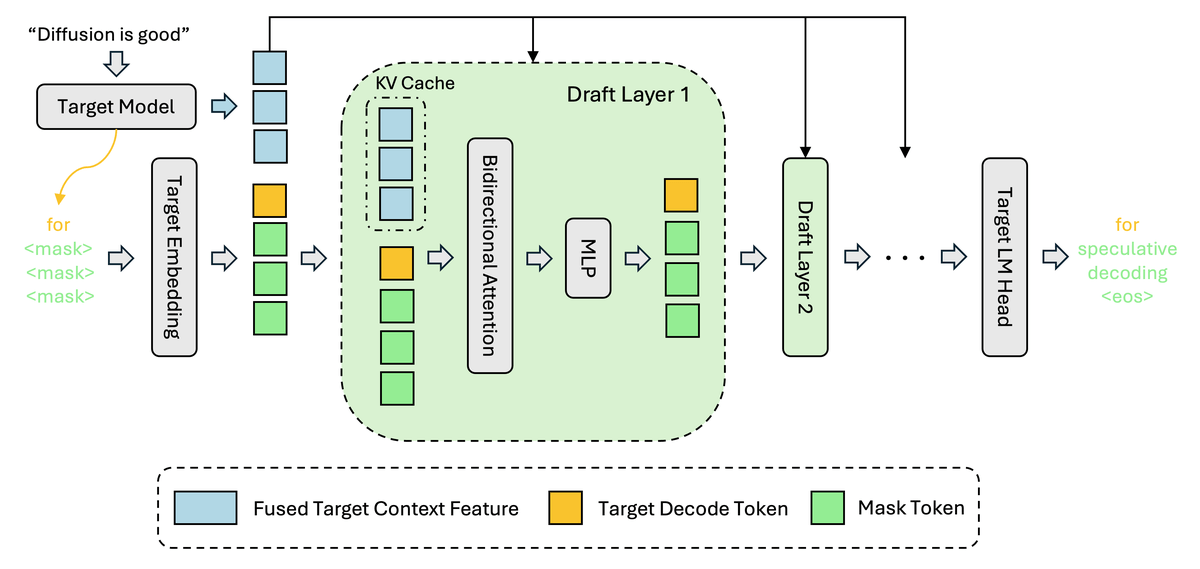
- Predicts a full block of draft tokens in one forward pass instead of one-by-one autoregression.
- Beats Qwen's native MTP draft path at every matched setting with higher mean accept lengths.
- Runs on SGLang today with the DFLASH algorithm; vLLM support in review.
- Output distribution preserved, so speedups are lossless relative to the target model.
Speculative decoding usually looks the same. A small autoregressive draft model guesses the next few tokens one at a time, and the big target model verifies them in parallel. Z-Lab and Modal just shipped a drafter that breaks that pattern. Qwen3.6-35B-A3B-DFlash is a 0.4B block diffusion drafter for the Qwen3.6-35B-A3B mixture-of-experts model, and on a single B200 it pushes end-to-end throughput up to 3.61x at concurrency 1 and 2.89x at concurrency 32 versus the plain autoregressive baseline.
The model lives on Hugging Face under the Apache 2.0 license, mirrored between the Z-Lab and Modal-Labs organizations. You do not run it directly. It is a DFlash draft model for Qwen/Qwen3.6-35B-A3B, not a standalone LLM, and is meant to be paired with the target model in a speculative decoding server.
Diffusion, but only for drafting
Standard speculative decoding has a subtle bottleneck. Methods like the EAGLE series and the native multi-token prediction (MTP) modules in recent models still rely on sequential autoregression in the drafter, generating tokens one by one, which fits modern hardware poorly and caps the achievable speedup. If your GPU can chew through hundreds of tokens per forward pass, spending a whole pass to emit one draft token wastes silicon.
DFlash swaps the drafter for a small diffusion language model that predicts an entire block of tokens in a single forward pass, conditioned on hidden states from the target model. Where Eagle-3 drafts autoregressively, DFlash uses a non-causal attention mask so each query attends to both the verifier's hidden states and mask token embeddings simultaneously, producing all draft tokens at once. The block-parallel approach can yield 2 to 3x larger speedups than Eagle-3 on synchronous requests.