
Zhipu AI's ChatGLM3-6B Brings Native Tool Use to a 3.81GB Model
Zhipu AI and Tsinghua KEG's 6B bilingual chat model brings native function calling, code interpreter, and agent workflows to consumer GPUs.
Takeaways
- ChatGLM3-6B is a 6B bilingual chat model from Zhipu AI and Tsinghua KEG.
- Natively supports function calling, code interpreter, and agent workflows via new prompt format.
- Claimed strongest base model under 10B on semantics, math, reasoning, code, and knowledge benchmarks.
- Family includes 6B-Base, 6B-32K, and 6B-128K long-context variants for document workloads.
- Apache 2.0 code license, weights free for commercial use after registration questionnaire.
- Runs on consumer GPUs; int4 quantized chat variant is roughly 3.8 GB.
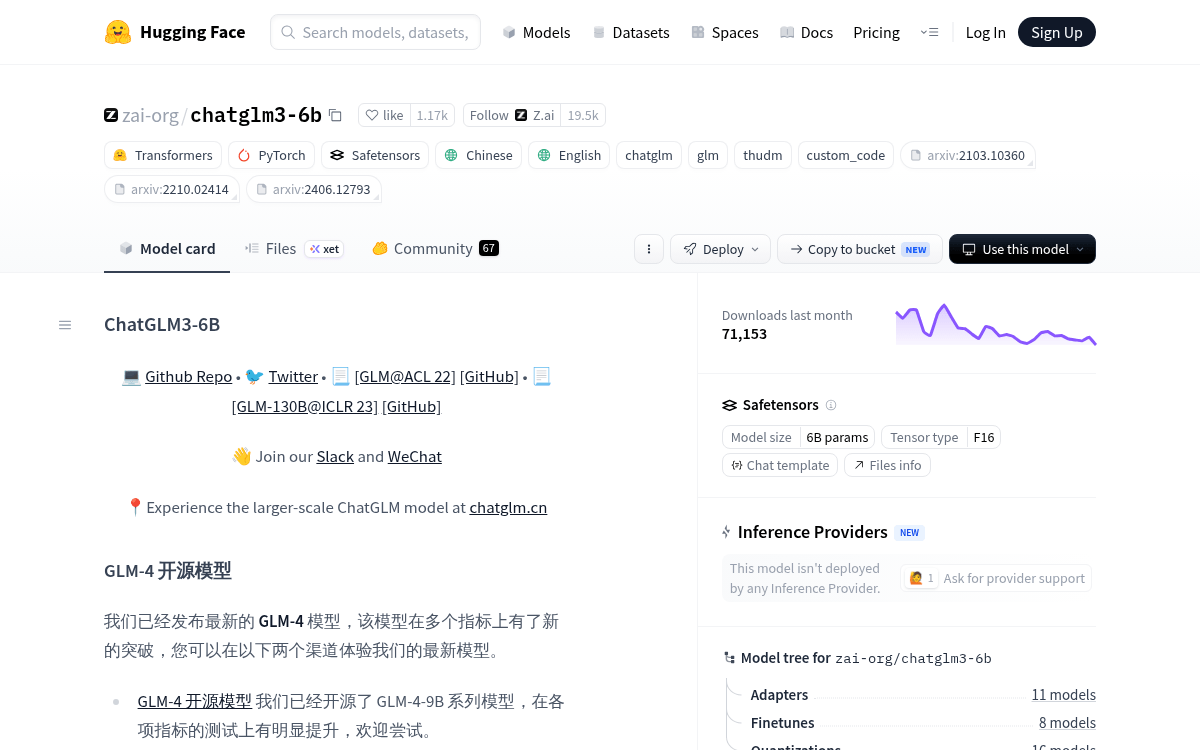
The ChatGLM3-6B checkpoint on Hugging Face is quietly climbing the trending list again, and it's worth understanding why a model this size still matters. Zhipu AI (now branded internationally as Z.ai) and Tsinghua University's Knowledge Engineering Group released this 6-billion-parameter bilingual chat model as one of the first small open-weight models to ship with native tool use baked in rather than bolted on afterwards.
A small model with grown-up habits
ChatGLM3 is a generation of pre-trained dialogue models jointly released by Zhipu AI and Tsinghua KEG. The 6B open-source variant keeps the smooth dialogue and low deployment threshold of the previous two generations, while pairing them with a stronger base model trained on a more diverse dataset, for more steps, under a more considered training strategy. The team claims ChatGLM3-6B-Base leads all sub-10B base models on semantics, math, reasoning, code, and knowledge evaluations.
The headline change is the prompt format, not the raw benchmark numbers. ChatGLM3-6B adopts a newly designed template that supports multi-turn dialogues as usual and natively handles tool invocation (Function Call), code execution (Code Interpreter), and agent tasks in complex scenarios. The chat template itself knows how to emit tool calls and consume tool outputs, so you don't need to graft on an external agent framework to get useful agent behavior out of a 6B model.