
Anthropic Bets $10M on Canadian AI Research to Deepen Its Roots
Anthropic pledges $10M CAD and Claude API credits to eight Canadian research institutions, deepening ties with the country that invented deep learning
Takeaways
- $10M CAD committed: Anthropic is funding eight Canadian research institutions with Claude API credits, including Mila, Vector Institute, Amii, CHEO, CAMH, and three universities.
- Startup pipeline: Hundreds of Canadian startups affiliated with Amii, Mila, and Vector will each receive at least $5,000 USD in API credits through Anthropic's Startups program.
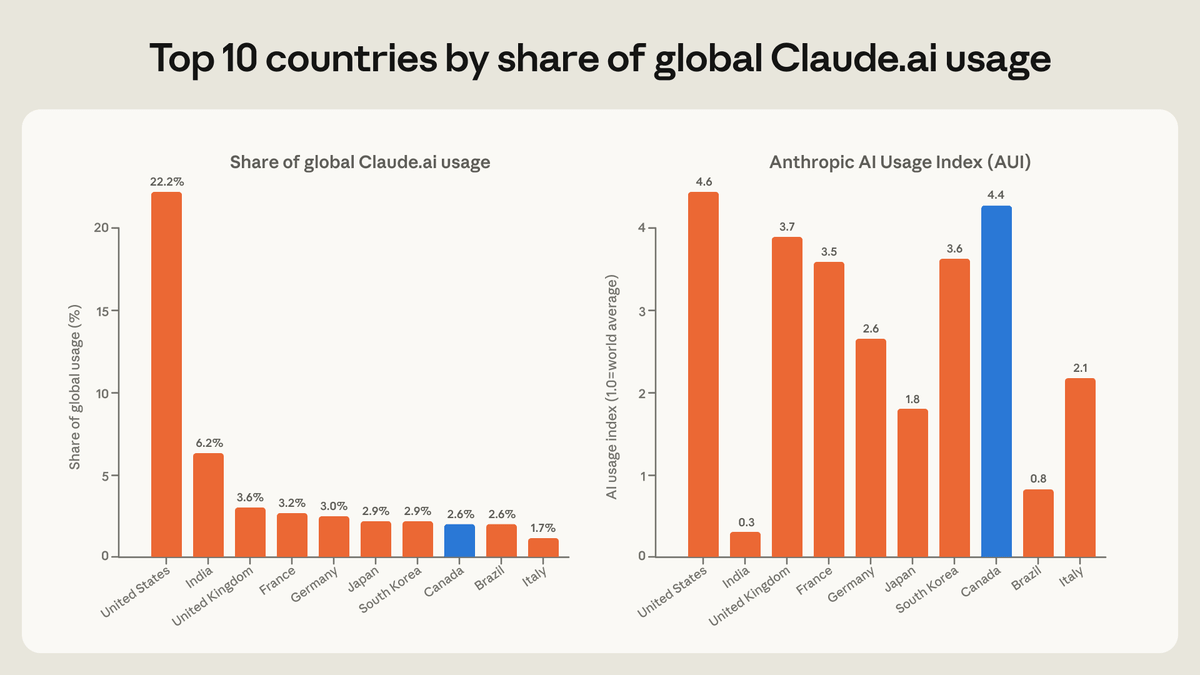
- Canada is a top Claude market: Canada ranks 8th globally in Claude.ai usage but 2nd per capita, using Claude at 4x the rate its population would predict.
- Sovereignty tension: The investment follows a U.S. export-control order that briefly cut off Canadian access to Anthropic's most advanced models, raising AI dependency concerns.
- National strategy alignment: Canada's new "AI for All" strategy targets raising business AI adoption from 12% to 60% by 2034, with Amii, Mila, and Vector at its center.
- Research-to-commercialization gap: Despite hosting ~10% of the world's top AI researchers, Canada captures less than 2% of global AI VC investment -- the gap this partnership aims to help close.
Anthropic is committing $10 million CAD to Canadian AI research institutions, partnering with eight universities and institutes to fund what it calls the next generation of beneficial AI work. The announcement lands at a charged moment: Canada is simultaneously rolling out its most ambitious national AI strategy ever, and the country's relationship with U.S. AI companies has never been more complicated.
What's in the deal
The $10 million will fund research into beneficial and responsible applications of AI, distributed across partnerships with Canada's three leading regional AI institutes: the Alberta Machine Intelligence Institute (Amii) in Edmonton, Mila in Montréal, and the Vector Institute in Toronto, along with CHEO, the Centre for Addiction and Mental Health (CAMH), Université Laval, the University of Toronto, and the University of Saskatchewan.
The funding is primarily delivered as Claude API credits rather than cash grants, meaning researchers get direct access to Anthropic's models for their work. Here is what each institution is doing with it:
- Amii will use credits for reinforcement learning and AI trust and safety research, plus driving AI adoption across Canada's key economic sectors.
- Mila, home to the world's largest concentration of academic deep learning researchers, will support research in responsible AI, health, sustainability, multi-agent systems, and robotics, and will build AI assistants to help researchers discover scientific breakthroughs.
- Vector Institute will advance research in AI trust and safety, health, and science.
- CHEO and the CHEO Research Institute will develop AI-enabled approaches for improving health outcomes for children and youth.
- CAMH's Krembil Centre for Neuroinformatics will run computational mental health research, including predictive treatment models and large-scale fairness evaluations of psychiatric AI systems.
- Université Laval's Institute for Intelligence and Data will study how large language models behave in varied cultural contexts and with low-resource languages like Quebec French and Indigenous languages.
- University of Saskatchewan will apply Claude to biomedical research, food and water security, quantum computing, and public service.
- University of Toronto Data Sciences Institute will run a scientific review process to allocate Claude API credits across research projects.
Beyond the direct research partnerships, Anthropic will add Amii, Mila, and Vector to its Startups program this summer, and hundreds of Canadian startups affiliated with these institutions will receive at least $5,000 USD each in API credits.
Why Canada, and why now
The timing is deliberate. Anthropic co-founder Chris Olah noted that some of the foundations of modern AI came out of Toronto, Montréal, and Edmonton, and that many of the researchers most committed to making AI safe came from that same culture. That is not just sentiment -- it is history. Canada's universities incubated the neural network research that most of the world dismissed in the 1990s and early 2000s, and the payoff arrived in the deep learning era.
Canada's Pan-Canadian AI Strategy, launched in 2017 with $125 million, was celebrated internationally as visionary, but Canada has struggled to turn that research strength into domestic commercial control -- only seven percent of the IP rights generated through the strategy are owned by Canadian private sector firms. In 2024, two-thirds of high-potential Canadian-led startups that raised more than $1 million were headquartered outside Canada, and Canada deployed less than two percent of global AI venture capital despite hosting roughly 10 percent of the world's top-tier AI researchers.
That gap between research prestige and commercial capture is exactly the context Anthropic is stepping into. The announcement also aligns with Canada's freshly published national AI strategy.
The national strategy backdrop
Prime Minister Mark Carney launched "AI for All," Canada's new national artificial intelligence strategy, alongside Minister of Artificial Intelligence and Digital Innovation Evan Solomon. The strategy is a sweeping five-year plan with aggressive economic ambitions, including $200 billion in GDP gains, 250,000 jobs, and a fivefold increase in business adoption.
The strategy is presented as a five-year plan with a stated goal of increasing Canadian business AI adoption from 12% to 60% by 2034. The three national institutes Anthropic is partnering with -- Amii, Mila, and Vector -- sit at the center of that strategy. The federal government's AI for All strategy contains $2.3 billion in spending, some of which Amii, Mila, and the Vector Institute will share, including $50 million for the Canadian AI Safety Institute and $130 million for the commercialization of AI research.
Anthropic's $10M CAD is a fraction of that federal commitment, but the symbolic weight is different: it is a U.S. frontier AI lab voluntarily routing resources back into the Canadian research ecosystem that helped create the field.
The sovereignty tension hiding in plain sight
There is a harder edge to this story. The U.S. government recently ordered Anthropic to suspend foreign nationals' access to two of its most advanced AI models, citing national security concerns, and Anthropic responded by disabling the models for all customers. Organizations in Canada, Europe, and around the world that had embedded those tools in their workflows found them simply gone.
A U.S. export-control directive forced Anthropic to suspend access to its two most advanced models for customers worldwide, though the U.S. government lifted the controls last week. The episode crystallized a concern that had been building in Canadian policy circles: research leadership alone does not create sovereignty -- sovereignty depends on who owns the companies, controls the models, and sets the terms of access, and Canada is still playing catch-up.
Against that backdrop, Anthropic's investment reads as both a goodwill gesture and a practical hedge. Deepening ties with Canadian institutions makes it harder -- politically and reputationally -- to cut off Canadian access again. For Canada, accepting API credits from a U.S. company is a pragmatic move, but it does not resolve the underlying dependency.
What the numbers actually say about Canadian Claude usage
Canada ranks eighth worldwide in Claude.ai use, and per person, Canadians use Claude at more than four times the rate the population predicts. Among the 10 countries where Claude is used most, only the US ranks higher. Within Canada, British Columbia leads in per-person use, with Ontario close behind. Across the country, per-person usage is higher in provinces where professional, scientific, and technical work is concentrated.
That usage data matters because it validates the strategic logic. Anthropic is not investing in a market it is trying to enter -- it is investing in one where it already has deep traction, and where the research institutions it is partnering with are actively training the next generation of people who will build on or compete with its models.
Who wins and what comes next
The clearest winners are the researchers. Access to frontier model APIs has become a real bottleneck for academic labs that cannot afford commercial-scale compute. Giving Mila's 1,500-person research community direct Claude access for work on responsible AI, multi-agent systems, and health applications is a meaningful unlock. The health-focused partnerships -- CHEO, CAMH, and the University of Saskatchewan -- get a tool that could accelerate clinical AI research that would otherwise require expensive custom model development.
For Anthropic, the benefits are strategic. Canada's AI research community, built around Turing Award laureates and globally respected institutes like Mila and the Vector Institute, has long argued that the country's weakness is not ideas but execution: compute capacity, commercialization capital, and the willingness of domestic firms to deploy. Embedding Claude into that research ecosystem means the next wave of Canadian AI startups will build on Claude's APIs by default.
Mila's own Venture Scientist Fund is an attempt to correct Canada's underperformance in AI-based entrepreneurship -- the country is home to 10 percent of the world's top AI researchers but accounts for less than two percent of global AI VC investment. Anthropic's startup credits program plugs directly into that commercialization push.
The announcement also explicitly signals more to come. Anthropic says the eight partnerships announced are just the beginning, with more to follow in the months ahead. For researchers at Canadian institutions, the practical next step is watching for how API credit access gets allocated and what research output requirements, if any, come attached to the partnerships.