
Anthropic's Claude Fable 5 Dethrones GPT-5.5 Pro on Math
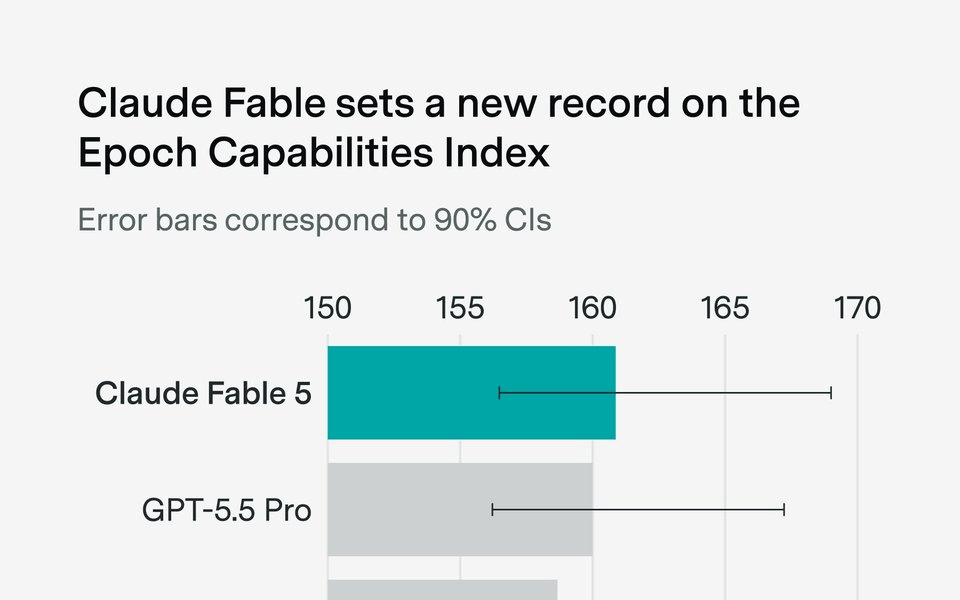
Epoch AI's independent benchmark puts Claude Fable 5 at 161 on the ECI, edging GPT-5.5 Pro by a single point and ending Anthropic's year-long deficit at the frontier.
Takeaways
- ECI lead: Claude Fable 5 scores 161 on the Epoch Capabilities Index, beating GPT-5.5 Pro (159) — Anthropic's first lead in over a year.
- Math breakthrough: Fable 5 hits 88% on FrontierMath Tier 4 vs GPT-5.5's 75%, and leads WeirdML v2 at 87.8% — the first model above 70% on every task.
- Coding dominance: 80.3% on SWE-Bench Pro vs GPT-5.5's 58.6%; 29.3% on FrontierCode Diamond vs GPT-5.5's 5.7%.
- Mythos-class, publicly available: Fable 5 is the first Mythos-tier model released for general use, with safety classifiers that fall back to Opus 4.8 for flagged domains.
- Pricing: $10/M input tokens, $50/M output tokens; available on AWS Bedrock, Vertex AI, Microsoft Foundry, and the Claude API.
- Caveat: GPT-5.5 still beats Fable 5 on Agents' Last Exam; the ECI margin is a single point and the frontier race remains tight.
Anthropic has spent the better part of a year watching OpenAI hold the top spot on the Epoch Capabilities Index. That streak just ended. Epoch AI's independent tracking data shows Claude Fable 5 hitting a score of 161 on the ECI , one point ahead of GPT-5.5 Pro's 159 , the first time Anthropic has led the index in over a year.
What the ECI actually measures
The ECI is not a single test. It combines scores from many different AI benchmarks into a single general capability scale, allowing comparisons between models even over timespans long enough for individual benchmarks to reach saturation. Think of it as a composite leaderboard that stays meaningful even as any one benchmark gets solved.
The ECI uses a statistical model similar to Item Response Theory, under which models are deemed more capable if they score well on difficult benchmarks, and benchmarks are deemed more difficult if capable models are unable to score highly on them. Currently, the ECI uses 1,123 distinct evaluations, covering 147 models and 39 underlying benchmarks. That breadth is what makes a one-point lead meaningful , it is not a fluke on a single test.
Math is where Anthropic flipped the script
Historically, Anthropic models have trailed the frontier on the ECI while punching above their weight on software benchmarks. Fable 5 changed the pattern by taking the lead specifically on math. That shift is visible in the FrontierMath numbers:
- Claude Fable 5 hit 87% accuracy on FrontierMath tiers 1 through 3, and 88% on the hardest tier 4 version 2 problems.
- GPT-5.5 reached about 75% on that same hardest tier.
- Claude Fable 5 (high) scores 87.8% on WeirdML v2 , the first model to score above 70% on average across each separate task in the suite.
- Epoch AI notes that Fable 5's performance on WeirdML v2 alone would suggest a software-engineering-specific ECI of 169.
Fable 5's predecessor, Opus 4.5, reportedly scored below 10% on the hardest FrontierMath tier earlier in 2026. That kind of jump in a single generation is what makes the math story the real headline inside this benchmark result.
The model behind the numbers
Mythos-class models are a tier of Claude models that sit above the Opus class in capability. The first, Claude Mythos Preview, was released in April through Project Glasswing. That is followed by Claude Fable 5 and Claude Mythos 5. Fable 5 is the publicly available version: its broad release is possible because of new safeguards that block responses in specific high-risk areas.
Claude Fable 5 runs with always-on adaptive thinking, a 1-million-token context window, and 128K output tokens, and includes safety classifiers that automatically fall back to Claude Opus 4.8 for flagged requests in domains such as cybersecurity and biology. Claude Fable 5 and Claude Mythos 5 are the same underlying model weights , the only difference is the safety layer.
The broader benchmark picture
The ECI lead is third-party and independent, but the underlying benchmark data paints a consistent picture across multiple evaluations:
- On SWE-Bench Pro, Claude Fable 5 scored 80.3%, ahead of Claude Mythos Preview at 77.8%, Claude Opus 4.8 at 69.2%, GPT-5.5 at 58.6%, and Gemini 3.1 Pro at 54.2%.
- On Cognition's FrontierCode Diamond split, Fable 5 reaches 29.3%, more than double Opus 4.8's 13.4% and far ahead of GPT-5.5's 5.7%.
- On Terminal-Bench 2.1, Claude Fable 5 reached 88.0%, versus 82.7% for Claude Opus 4.8, 83.4% for GPT-5.5, and 70.7% for Gemini 3.1 Pro.
- On GDP.pdf, a vision evaluation that asks a model to reason over a rendered document with no tools, Fable 5 leads the field at 29.8%, ahead of GPT-5.5's 24.9%.
It is worth noting that GPT-5.5 does beat Fable 5 on the Agents' Last Exam benchmark, with third-party analysis suggesting OpenAI's model is currently superior at strictly adhering to multi-part, complex prompts. The ECI lead is real but narrow, and the race at the frontier remains genuinely competitive.
Pricing and access
Claude Fable 5 is priced at $10 per million input tokens and $50 per million output tokens, with the existing 90% input token discount for prompt caching. It is generally available on the Claude API, Claude Platform on AWS, Amazon Bedrock, Vertex AI, and Microsoft Foundry. Claude Mythos 5 is not generally available , it is offered in limited availability to approved customers in Project Glasswing.
For teams evaluating whether to upgrade, the practical case for Fable 5 is clearest on long-horizon tasks. It is designed for ambitious, long-running, asynchronous tasks , large-scale code migrations, multi-day agentic sessions, deep research, and dense knowledge work , with Anthropic's own framing being that "the longer and more complex the task, the larger Fable 5's lead over other models." If your workloads are short and simple, the price jump may not be justified. If they are not, the ECI data suggests Anthropic is back at the top of the stack.