
Anthropic's Claude Science Collapses 60+ Research Tools Into One Desktop App
Anthropic launches Claude Science, a dedicated AI research workbench with 60+ scientific databases, compute orchestration, and full reproducibility for every result
Takeaways
- New app, not a new model: Claude Science is a dedicated research workbench that wraps Claude models in a full scientific environment with compute, databases, and reproducibility tools.
- 60+ scientific databases: Pre-configured for genomics, single-cell, proteomics, structural biology, and cheminformatics, with native connections to resources like UniProt, PDB, ChEMBL, and more.
- Compute orchestration built-in: Submits and manages jobs over SSH on your own HPC cluster or through Modal, scaling from one GPU to hundreds on demand.
- Every artifact is reproducible: Figures ship with the exact code, environment, and conversation that produced them; a reviewer agent flags incorrect citations and figures that don't match their code.
- NVIDIA BioNeMo integration: Connects natively to Evo 2, Boltz-2, and OpenFold3 via NVIDIA's BioNeMo Agent Toolkit for life sciences model access.
- Grant program available: Up to $30,000 in credits for 50 selected AI for Science projects; applications open through July 15, 2026.
Anthropic has just launched Claude Science, a purpose-built AI workbench for scientific research. It is not a new model -- it is a new app that wraps Claude's existing models in a full research environment: one that can run analyses, manage compute, query scientific databases, and trace every figure back to the exact code that generated it. It is available now in beta for macOS and Linux.
The timing is deliberate. Last October, Anthropic launched Claude for Life Sciences -- a suite of connectors and skills that made Claude a better scientific collaborator. Claude Science is the next, much bigger step: a standalone desktop application that brings the entire research pipeline under one roof.
The problem it is solving
Scientific research is often tedious. Researchers must work across dozens of databases, each with their own schema, contend with file formats that require bespoke data pipelines and viewers, and transition between a roster of tools: PubMed, Jupyter, R, a cluster terminal, and more. Claude Science is built to collapse that fragmentation.
Claude Science brings these fragmented tools into a single research environment where scientists can conduct all stages of their work. It helps you analyze literature and execute multistep research, produces detailed artifacts, and lets you iteratively refine figures and manuscripts until they're ready for publication.
What it actually does
Claude Science is built around three core pillars:
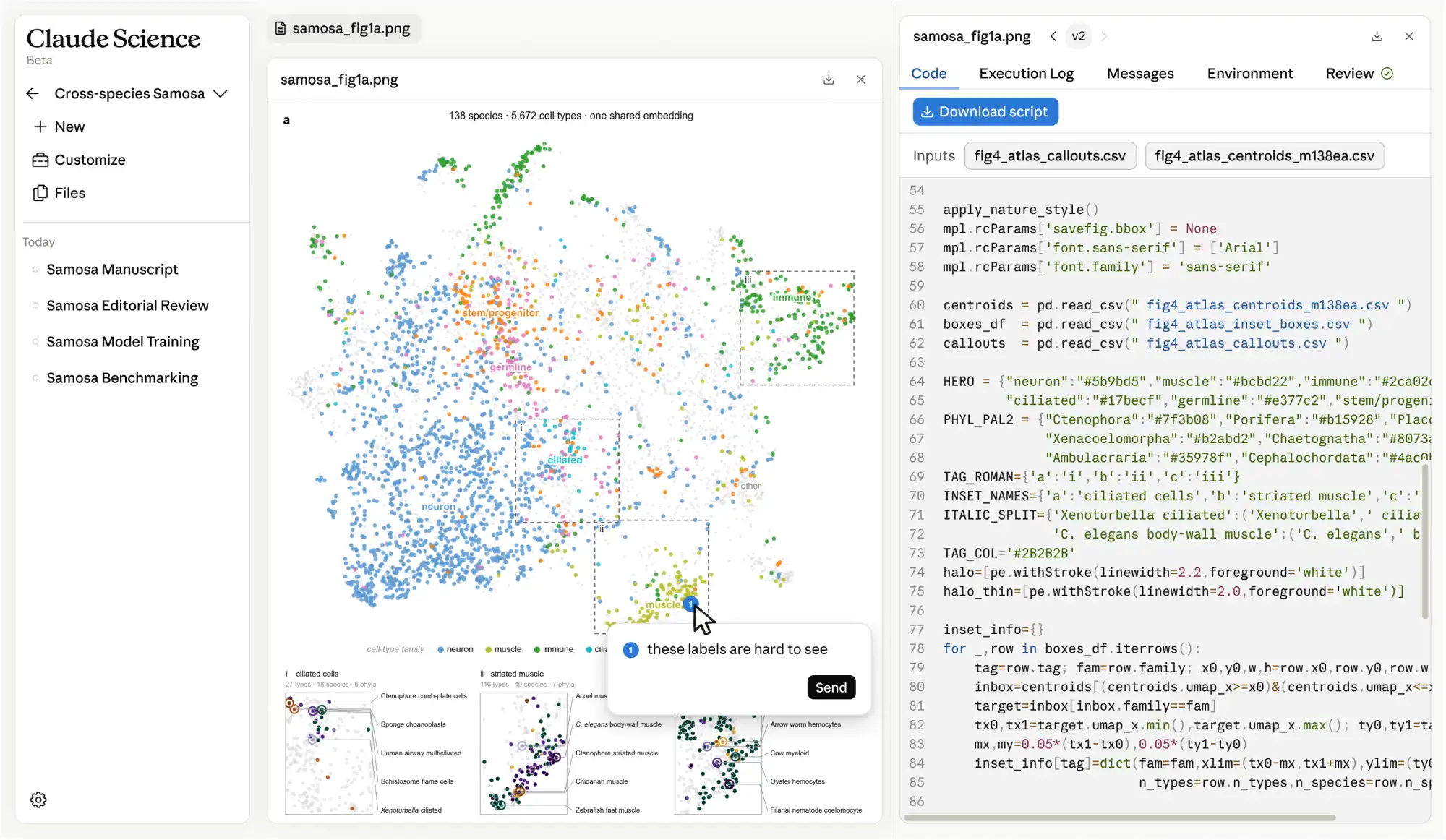
- Reproducible artifacts. Every output carries an auditable history of how it was made, so you can validate and reproduce the results. When Claude Science generates a figure, it bundles the exact code, the environment it ran in, a plain-language description, and the full conversation history. You can ask it to edit a figure in plain English -- "remove the gridlines" or "switch the y-axis to log scale" -- and the agent edits its own code directly.
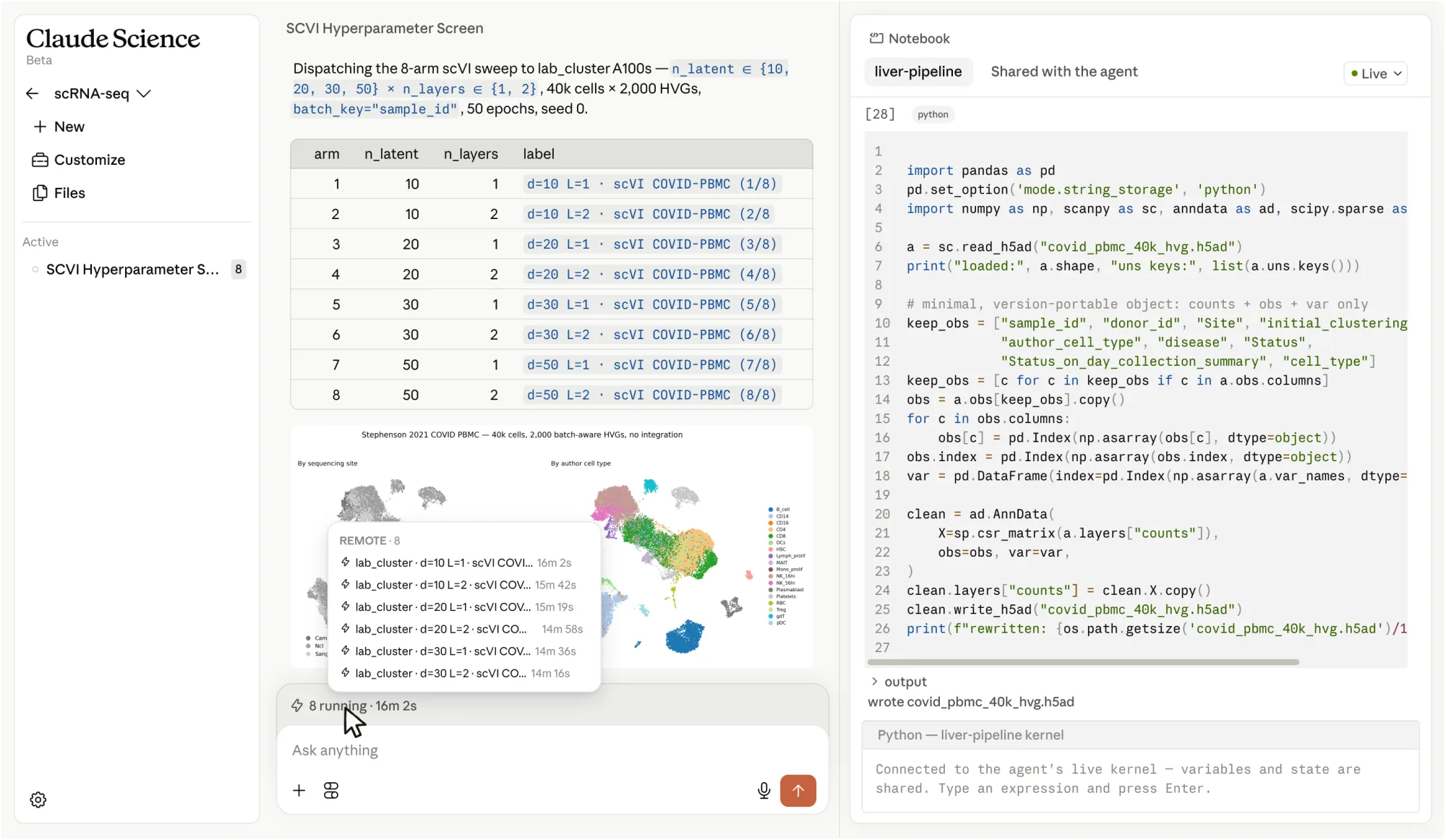
- Compute orchestration. Claude Science handles the process of drafting a plan, asking before reaching new resources, and letting you review or revoke any decision before writing and submitting the job to the computing resources your lab already uses -- your own HPC cluster over SSH, or your Modal account for compute on demand -- scaling the analysis from a single GPU to hundreds as needed.
- Domain-ready databases. The app ships with analysis specialists for genomics, single-cell, proteomics, structural biology, cheminformatics, and more. It can connect natively to 60+ scientific databases and domain-specific open models.
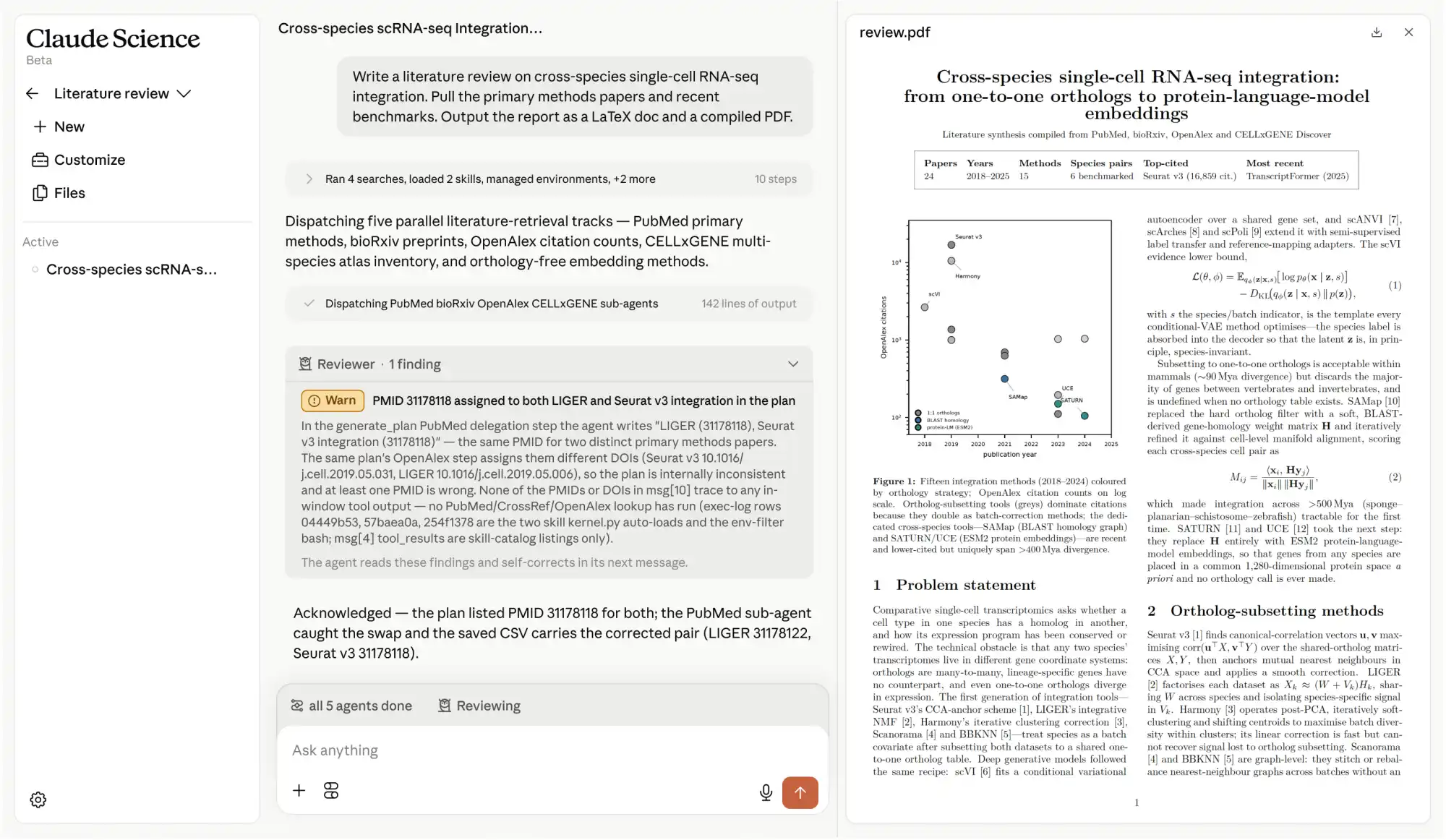
Users interact with a generalist coordinating agent with access to over 60 curated skills and connectors pre-configured for genomics, single-cell, proteomics, structural biology, cheminformatics, and more. These agents can spin up others and engage with specialist agents created by users. And a reviewer agent checks citations and calculations, flagging and correcting errors.
The NVIDIA partnership
One of the most significant technical details in this launch is the NVIDIA integration. Claude Science uses the skills in NVIDIA's BioNeMo Agent Toolkit to connect natively to the life sciences models and libraries in BioNeMo, including Evo 2, Boltz-2, and OpenFold3. This is not a superficial integration -- frontier labs and scientific agent builders including Anthropic, Edison Scientific, Lila Sciences, OpenAI and Owkin are integrating with BioNeMo to help agents move from answering questions to completing scientific work.
The next phase, NVIDIA says, will be driven by AI agents that can use tools, execute multi-step plans and complete tasks autonomously. "Agentic AI has arrived," said NVIDIA VP of Healthcare Kimberly Powell, framing the toolkit not as another model release but as part of a broader shift in how scientific software, data and laboratory systems may be used.
Real-world results from beta users
Anthropic has been running a private beta with researchers across academia and industry, and the early results are striking. A few standouts:
- Manifold Bio used Claude Science to nominate targets for its latest experiments, with the app assessing surface expression, trafficking, and safety for each tissue and target -- end-to-end, without a human stitching together the pipeline.
- Allen Institute neuroscientist Jérôme Lecoq built a multi-agent computational review system using about 20 custom skills. Sub-agents read thousands of papers, extracted central claims, and stored them in an evidence database. Before Claude Science, such a review could take two years. He now has about 10 reviews, many over 100 pages, with citations checked by reviewer agents.
- UCSF's Stephen Francis used it to support studies on the molecular epidemiology of glioma. The app has dramatically accelerated the analysis, enabling comprehensive germline workups across multiple approaches in roughly one-tenth the time it previously took.
Data privacy and where it runs
A critical concern for any lab is data sovereignty. The Claude Science app runs on your infrastructure -- your laptop, Linux box, or HPC login node -- so large or sensitive datasets never have to leave the systems they're already on, and only the context needed for each step of the analysis is sent to Claude. Raw datasets and compute stay local; only the prompt context is processed by Anthropic under standard retention policies.
Because its agents work inside a running session that holds context in memory, even massive datasets only need to be loaded once. It runs persistent Python and R kernels, so variables, dataframes, and loaded models stay in memory across the whole analysis, making iteration fast.
Who can access it and what it costs
The Claude Science app is available in beta on macOS and Linux for Pro, Max, Team, and Enterprise plans. Team and Enterprise users need their admin to enable it first. There is a discounted Team plan for active scientific labs at academic institutions and nonprofit research organizations, with eligibility verified through the lab's principal investigator.
For researchers who want to go deeper, Anthropic is also running a grant program. Anthropic will support up to 50 Claude Science AI for Science projects, providing up to $30,000 in credits. Modal will also be providing up to $2,000 in compute for select projects. Applications are open through July 15, 2026, with award notifications sent out by July 31. Projects will run from September 1 to December 1, 2026.
What this means for the research community
The gap Claude Science is targeting is real. Today, a biologist's work is scattered across dozens of disconnected tools, databases, and compute environments. For decades, that fragmentation has been the cost of doing science at speed. A tool that genuinely closes that gap -- not just for computational biologists but for wet-lab scientists who have never written a pipeline -- would be a significant shift.
The reviewer agent is worth highlighting specifically. It is not just a convenience feature: a background reviewer flags incorrect citations, untraceable numbers, and figures that don't match their underlying code, and self-corrects as it goes. For a field where reproducibility crises are a known problem, baking provenance and error-checking into the artifact itself is a meaningful design choice.
Claude Science is still in beta, and Anthropic is explicitly collecting feedback to refine the platform. But the combination of compute orchestration, 60+ database connectors, NVIDIA's BioNeMo models, and a built-in reviewer agent makes this the most complete AI research environment any major lab has shipped. The question now is whether it holds up under the full weight of real research workflows -- and early users suggest it just might.