
Cursor Adds Anthropic's Fable 5, Scoring 72.9% on Its Hardest Coding Benchmark
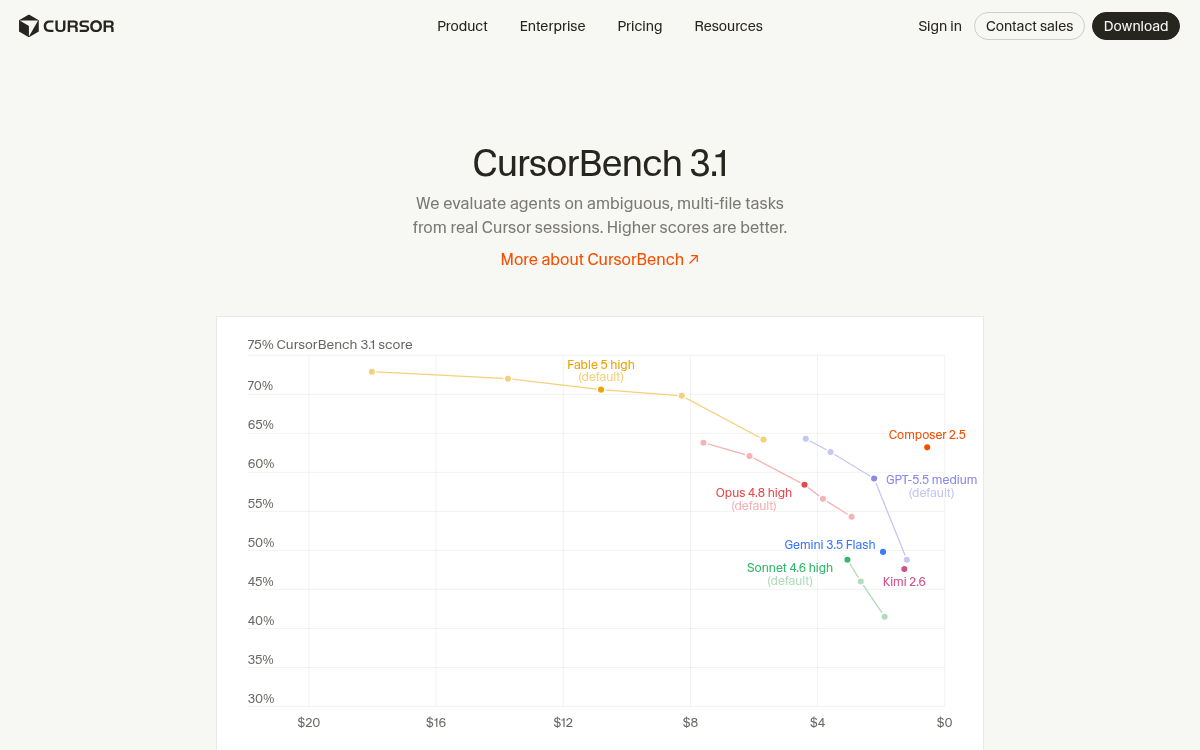
Cursor adds Claude Fable 5 to its IDE, posting a record 72.9% on CursorBench — 8 points clear of every other model on the leaderboard
Takeaways
- Cursor announced Claude Fable 5 is available in its IDE, posting 72.9% on CursorBench 3.1 — 8 points above the previous best model.
- CursorBench is built from real Cursor sessions, making it harder to game than public benchmarks and more aligned with actual developer workflows.
- Fable 5 is Anthropic's first Mythos-class model for general use, designed for long-horizon, multi-file agentic coding with minimal check-ins.
- Pricing is $10/$50 per million input/output tokens — twice Opus 4.8 — with a 1M token context window and 30-day data retention requirement.
- Access is currently suspended: Anthropic removed Fable 5 for all customers due to capacity; Cursor's leaderboard no longer lists it while it's unavailable.
- Best used for complex, long-running tasks; community feedback confirms it's overkill and expensive for small or routine coding jobs. See the leaderboard.
Cursor announced that Claude Fable 5, Anthropic's new Mythos-class model, is now available inside its IDE , and backed the news with a number: 72.9% on CursorBench 3.1, 8 points above the previous best. That gap is not noise. It is the largest single-model jump the leaderboard has recorded, and it comes from a benchmark that Cursor designed specifically to resist the problems that plague public evals.
Why this benchmark actually matters
Most coding benchmarks are built around bug-fixing tasks pulled from public GitHub issues , tasks that frontier models have likely seen in training. CursorBench is different: Cursor evaluates agents on ambiguous, multi-file tasks sourced from real Cursor sessions, which reduces contamination risk and keeps the eval aligned with what developers actually do. The tasks are intentionally underspecified, mirroring how real engineers talk to agents, and graded by an agentic grader rather than a narrow set of expected outputs.
CursorBench produces more separation between models at frontier levels, where public benchmarks are increasingly saturated. That is exactly the context in which Fable 5's 8-point lead is meaningful , it is not a margin squeezed out of a near-saturated benchmark.
What Fable 5 actually is
Claude Fable 5 is Anthropic's first generally available Mythos-class AI model: a new tier above Opus, built for demanding reasoning, long-horizon agentic work, coding, knowledge work, vision, and large-context analysis. The key phrase is "long-horizon" , this is a model designed to hold intent across very long sessions and drive tasks to completion with fewer interruptions, not just answer a single hard question well.
It is suited for long-running, complex, and asynchronous tasks that previously required frequent human check-ins, and is particularly strong at end-to-end work that would otherwise take a person hours, days, or weeks. Anthropic's own benchmark table shows it leading on SWE-bench Pro at 80.3%, and on FrontierCode Diamond , a harder, less contaminated coding eval , Fable 5 scores highest among frontier models even at medium effort, reaching 29.3%, more than double Opus 4.8's 13.4% and far ahead of GPT-5.5's 5.7%.
What it can do inside Cursor
Inside Cursor, Fable 5 has access to the full agent tool suite. That includes semantic codebase search, file and directory navigation, web search, file reading with vision support, automatic edit application, terminal command execution, and browser control for testing and visual verification. A thinking variant is also available for problems that reward deeper deliberation before acting.
The model is built to self-correct. It executes well-scoped tasks with few mistakes, automatically self-correcting through verification loops. In practice, that means fewer back-and-forth cycles on complex refactors or multi-file migrations , the model checks its own work rather than waiting for you to catch errors.
The cost tradeoff
Fable 5 costs about twice as much as Claude Opus 4.8, at $10 per million input tokens and $50 per million output tokens. It also comes with a 1M token context window by default, and up to 128k output tokens per request. That is a meaningful context budget for large codebases, but it also means costs can compound quickly on long agentic sessions.
The community has noticed. One forum user reported spending $1.72 on a small bug fix that took three minutes, and concluded that Composer 2.5 was better for that need and cost about 13 cents. The practical guidance from Cursor's own docs is clear: it costs about twice as much as Claude Opus 4.8, so it's a strong fit for your team's most complex agentic work. Routine tasks belong on cheaper models.
There is one more wrinkle worth flagging. Fable 5 has new privacy considerations because of how Anthropic handles data retention for these models. If Privacy Mode is enabled for your account, team, or organization, you will need to approve Fable 5's Data Retention Policy in the Cursor Dashboard before you can use the model. Claude Fable 5 carries a 30-day data retention requirement and is not available under zero data retention. Enterprise teams with strict data policies will want to review this before rolling it out.
Where it shines, and where to be careful
The clearest use cases for Fable 5 in Cursor are the ones where the previous best model would have stalled or required constant supervision:
- Codebase-wide migrations across dozens of files
- Long refactors that require holding context across a full module or service
- Multi-step debugging sessions where the agent needs to investigate logs, run tests, and iterate
- Complex implementations that benefit from the model writing and running its own tests
Where it is overkill: the right model depends on cost per successful task, not just benchmark score. For hard tasks, paying more for a model that succeeds may be cheaper than paying less for several failed runs. For routine tasks, Fable 5 may be overkill.
One thing to know right now
Anthropic has removed access to this model for all customers. The Cursor docs page for Fable 5 currently shows this notice, pointing to a separate explanation. This appears to be a capacity issue rather than a permanent withdrawal , Anthropic says it aims to restore Fable 5 as a standard subscription feature once capacity allows. The CursorBench leaderboard has been updated accordingly and no longer lists Fable 5 while access is suspended. When it returns, the benchmark case for using it on your hardest agentic tasks remains intact.
Cursor's Michael Truell called Fable 5 "the state of the art model on CursorBench" and said it has opened up long-horizon problems that were out of reach before. That is the real story here: not just a higher number on a leaderboard, but a model that moves the ceiling on what a coding agent can be asked to do autonomously inside an IDE. The benchmark lead is the signal. The question for most teams is whether their hardest problems are hard enough to justify the cost.