
Cursor Slashes Team Costs for 90% of Users With Composer 2.5 Pricing Overhaul
Cursor overhauls Teams pricing with split usage pools, a new Premium seat at 5x usage for 3x the cost, and real-time spend controls for admins

Takeaways
- New Premium seat: 5x usage of Standard at 3x the cost — $96/seat/month (annual) or $120/seat/month (monthly). Details
- Split usage pools: Every Teams seat now has separate pools for Cursor's first-party models (Composer/Auto) and third-party APIs (Claude, GPT, Gemini).
- Standard seat unchanged in price but now includes more total usage — $32/seat/month annually, $40/seat/month monthly.
- Composer 2.5 is the key enabler: Cursor's in-house model matches Opus 4.7 on SWE-Bench at ~1/10th the cost per task, making the dedicated pool genuinely valuable.
- Rebuilt admin controls: Real-time usage dashboards split by model type, plus Slack/email spend alerts based on dollar thresholds.
- Rollout timeline: Immediate for new customers; renewing customers on billing cycles starting July 1st, 2026. Cursor expects 90% of teams to see lower costs.
Cursor just made a significant move on the enterprise pricing front, rolling out a restructured Teams plan that the company says will lower costs for 90% of teams. The changes introduce split usage pools, a new Premium seat tier, and a rebuilt admin dashboard , all driven by a single insight: a small number of power users are blowing up team budgets in unpredictable ways.
Cursor is increasing Teams plan usage limits, introducing a Premium seat to support the heaviest agent users, and making it easier for admins to forecast and control spend. The changes take effect immediately for new customers, and for renewing customers on billing cycles starting July 1st, 2026.
The power user problem
The root cause of this restructuring is a usage distribution problem that anyone running a dev team on AI tooling will recognize. P99 power users are achieving significantly larger gains than everyone else, and the gap is growing on an absolute basis as total AI usage grows. AI usage is highly concentrated, with a small share of developers accounting for a disproportionate share of spend.
One developer using Auto mode exclusively might cost $20/month flat. Another manually selecting frontier models for every task could hit $80+ on the same plan. Multiply that variance across 50 seats and the gap between base cost and actual bill becomes a CFO conversation. Cursor's own Developer Habits Report quantified this: in just the last two months, average tool calls per session have risen roughly 30%. Agents are going deeper, and the bills are following.

Two usage pools instead of one
The first structural change is how usage is counted. Previously, all model usage drew from a single shared pool, meaning a heavy session with Claude Opus could eat into the same budget as a quick Composer autocomplete. Now, every Teams seat comes with two distinct pools:
- Composer and Auto: A dedicated pool for first-party Cursor models, including the new Composer 2.5
- Third-Party API: A separate pool for third-party models like Claude, GPT, and Gemini
This split matters because according to Cursor's published benchmarks, Composer 2.5 performs comparably to Opus 4.7 on SWE-Bench Multilingual and CursorBench v3.1, while costing roughly one-tenth the price per task. By carving out a generous Composer-specific pool, Cursor is effectively nudging teams toward its own model , which is both cheaper for Cursor to serve and now genuinely competitive on performance.
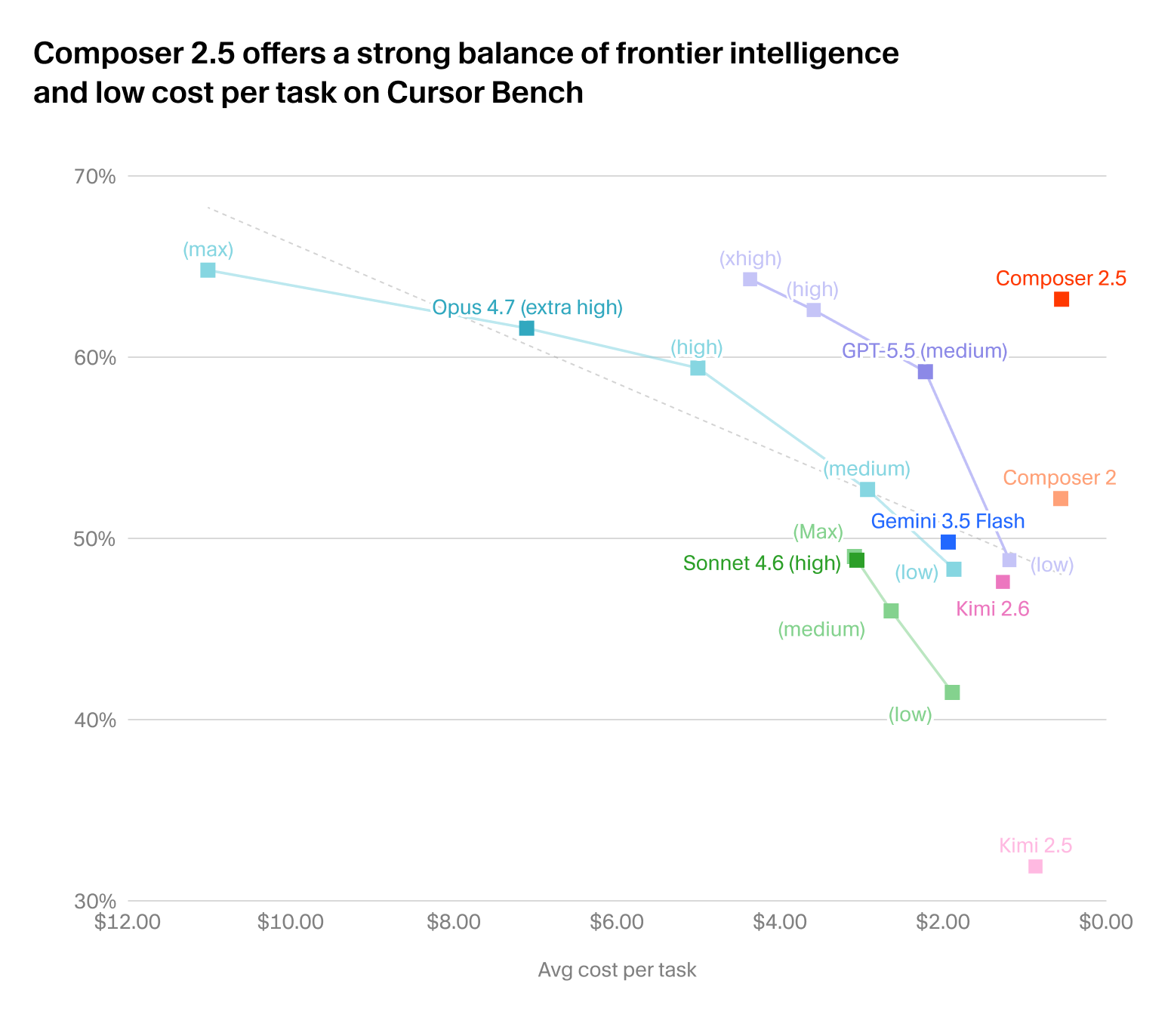
The Composer 2.5 story is worth understanding here. Composer 2.5 performs on par with Claude Opus 4.7 and GPT-5.5 on coding benchmarks including SWE-Bench Multilingual (79.8%) and CursorBench v3.1 (63.2%), but at roughly one-tenth the cost per task. The model is built on Moonshot AI's open-source Kimi K2.5 checkpoint with 25x more synthetic training tasks and a new targeted reinforcement learning technique. In short: Cursor now has a credible reason to ask teams to use its own model, and the pricing restructure is built around that bet.
A new Premium seat for heavy hitters
The second change is the introduction of a Premium seat tier, directly inspired by the success of Cursor's individual Ultra plan. The $200/month Ultra plan launched in June 2025 signaled a shift toward high-value power users, offering 20x more model usage and priority features, showing Cursor's confidence in delivering ROI that justified premium pricing. The Premium Teams seat applies the same logic at the organizational level.
Here is how the updated seat pricing breaks down:
| Seat Type | Monthly (billed monthly) | Monthly (billed annually) | Usage |
|---|---|---|---|
| Standard | $40/seat | $32/seat | Base (increased from before) |
| Premium | $120/seat | $96/seat | 5x Standard |
The Premium tier provides five times the included usage of the Standard seat but at three times the price. Cursor expects this to cover a full month of intensive agent use for most users. Critically, teams can mix seat types freely , so you can put your five heaviest agent users on Premium and keep the rest on Standard, rather than upgrading the entire org.
Admin controls that actually help
The third pillar is visibility and alerting. The Cursor dashboard now shows users how close they are to hitting their limits, split between Auto + Composer and 3rd party API models. Recommendations will be provided to help teams optimize their plan based on individual usage patterns. Spend alerting has also been rebuilt, allowing admins to set dollar-based thresholds and receive notifications via Slack or email.
The bigger picture
This pricing update is not happening in a vacuum. Cursor's annualized revenue exceeded $2.0 billion by February 2026, having crossed $1.0 billion in annualized revenue in November 2025. The product is used by over half the Fortune 500. At that scale, billing unpredictability is not just a customer annoyance , it is a retention risk.
The competitive angle is also real. For 25 developers, Cursor Teams costs $12,000 per year versus roughly $5,700 per year for GitHub Copilot Business at $19/seat/month. The premium buys agentic capabilities, Cloud Agents, and multi-model access that Copilot is still developing. By making the cost structure more predictable and adding a high-usage tier that delivers genuine value per dollar, Cursor is shoring up the enterprise argument against cheaper alternatives.
What this means for your team
If you are an admin or team lead running Cursor at scale, here is the practical read:
- Most teams get more for the same price. The Standard seat now includes more total usage with no price change on monthly plans.
- Identify your power users. The new dashboard recommendations will flag who on your team is burning through quota fastest , those are your Premium seat candidates.
- The math on Premium is favorable. Five times the usage at three times the cost is a better deal than paying on-demand overages for heavy users.
- Composer 2.5 is now the default value play. The separate Composer pool is generous by design. Leaning on it for routine agent work and reserving third-party models for tasks that genuinely need them will stretch budgets significantly further.
- Set up Slack alerts. The rebuilt spend alerting is worth configuring before your next billing cycle , billing surprises at the team level are avoidable now.
The changes roll out immediately for new customers and hit renewing customers starting July 1st. If your team is already on Cursor, now is the time to audit who your heaviest users are and decide whether the Premium seat math works in your favor before the next renewal.