
Google Convinces OpenAI and ElevenLabs to Adopt SynthID Watermarking
Google's SynthID watermarking standard goes cross-industry as OpenAI, ElevenLabs, and Kakao adopt it — and verification lands in Search and Chrome
Takeaways
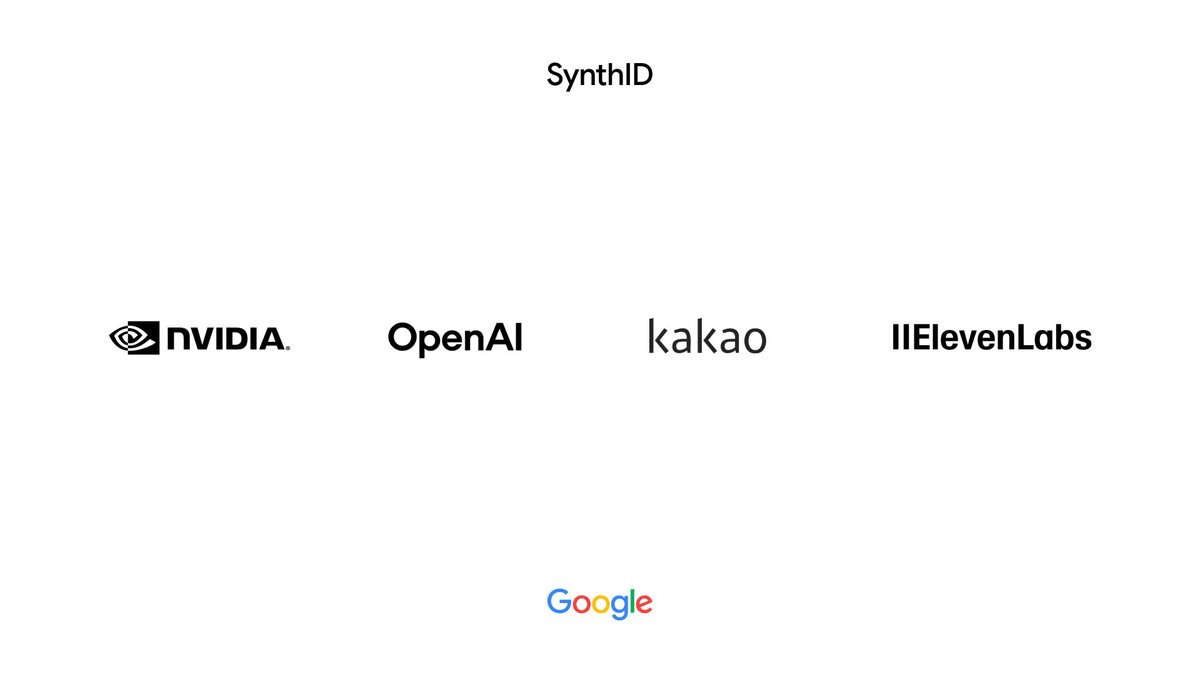
- Cross-industry coalition: OpenAI, ElevenLabs, Kakao, and NVIDIA are all adopting Google's SynthID watermarking for their AI-generated content.
- Massive scale: SynthID has already watermarked over 100 billion images/videos and 60,000 years of audio; Gemini verification used 50M+ times.
- Verification in Search and Chrome: Users can now ask "Is this made with AI?" directly in Google Search via Lens, AI Mode, and Circle to Search; Chrome coming soon.
- New enterprise API: A new AI Content Detection API on Google Cloud can detect AI content from Google and other popular models; early partners include Shutterstock, Snap, and Canva.
- Pixel + Instagram: C2PA Content Credentials for video rolling out to Pixel 8/9/10; Meta will label Pixel-captured content on Instagram automatically.
- Key gap remains: Open-source models like Stable Diffusion and Midjourney are not part of the coalition, leaving the highest-risk content unlabeled.
Google just pulled off something genuinely unusual in the AI industry: it convinced some of its fiercest rivals to adopt its own watermarking technology. At Google I/O 2026, the company announced that OpenAI, Kakao, and ElevenLabs are all integrating SynthID , Google's imperceptible watermarking technology , into their own platforms. The move signals that SynthID is no longer just a Google safety feature. It is becoming the closest thing the industry has to a shared standard for labeling AI-generated content.
What SynthID Actually Does
SynthID works by embedding signals into AI-generated content that are invisible to humans but detectable by verification tools. Crucially, these signals survive common editing operations like cropping, compression, and color adjustment. Think of it as a fingerprint baked into the pixels, audio waveform, or token distribution of a piece of content , one that persists even after the file has been shared, re-encoded, or lightly edited.
SynthID supports watermarking across text, images, video, and audio. OpenAI is adopting a multi-layered approach, combining C2PA metadata and SynthID watermarking to make verification more resilient. C2PA helps content carry detailed context; SynthID helps preserve a signal when metadata does not survive. Watermarking can be more durable through transformations like screenshots, while metadata can provide more information than a watermark alone.
C2PA (Coalition for Content Provenance and Authenticity) is an open technical standard , think of it as a tamper-evident label attached to a file's metadata that records who created it, when, and with what tools. Together, SynthID and C2PA form a two-layer provenance system: one that survives stripping of metadata, and one that carries rich contextual detail.
The Numbers Behind the Push
The scale here is hard to ignore. Three years ago, Google introduced SynthID as its industry-leading digital watermarking technology. Since then, it has watermarked over 100 billion images and videos and 60,000 years of audio. Verification in the Gemini app alone has been used 50 million times globally. Those numbers gave Google the credibility to walk into negotiations with competitors and say: this already works at scale.
Who's In , and Who's Not
The new partner lineup is significant:
- Every image generated by ChatGPT, Codex, and the OpenAI API will now carry both a C2PA manifest and a SynthID watermark. OpenAI is also previewing a public verification tool that would let anyone check whether an image carries a SynthID watermark.
- Kakao adopted SynthID for image generation, and ElevenLabs adopted it for AI-generated audio.
- Through a partnership between NVIDIA and Google, SynthID will be used to watermark AI-generated video outputs from NVIDIA's Cosmos world foundation models.
But the coalition has clear limits. Adobe, Microsoft, and Meta have signed onto C2PA but have not committed to SynthID specifically. Stability AI, Midjourney, and the broader open-source generation ecosystem have not adopted SynthID at all. That gap matters enormously , the models most likely to be used for disinformation are precisely the ones outside this coalition.
Verification Moves Into Your Browser
Beyond the partnerships, Google is pushing verification directly into the tools people use every day. Google is adding SynthID verification to Search, letting users check whether images were created with AI. Users will be able to check the origin of images through Search features such as Lens, AI Mode, and Circle to Search. Chrome support is rolling out in the coming weeks.
Google is also using C2PA Content Credentials across its generative media tools. Pixel 10 was the first smartphone to provide Content Credentials for images in its native camera app, and the company is expanding this technology to include video on Pixel 8, 9, and 10 phones. Meta will also start labeling camera-captured media with Content Credentials on Instagram. Photos and videos taken natively on Pixel phones will be recognized and labeled when shared on Instagram.
A New Enterprise API
For organizations that need to operate at scale, Google is adding a new Content Detection API on Google Cloud's Gemini Enterprise Agent Platform. The API gives businesses a way to spot AI content made by both Google and other popular models, helping them evaluate and manage media across their own platforms , whether for backend operations like sorting feeds and preventing insurance fraud, or for user-facing content like fact-checking and labeling synthetic media.
The API accepts JPEG, PNG, or WebP images via REST and uses machine learning models to analyze pixel-level artifacts, noise patterns, and spectral anomalies. Google is previewing the API to a group of trusted partners, including Shutterstock, Snap, Fox Sports, and Canva, to refine it based on their feedback. Broader access will follow.
The Honest Limitations
Google is candid about what SynthID cannot do. SynthID alone will not solve problems like misinformation, impersonation, or copyright tracking. Watermarking in itself does not solve the provenance problem , it needs to become part of an ecosystem of tools, including C2PA, adopted by all major players across industry and governments.
On the text side, the limitations are more acute. Watermark application is less effective on factual responses, and detector confidence scores can be greatly reduced when AI-generated text is thoroughly rewritten or translated to another language. And the fundamental structural problem remains: open-source models trained outside these partnerships will continue to produce unlabeled output. The bad actors most motivated to misuse AI-generated content are the least likely to be using watermarked commercial APIs.
Why This Moment Matters
SynthID is becoming one of the most important attempts to answer a simple but difficult question: how can you tell whether an image, video, audio clip, or piece of text was generated by AI? Recent adoption by companies including OpenAI, NVIDIA, Kakao, and ElevenLabs suggests the technology is moving from a Google project into a broader AI transparency layer.
Governments and regulators worldwide are increasing pressure on AI companies to provide transparency and traceability for synthetic content. Google's decision to expand SynthID to rival platforms may also help position the company at the center of an emerging industry standard. That is a significant strategic win , not just for safety, but for influence over how the next generation of content infrastructure gets built.
For developers building on top of AI-generated media pipelines, the practical upshot is straightforward: if you are using OpenAI's image API, NVIDIA's Cosmos models, ElevenLabs for audio, or any of Google's own tools, your outputs will now carry machine-readable provenance signals. The official announcement confirms that the SynthID ecosystem is expanding fast , and the enterprise Google Cloud API gives teams a way to build verification directly into their own content moderation stacks. The open question is whether the platforms that matter most for disinformation , the ones outside this coalition , will ever come to the table.