
Google's Gemini 3.5 Flash Beats Its Own Pro at 4x the Speed
Gemini 3.5 Flash turns images into interactive code, beats last-gen Pro on agents and coding, at 4x the speed
Takeaways
- Gemini 3.5 Flash launches at Google I/O 2026, outperforming Gemini 3.1 Pro on coding and agentic benchmarks at 4x the speed.
- Vision-to-code is a standout capability: the model analyzes images and generates functional, interactive UI and 3D visualizers directly from visual input.
- Pricing is $1.50/$9.00 per 1M tokens (input/output), 40% cheaper than 3.1 Pro but 3x more expensive than the previous Gemini 3 Flash.
- Available now via Google AI Studio, Gemini API (
gemini-3.5-flash), Antigravity, Vertex AI, and the Gemini app globally. - Weaknesses include long-context recall regressions, verbosity on reasoning-heavy tasks, and no Computer Use capability.
- Gemini 3.5 Pro is in internal testing and expected to ship next month, with Flash's gains suggesting a major leap over Claude Opus 4.7 and GPT-5.5.
Google just did something unusual with a Flash-tier model: it made it better than its own Pro. Gemini 3.5 Flash, announced at Google I/O 2026, is the first model in the new Gemini 3.5 family , and its headline claim is that a mid-tier, fast model now outperforms the previous flagship on the benchmarks that matter most to builders: coding, agentic workflows, and multimodal reasoning.
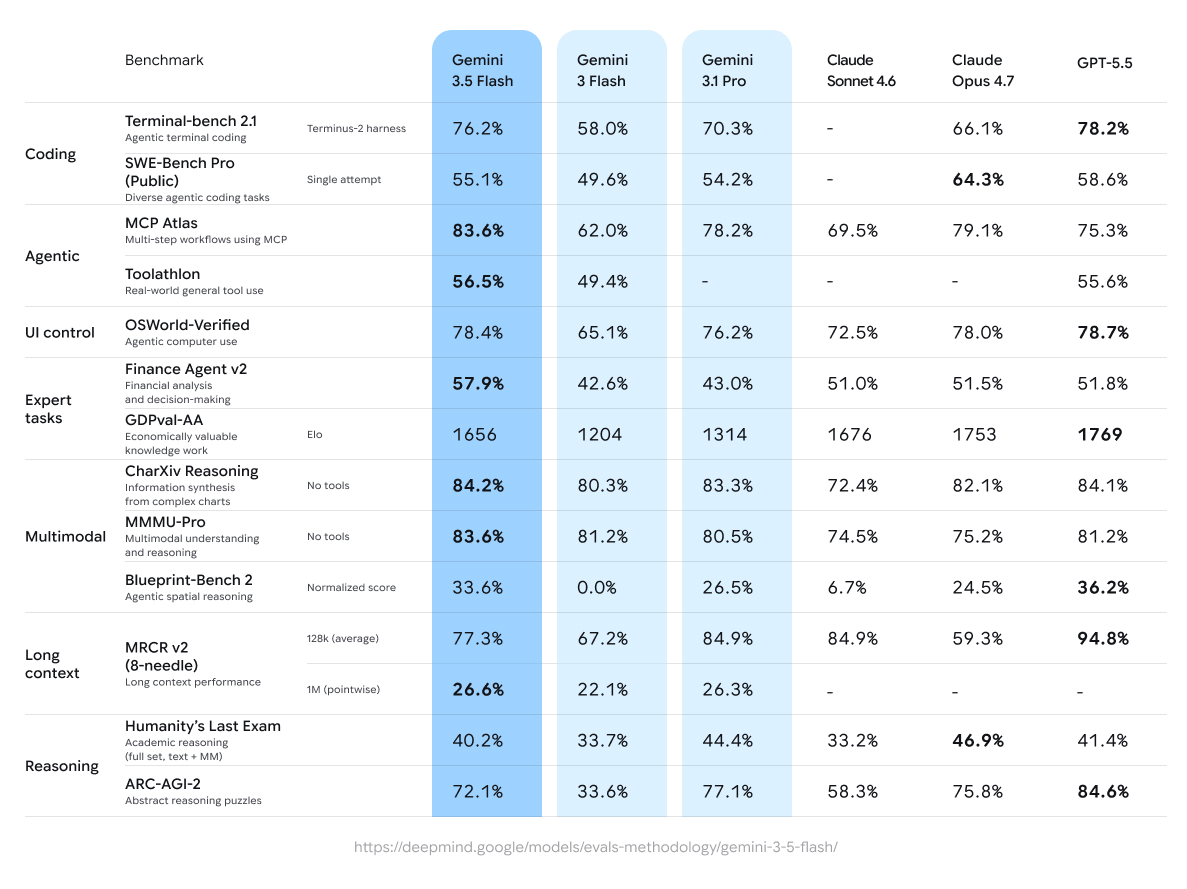
It outperforms Gemini 3.1 Pro on challenging benchmarks like Terminal-Bench 2.1 (76.2%), GDPval-AA (1656 Elo), and MCP Atlas (83.6%), while leading in multimodal understanding with 84.2% on CharXiv Reasoning , and it does all of this at 4x the output token speed of other frontier models. That combination of quality and throughput is what makes this release worth paying attention to.
What broke the Flash ceiling?
Google broke one of the unwritten rules of AI model releases: the cheap, fast Flash tier now outperforms the previous flagship Pro model on coding and agentic benchmarks. 3.5 Flash scores 76.2% on Terminal-Bench 2.1 while running 4x faster than comparable frontier models , and it costs less than Gemini 3.1 Pro.
Unlike models that bolt vision onto a text foundation, Gemini 3.5 Flash was built multimodal from the ground up. It can analyze complex charts and extract quantitative insights, understand the spatial relationships in images and video frames, process audio for transcription or reasoning tasks, and read PDFs structurally rather than just as text streams. The tweet that sparked this article is a perfect illustration: the model watches a reference photo of a lighting setup, reasons about the spatial arrangement of light sources, and generates a fully interactive 3D visualizer from that analysis alone.
The 3.5 generation improves vision-language alignment, meaning the model is better at connecting what it "sees" in an image with the reasoning it applies to that input. Tasks like document parsing from images, chart interpretation, and visual Q&A all benefit from this.
Built for agents, not just answers
The real design shift in 3.5 Flash is the move from single-turn question-answering to long-horizon task execution. This balance of speed and performance makes 3.5 Flash ideal for tackling long-horizon agentic tasks. What used to take a developer days or an auditor weeks, 3.5 Flash can now help complete in a fraction of the time, often at less than half the cost of other frontier models.
The model ships alongside an updated version of Google's Antigravity harness , an orchestration layer that lets you deploy multiple subagents in parallel. It acts as a central home for agent interaction with parallel subagent execution, scheduled tasks for background automation, and integrations into AI Studio, Android, and Firebase. The updated Antigravity harness is co-optimized with 3.5 Flash specifically.
Real enterprise partners are already seeing the impact:
- Ramp is using it for smarter OCR through multimodal understanding of complex invoices combined with reasoning over historical patterns.
- Xero is deploying agents to autonomously manage complex, multi-week workflows, such as identifying suppliers and gathering information for 1099 tax forms.
- Databricks is using agentic workflows to monitor and retrieve real-time information, reason across massive datasets to diagnose issues, identify fixes, and propose solutions for data scientists.
- Box reports that 3.5 Flash beat Gemini 3 Flash by 19.6% on their enterprise work evaluation set, and Life Sciences customers are seeing 96.4% greater accuracy in data extraction and calculations.
What it's good at , and where it falls short
The model's strengths cluster tightly around a few domains:
- Agentic coding: multi-step tool use, codebase refactoring, terminal operations
- Visual-to-code generation: turning images, sketches, or screenshots into functional UI
- Multimodal document processing: invoices, charts, PDFs with structured extraction
- High-volume pipelines: the speed advantage compounds at scale
The trade-off is real: 3.5 Flash gives up ground on academic reasoning and dense long-context recall. If your workload is a hard question answered in one turn, stay with 3.1 Pro or wait for 3.5 Pro. If your workload is a multi-step agent that has to plan, call tools, and finish a real task, 3.5 Flash is the new default.
Limitations like regressions in long-context retrieval and verbosity in reasoning-heavy tasks require manual oversight for precision-critical applications. It also inherits all Gemini 3 family capabilities except Computer Use , direct desktop/OS interaction remains unavailable.
The pricing math
Pricing is $1.50 input / $9.00 output per 1M tokens, with cached input at $0.15. Non-global regions are priced at $1.65 / $9.90. That's a 3x jump from Gemini 3 Flash ($0.50/$3), but still 40% cheaper on input and 40% cheaper on output than Gemini 3.1 Pro at $2.50 / $15.
The 90% cache discount makes long agent contexts the dominant cost lever, not per-request input. For agent harnesses that re-use system prompts across many tool turns, the effective rate drops dramatically. For teams running high-frequency agentic loops, the economics are genuinely compelling.
One important nuance: "Flash" used to mean cheap. Gemini 3.5 Flash is fast and capable, not cheap , it costs six times more per token than the Flash-Lite model it sits above, and a reasoning-heavy workload can cost more end-to-end than Gemini 3.1 Pro. Benchmark your actual workload before committing.
How to use it today
Distribution covers the Gemini app, AI Mode in Search, Gemini API, Google AI Studio, Android Studio, Google Antigravity, Vertex AI, and Gemini Enterprise Agent Platform.
The API model ID is gemini-3.5-flash , no preview suffix, stable from day one.
Here's the minimal setup to get started via the Gemini API:
import google.generativeai as genai
genai.configure(api_key="YOUR_API_KEY")
model = genai.GenerativeModel("gemini-3.5-flash")
# Vision-to-code: pass an image and ask for interactive output
with open("lighting_reference.jpg", "rb") as f:
    image_data = f.read()
response = model.generate_content([
    {"mime_type": "image/jpeg