
Google's Gemini Enterprise Agent Fixes RAG's Worst Flaw With 34% Accuracy Boost
Google's new multi-agent RAG framework keeps searching until it has enough context, boosting factuality accuracy by up to 34% over standard RAG.
Takeaways
- Google Research and Google Cloud launched an agentic RAG framework inside the Gemini Enterprise Agent Platform.
- Multi-agent workflow with Orchestrator, Planner, Query Rewriter, Search Fanout, and Sufficient Context agents.
- Improves accuracy on factuality datasets by up to 34% over standard RAG.
- Hits 93.61% accuracy on FramesQA single-corpus, 90.1% cross-corpus.
- Sufficient Context Agent inspects retrieved snippets, draft answer, and gaps before responding.
- Available now as a public preview offering for enterprise customers.
Standard retrieval-augmented generation has a stubborn failure mode: when the first search returns partial results, the model either hallucinates or gives up. Google Research and Google Cloud just shipped a fix in the form of an agentic RAG framework that plans, searches, checks its own work, and loops back for more information when the evidence is thin.
The system is now available as a public preview inside the Gemini Enterprise Agent Platform under the Cross-Corpus Retrieval feature. Compared to standard RAG, the framework increases accuracy on factuality datasets by up to 34%, and it can route queries across multiple unrelated corpora without a meaningful latency penalty.
Why vanilla RAG breaks on real enterprise questions
Current single-step RAG systems weren't designed for the multi-source, multi-hop queries of modern business workflows. Ask something like "What are the specs of the server used in Project X?" and a typical pipeline retrieves the Project X docs, sees a server ID, and stops. It won't know to take that ID and perform a second search in another database to find the specs, so you get a half answer or a "not found."
The agentic version treats retrieval less like a single lookup and more like a small research team that decomposes the question, dispatches parallel searches, and refuses to answer until the evidence actually covers the prompt.
The agents and how they hand off work
The pipeline replaces the monolithic retriever with specialized roles:
- Orchestrator / Root Agent: parses the request and decides it needs delegation.
- Planner Agent: maps information pathways, deciding for example to check the finance database first, then project management logs.
- Query Rewriter: turns vague prompts into multiple targeted search strings.
- Search Fanout Agent: sends those queries out to retrieval sources in parallel.
- Sufficient Context Agent: the new piece, which decides whether to answer or keep searching.
- Synthesis Agent: writes the final grounded response.
The real innovation: knowing when you don't know enough
The differentiator is persistence. The framework knows when it is missing information and continues searching until the context is complete. This prevents the AI from guessing when the first search comes up empty, or from simply saying, I don't have enough information.
The Sufficient Context Agent, which builds on earlier Google Research on sufficient context, inspects three things before letting a response through: the actual retrieved text chunks, an intermediate draft answer, and a gap analysis of what is still missing. Crucially, it does not just flag "insufficient." It writes a specific feedback log like "You found meds and diet, but you missed allergies. Go back and search specifically for 'rashes' or 'adverse events'." That feedback feeds the Query Rewriter for another iteration.
Benchmark results on FramesQA
Google tested the system on FramesQA, a multi-hop question answering benchmark from the FRAMES paper. The benchmark has 824 queries along with a corpus containing 2,676 PDF documents. An example query asks which of the two most-watched TV finales ran longest, requiring the system to identify M*A*S*H and Cheers, look up their runtimes, then do arithmetic.
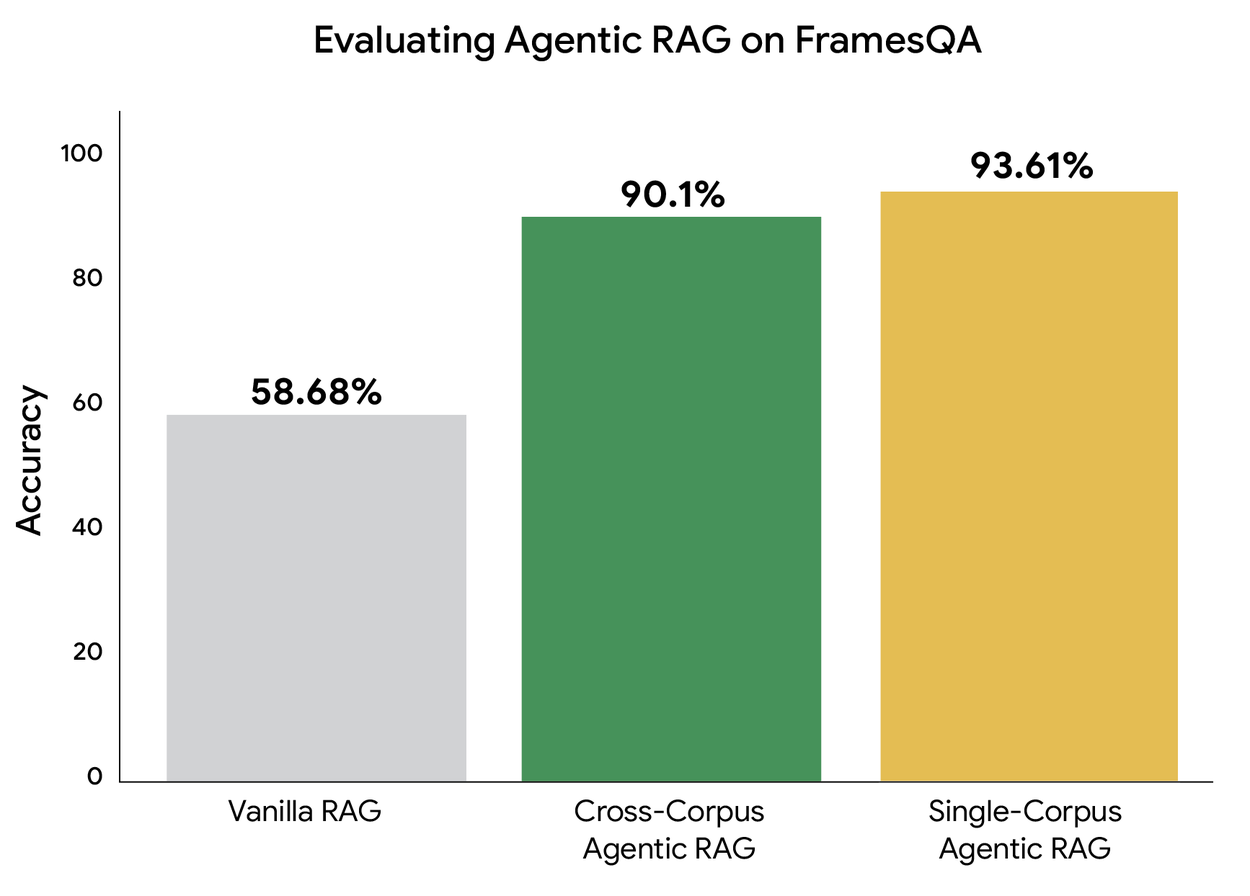
Against Google's production RAG Engine baseline, the agentic version jumped from 58.68% to 93.61% accuracy on the single-corpus setting. The harder test was cross-corpus: three other distracting datasets were added, and the Planner Agent had to determine where to retrieve from. This cross-corpus setting mimics use cases where companies have databases managed by separate teams.
Even when the Planner Agent must select the correct corpus out of 4 possibilities, the system answers 90.1% of questions correctly. The latency of both single- and cross-corpus versions is about the same, within 3% on average. This demonstrates that the Agentic RAG system can reason over multiple, unrelated data sources.
When this actually helps you
The framework targets workloads where vanilla RAG quietly underperforms:
- Multi-hop queries that chain facts across documents, like "find the server ID, then look up its specs."
- Cross-corpus retrieval where data lives in separate systems owned by different teams.
- High-stakes domains like clinical, legal, or financial QA where a "don't know" answer is preferable to a confident guess but a grounded answer is even better.
- Compliance and audit scenarios. By combining advanced query planning, routing, and sufficient context, the system ensures that AI-generated responses are auditable, traceable, and grounded.
The tradeoff is the obvious one for any agent loop: more LLM calls per query than vanilla RAG. For latency-sensitive chatbots that mostly answer single-hop questions, plain RAG is still the right tool. For internal copilots digging through fragmented enterprise data, this is the kind of pipeline that turns "not found" into a usable answer.