
Google's Gemini Spark Runs 24/7 to Book, Order, and Design for You
Gemini gains MCP-powered connections to Canva, OpenTable, and Instacart as Google's new Spark agent prepares to act on your behalf across the web
Takeaways
- New app integrations: Gemini now connects to Canva, OpenTable, and Instacart via MCP, enabling real actions like bookings and grocery orders.
- Gemini Spark launched: A 24/7 cloud AI agent that runs on Google's servers even when your device is off, handling multi-step tasks autonomously.
- 900M users: Gemini more than doubled its monthly active users from 400M to 900M in a single year, with daily requests up 7x.
- MCP is the standard: Google adopted Anthropic's open Model Context Protocol, meaning any MCP-compliant service can plug into Spark without custom code.
- More partners coming: Adobe, Samsung, Spotify, GitHub, Notion, and Slack are confirmed MCP integrations arriving summer 2026.
- Ultra subscribers first: Spark beta is limited to U.S. Google AI Ultra subscribers, with broader rollout and local browser control planned later.
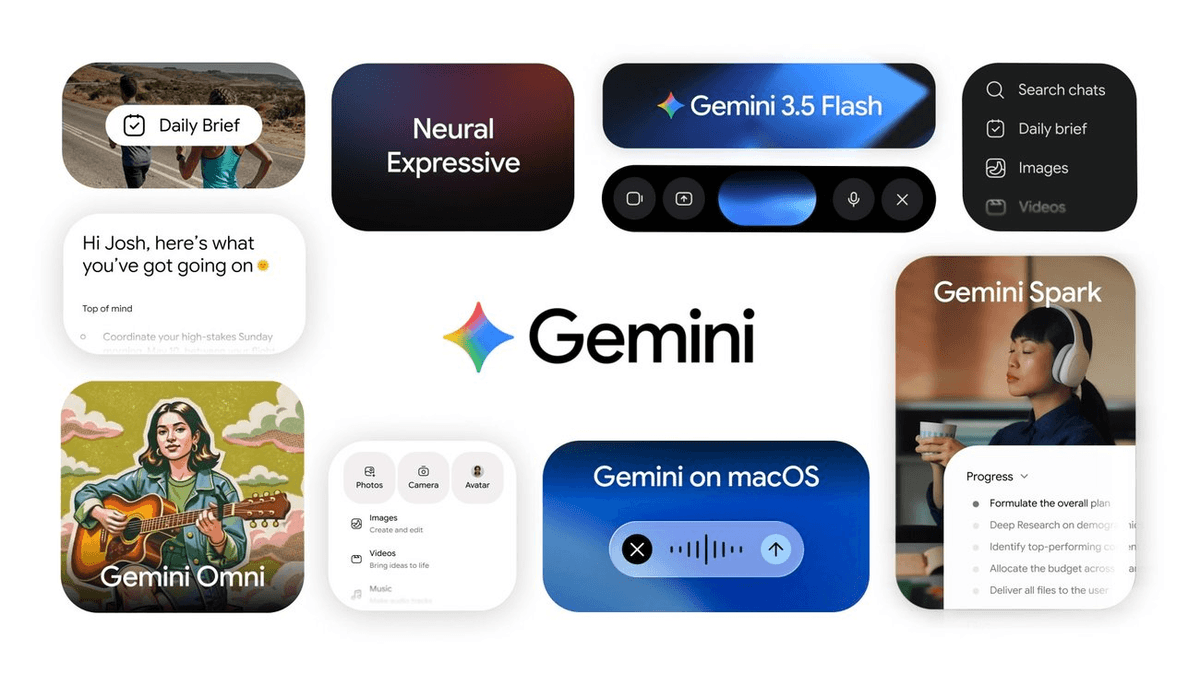
Google's Gemini app just got a lot more hands-on. At Google I/O 2026, the company announced that Gemini can now connect to Canva, OpenTable, and Instacart through the Model Context Protocol (MCP), letting the assistant move beyond answering questions and actually take action inside third-party apps. Book a restaurant, add groceries to a cart, or spin up a design , all without leaving Gemini.
This is part of a much larger shift Google is calling the "agentic Gemini era." The connected app expansion is the most immediately accessible piece of it, but it's really the on-ramp to something bigger: Gemini Spark, a 24/7 cloud-based AI agent that keeps working even after you close your laptop.
The Numbers Behind the Push
Last year at I/O, the Gemini app had 400 million monthly active users. Today, Google has surpassed 900 million , more than doubling in a year , and in that same time, daily requests have grown over seven times. That kind of growth gives Google serious leverage to pull third-party services into its orbit, and that's exactly what the new MCP integrations are designed to do.
Google is now processing more than 3.2 quadrillion tokens per month, a massive jump from 480 trillion tokens per month at Google I/O 2025. The infrastructure is clearly ready. The question was always about the product layer on top of it.
What MCP Actually Means Here
MCP , the Model Context Protocol , is an open standard originally developed by Anthropic that defines how AI agents communicate with external tools and APIs. Think of it as a universal adapter: instead of Google writing a custom integration for every app, any service that builds an MCP-compliant server can plug directly into Gemini.
Because MCP is an open, cross-platform standard now adopted by Anthropic, Google, and other major AI platforms, any developer that builds an MCP-compliant server can make their product accessible to Spark without writing custom integration code for Google specifically. That's a big deal for the ecosystem , it means MCP compliance is quickly becoming a distribution strategy, not just a technical checkbox.
Google is currently rolling out OpenTable (en-US), Canva (en*), and Instacart (en-US), which will become fully available to all eligible users over the next few weeks. And the pipeline is already filling up: Gemini will act as an intelligent orchestrator across a growing network of connected apps, with more partners on the way including Zillow, Adobe, and Box.
Spark: The Agent Behind the Curtain
The connected apps are the user-facing story. The deeper story is Gemini Spark, the always-on agent that will eventually use those connections to act autonomously on your behalf. Spark runs continuously on Google Cloud virtual machines and takes actions across your apps , even when your device is off. Unlike the standard Gemini chatbot, which ends when you close the tab, Spark operates on tasks, skills, and scheduled workflows, handling multi-step jobs without requiring you to be present for each step.
A user can ask Spark to prepare a Canva presentation from notes in Google Docs, make an OpenTable reservation based on context in their inbox, or assemble an Instacart grocery order , tasks that previously required manually switching between apps and entering the same information multiple times.
Spark is built on Gemini 3.5 Flash and runs on Google's Antigravity agent harness. It connects natively to Gmail, Calendar, Drive, Docs, Sheets, Slides, YouTube, and Google Maps. The third-party MCP layer , starting with Canva, OpenTable, and Instacart , extends that reach outside Google's own walls.
Here's a concrete picture of what Spark can do at launch:
- Recurring tasks: Automatically parse monthly credit card statements to flag hidden subscription fees
- Custom skills: Monitor your inbox for school updates, extract deadlines, and send a consolidated digest to you and your partner
- Full workflows: Synthesize meeting notes across emails and chats, create polished Google Docs, and draft the kickoff email , all in one go
- Cross-app actions: Book a restaurant from your calendar context, order groceries from a recipe link, or generate a Canva deck from raw notes
Who Gets It and When
Spark is designed to ask you first before performing high-stakes actions like spending money or sending emails. It will roll out to trusted testers first, with a Beta planned for U.S. Google AI Ultra subscribers shortly after. Adobe, Samsung, Spotify, GitHub, Notion, and Slack are confirmed as additional MCP partners arriving over summer 2026.
On the web side, Canva's connected app has now also appeared on Gemini's browser version, closing a gap that had frustrated users who could access third-party connectors on mobile but not on desktop. Additional capabilities planned for later this year include Chrome integration, texting and emailing Spark directly, custom sub-agents, and local browser control.
The Competitive Stakes
The announcement lands in the middle of intense competition with OpenAI, Anthropic, and Microsoft on how to integrate agents. Google's bet with Spark is different from Claude or ChatGPT Agent: persistent cloud execution combined with deep integration into its own consumer services, from Gmail to Google Slides.
Users can email Spark directly through a dedicated Gmail address, much as they would message a human colleague, and the agent can pull context from Gmail, Google Docs, and other Workspace applications without requiring manual setup. That out-of-the-box connectivity gives Google a structural advantage over rivals whose agents must rely on third-party integrations to access the same services.
By adopting MCP , an open standard now managed under the Linux Foundation's Agentic AI Foundation , Google sidesteps the N×M integration problem that made earlier plugin ecosystems fragile. Any service that builds an MCP-compliant server gains immediate compatibility with Gemini Spark without writing a custom connector, positioning Google as a neutral orchestration hub rather than a walled garden demanding proprietary SDK adoption.
What This Means If You Build Things
For developers and product teams, the signal is clear: MCP compliance is now a distribution strategy. An application that speaks MCP becomes automatically visible to Spark's task routing logic. One that doesn't is invisible to every user operating through an agent layer.
If you maintain a SaaS product, a developer tool, or any kind of API, you no longer need separate integrations for each AI platform. Build once to the MCP spec and you're reachable from Gemini Spark, Claude, and any other agent that adopts the standard. The race to be in the agent's tool belt has started , and the entry ticket is an MCP server.
The connected app rollout is available now for eligible users globally, with Spark's full agentic capabilities following in beta for Ultra subscribers in the U.S. The broader expansion , more partners, local browser control, custom sub-agents , is expected across the summer. Always-on personal AI agents have crossed from enterprise pilot to consumer subscription. The barrier for operators is no longer access or cost , it is workflow design. The teams that get value from Spark will be the ones who can articulate the recurring, low-judgement work worth running overnight.