
Meta's Brain2Qwerty v2 Decodes Thoughts Into Text Without Brain Surgery
Meta's Brain2Qwerty v2 decodes full sentences from brain waves without surgery, hitting 61% word accuracy and releasing all training code publicly
Takeaways
- Brain2Qwerty v2 is Meta's new non-invasive brain-to-text decoder, achieving 61% average word accuracy from MEG brain recordings — no surgery required. Blog
- The system uses a three-stage pipeline: a Conformer encoder for character-level CTC decoding, a word-level aligner, and a fine-tuned Qwen3-4B LLM that reads brain-derived word tokens.
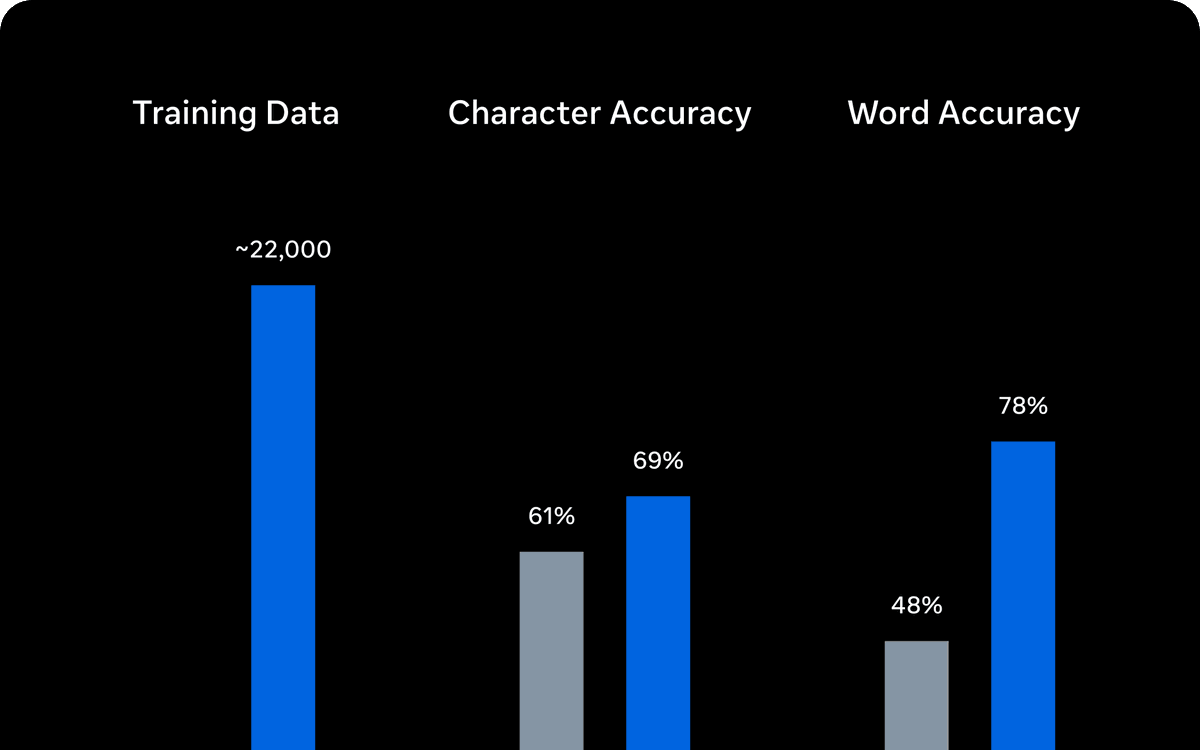
- Best participant hit 78% word accuracy, with over 50% of sentences decoded with ≤1 word error; performance scales log-linearly with data — no saturation yet at 90 hours.
- Autonomous AI coding agents (Claude Opus 4.6 via Cursor) were used to optimize the training pipeline, outperforming classical Bayesian hyperparameter search by ~10 percentage points WER.
- Full training code for v1 and v2 is open-sourced on GitHub; the v1 dataset is available on Hugging Face.
- Key limitations: requires a cryogenic MEG machine, processes full sentences (not real-time word-by-word), and has only been tested on healthy volunteers who can physically type.
For the millions of people who have lost the ability to speak or move after a stroke, ALS, or locked-in syndrome, the only path to communication today runs through brain surgery. Implanted electrode arrays can restore near-natural speech, but they require neurosurgery, carry infection risks, and are nearly impossible to scale to a broad patient population. Brain2Qwerty v2, released today by Meta AI, is the strongest evidence yet that this tradeoff may not be permanent.
Brain2Qwerty v2 is the highest-performing end-to-end pipeline capable of real-time sentence decoding from non-invasive brain recordings, approaching levels of accuracy previously exclusive to techniques that require brain surgery. The v1 paper was simultaneously published in Nature Neuroscience, and Meta is releasing the full training code for both versions alongside a public dataset from their partner, the Basque Center on Cognition, Brain and Language (BCBL).
The problem with reading minds without a scalpel
Brain-computer interfaces (BCIs) that require implanted electrodes have achieved remarkable results. State-of-the-art invasive BCIs achieve below 2% word error rate for typing and below 6% character error rate for handwriting. Despite these breakthroughs, the invasive nature of intracortical implants is a challenge for large-scale clinical translation. Non-invasive alternatives like EEG have historically struggled with a poor signal-to-noise ratio, limiting them to simple, highly-constrained tasks that are impractical for real patients.
Magnetoencephalography (MEG) , a technique that measures the tiny magnetic fields produced by electrical currents in neurons , offers a middle ground. It has much better signal quality than EEG without requiring any implant. Invasive procedures like stereotactic electroencephalography and electrocorticography have shown that a neuroprosthesis feeding signals to an AI decoder can restore communication, but they're difficult to scale. Meta's non-invasive approach can help bridge that gap.
From characters to meaning: what changed in v2
The original Brain2Qwerty (v1) decoded brain signals at the character level, essentially trying to figure out which key a person pressed based on their neural activity. V2 is a fundamentally different beast. Brain2Qwerty v2 is the first architecture that jointly trains the decoding of characters, words, and sentences. It leverages character, word, and sentence-level representations to achieve an average word error rate (WER) of 39%.

The key shift is from synchronous to asynchronous decoding. V1 required knowing exactly when each key was pressed (keystroke timing), then classified one character at a time from that window. V2 uses a Connectionist Temporal Classification (CTC) objective , a technique borrowed from speech recognition that learns to align a continuous input stream to a sequence of labels without needing exact timing information. This means the model can decode from a raw, continuous MEG recording in real-time, without any external cues about when words begin or end.
A three-stage pipeline that teaches an LLM to read brains
The architecture is a three-module pipeline, each trained jointly at a different level of abstraction:
- Encoder (character level): Raw MEG signals pass through a BrainModule (a convolutional feature extractor that handles the variable geometry of MEG sensors across subjects) followed by a four-layer Conformer , a hybrid architecture combining convolutions and self-attention, originally developed for speech recognition. It outputs a sequence of character predictions via CTC.
- Aligner (word level): A CTC tokenizer segments the continuous MEG embeddings into word-sized chunks by detecting where the model predicts a space character. Each chunk is projected into the LLM's word-embedding space using a small MLP, trained with a contrastive loss (SigLIP) that aligns brain-derived word representations with the LLM's own word embeddings.
- LLM (sentence level): A Qwen3-4B model, fine-tuned with LoRA (Low-Rank Adaptation , a technique that trains only a small set of additional parameters rather than the full model), receives both the CTC character predictions and the MEG-derived word tokens, then autoregressively generates the final decoded sentence.

The CTC tokenizer is a clever bridge: because spaces are frequent (19% of characters) and robustly predicted, this segmentation is accurate , the predicted word count of 86% of sentences falls within ±1 word of the ground truth. This gives the LLM word-aligned neural tokens it can actually use, rather than a raw continuous embedding it has no prior for.
An important ablation confirms the LLM is genuinely reading brain signals, not just correcting noisy text. Removing the MEG tokens degrades every metric (CER, WER, SemER), showing that the LLM is actively integrating the MEG-derived word embeddings into its predictions rather than treating them as a redundant copy of the CTC sequence.
How it was trained
The team trained Brain2Qwerty v2 on approximately 22,000 sentences from nine volunteer participants, each recorded for 10 hours wearing a MEG device while actively typing. Participants listened to a sentence through headphones, waited for a cue, then typed it from memory , with no letters shown on screen. This design isolates the language production signal in the brain rather than visual reading.
One surprising finding: sentence diversity matters as much as volume. Encoders trained on non-repeated sentences achieved significantly lower character error rate than those trained on repeated sentences (CER: 0.45 vs. 0.65; p < 0.001), demonstrating that sentence diversity constitutes an independent axis of data quality, distinct from total sample volume.
For LoRA fine-tuning, the team used a technique called Model Soup: train a separate LoRA adapter for each of the nine subjects, then average all their weights into a single model. This avoids overfitting on the small per-subject dataset while still capturing individual neural variation. The final best configuration uses Qwen3-4B with LoRA rank 128 applied to all linear projection matrices.
AI agents that write their own training code
One of the most unusual aspects of this paper is the use of autonomous AI coding agents to optimize the training pipeline , what the team calls "Auto Research." Three independent agents (Cursor powered by Claude Opus 4.6) ran concurrently, each with full filesystem and terminal access to a dedicated git worktree, tasked with minimizing validation WER by iteratively changing the codebase and running experiments.
The results beat classical hyperparameter search. Optuna quickly plateaued at a WER of 0.41 (8.6% relative improvement), while all three Auto Research agents continuously improved, achieving final validation WERs of 0.38, 0.36, and 0.37 (relative improvements of 16–20%). The agents independently discovered techniques like label smoothing, modality dropout (randomly dropping CTC tokens to force the LLM to rely more on MEG embeddings), and beam search decoding. However, the paper is candid about limits: when given an open-ended objective starting from the v1 codebase, the agents consistently failed , large entangled code modifications caused most jobs to crash.
The numbers: promising but not yet clinical
The headline results are the best ever reported for non-invasive brain-to-text decoding:
- 61% average word accuracy (39% WER) across all 9 participants
- 78% word accuracy (22% WER) for the best-performing participant
- More than 50% of sentences decoded with one word error or less for the top participant
- 7x improvement over prior non-invasive methods, which achieved only ~8% word accuracy
- Performance scales log-linearly with data volume with no sign of saturation at 90 hours of total recording
The comparison to invasive systems is sobering but the trend is encouraging. State-of-the-art invasive BCIs achieve below 2% WER for typing, while Brain2Qwerty v2 achieves 39% on average. Still, the scaling curves show no sign of plateauing at 90 hours of aggregated data, suggesting that data collection may be a simple lever for further improvement.
There are real limitations to acknowledge. Large inter-subject variability persists , character error rates range from 17% to 41% across participants. The model is not based on a causal architecture and thus works with an entire sentence, meaning real-time latency is necessarily slow and would not allow users to see words before the end of the sentence. The study was also conducted with healthy volunteers who were actually typing , adapting this to patients who cannot physically press keys, and who would need to train the system without keystroke supervision, remains an open problem.
What this means for the field
The hardware bottleneck is real but shrinking. The current system uses a 306-sensor cryogenic MEG machine , bulky, expensive, and confined to a lab. But the sensor ablation experiments in the paper show that an OPM-class helmet with on the order of 150 sensors loses only ~5.7 percentage points WER versus the full 306-channel baseline, and optically-pumped MEG sensors that work at room temperature are an active area of development. The gap between lab proof-of-concept and wearable device is closing.
The broader implication is a shift in assumptions about what non-invasive BCIs can achieve. For years, the field assumed that surgical implants were the only path to high-accuracy language decoding. Brain2Qwerty v2 suggests that with enough data and the right architecture, the signal in MEG is richer than previously thought , and that the performance gap with invasive systems is at least partially a data problem, not a fundamental signal quality ceiling.
Everything is open. The full training code for both v1 and v2 is on GitHub, the v1 dataset is on Hugging Face, and the v2 paper is publicly available. For neuroscience and BCI researchers, this is a substantial foundation to build on.