
Microsoft's MAI-Code-1-Flash Beats Claude Haiku 4.5 Using 60% Fewer Tokens
Microsoft's first in-house coding model now runs across VS Code, JetBrains, Xcode, Eclipse, Mobile, and Copilot CLI — no extra setup required.
Takeaways
- Wider rollout: MAI-Code-1-Flash now available in JetBrains, Xcode, Eclipse, Mobile, Copilot CLI, and GitHub Chat.
- Microsoft's first in-house model: Built without OpenAI distillation, trained on Copilot's own production harness and real usage telemetry.
- Efficiency-first: 5B active parameters, solves hard coding tasks with up to 60% fewer tokens than Claude Haiku 4.5.
- Strong benchmarks: 51.2% on SWE-Bench Pro (+16 pts over Claude Haiku 4.5) and 85.8% on Microsoft's adversarial reasoning benchmark.
- Free for most plans: Available on Copilot Free, Student, Pro, Pro+, and Max — Business/Enterprise support coming soon.
- Strategic shift: Part of a broader MAI model family, signaling Microsoft's move to own its AI stack rather than license it.
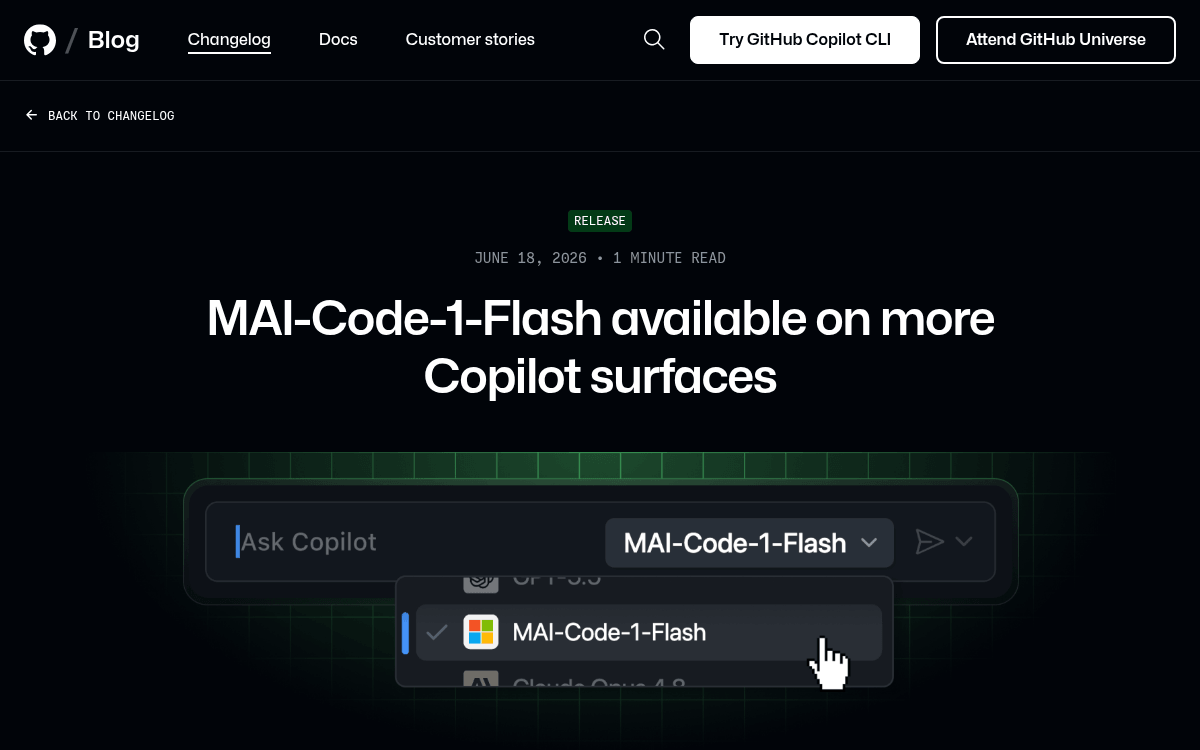
MAI-Code-1-Flash, Microsoft's first homegrown coding model, just got a lot more accessible. Originally launched at Build 2026 with VS Code support only, it now runs across nearly every surface GitHub Copilot touches. If you use Copilot in JetBrains, Xcode, Eclipse, GitHub Mobile, Copilot CLI, or Copilot Chat on GitHub, the model is now available to you.
What makes this model different
Microsoft trained MAI-Code-1-Flash from the ground up on clean, traceable, and enterprise-grade data, without distillation from third-party models. That last part matters: this is not a repackaged OpenAI model. Strategically, Microsoft now has a homegrown coding stack that reduces its reliance on OpenAI and undercuts frontier models on cost.
It is a 5-billion-parameter model trained directly on Copilot production workflows, optimized for the tasks that dominate a developer's day: inline edits, quick refactors, and single-file fixes. The architecture is a sparse Mixture-of-Experts model with 137 billion total parameters and a 256,000-token context window. Because it is sparse MoE, only a fraction of those 137B parameters activate per token, which is how Microsoft hits its efficiency target while keeping a large total capacity.
Trained inside the tool, not just for it
Most coding models are trained on general code, then evaluated against benchmarks, then deployed to tools. MAI-Code-1-Flash inverts that: it was trained inside GitHub Copilot's production harness, not just evaluated against it. The model was trained directly with GitHub Copilot harnesses used in production, allowing it to learn how to interact with surrounding tools and systems in agentic coding tasks, making it uniquely well suited to real-world Copilot workflows.
During training, Microsoft evaluated checkpoints across core software engineering tasks, repository question answering, refactoring, and telemetry-grounded tasks adapted from real GitHub Copilot usage. The payoff is that benchmark gains actually translate to real-world quality, instead of evaporating when the model hits a live codebase.
The efficiency story
The headline capability is adaptive solution length control , the model scales how much it "thinks" based on task complexity. This allows it to remain concise for simple queries while allocating a larger reasoning budget to complex programming challenges. In practice, it uses 60% fewer tokens than comparable models on hard tasks.
On benchmarks run inside the same production harness developers actually use:
- With 5 billion parameters, it beats Claude Haiku 4.5 across coding benchmarks, including a 16-point lead on SWE-Bench Pro.
- It scores 85.8% on Microsoft's adversarial coding benchmark and ~51% on SWE-Bench Pro.
- It outperforms Claude Haiku 4.5 with better price-to-performance across coding benchmarks.
Microsoft also built a custom 186-question adversarial benchmark with inverted classics, impossible tasks, and underdetermined scenarios to test whether the model was actually reasoning or just pattern-matching. MAI-Code-1-Flash reached 85.8% adjusted accuracy , though adversarial categories like Einstellung traps (where prior experience blocks a better solution) remained below 50%, signaling room to grow.
Where it shines, where it doesn't
MAI-Code-1-Flash is purpose-built for the fast, iterative loops of everyday coding:
- Inline edits and single-file changes
- Quick refactors and code cleanup
- Repo question answering
- Agentic multi-step tasks inside Copilot CLI
- Strong instruction-following across single-turn and multi-turn scenarios.
It is not positioned as a frontier reasoning model. For deep architectural decisions, complex multi-file rewrites, or tasks requiring extended reasoning chains, heavier models in the Copilot picker , like Claude Opus or GPT-5.5 , remain better choices. Microsoft's own adversarial benchmark results confirm the model still has blind spots in pure reasoning traps.
Where you can use it now
MAI-Code-1-Flash is now rolling out in GitHub Copilot across the following surfaces:
- VS Code
- Visual Studio
- JetBrains IDEs
- Xcode
- Eclipse
- GitHub Mobile
- Copilot Chat on GitHub
- Copilot CLI
- GitHub Copilot app
MAI-Code-1-Flash is available in Copilot Free, Student, Pro, Pro+, and Max plans. Availability starts with a limited set of users and expands gradually over the coming weeks. Access for Copilot Business and Enterprise is coming soon. No additional setup is required , just open the model picker and select it, or let the Auto picker route tasks to it automatically.
GitHub-listed API pricing is $0.75 input / $4.50 output per million tokens. For Copilot plan subscribers, it counts against your standard AI credits with no premium multiplier, making it one of the most cost-efficient options in the picker.
The bigger picture
Microsoft has spent two years watching Cursor and Claude Code absorb the developer mindshare that GitHub Copilot should have owned by default. Copilot invented the AI pair-programmer category in 2021, had the VS Code integration, had GitHub's codebase signal , and still lost early-adopter developers to whoever had the best model that week. MAI-Code-1-Flash is the first step in a different strategy: instead of licensing the best available model, build one that is native to the environment.
This marks the first in a new wave of purpose-built coding models from Microsoft. The "Flash" suffix implies a larger MAI-Code-1 family is coming. For now, the expansion to eight Copilot surfaces means that for most developers, the default Copilot experience will increasingly be powered by a model Microsoft controls end-to-end , with all the data, iteration speed, and pricing leverage that implies. Check the official supported models docs for the latest availability details.