
Microsoft's MAI-Image-2.5 Hits #2 on Arena Beating Google and xAI
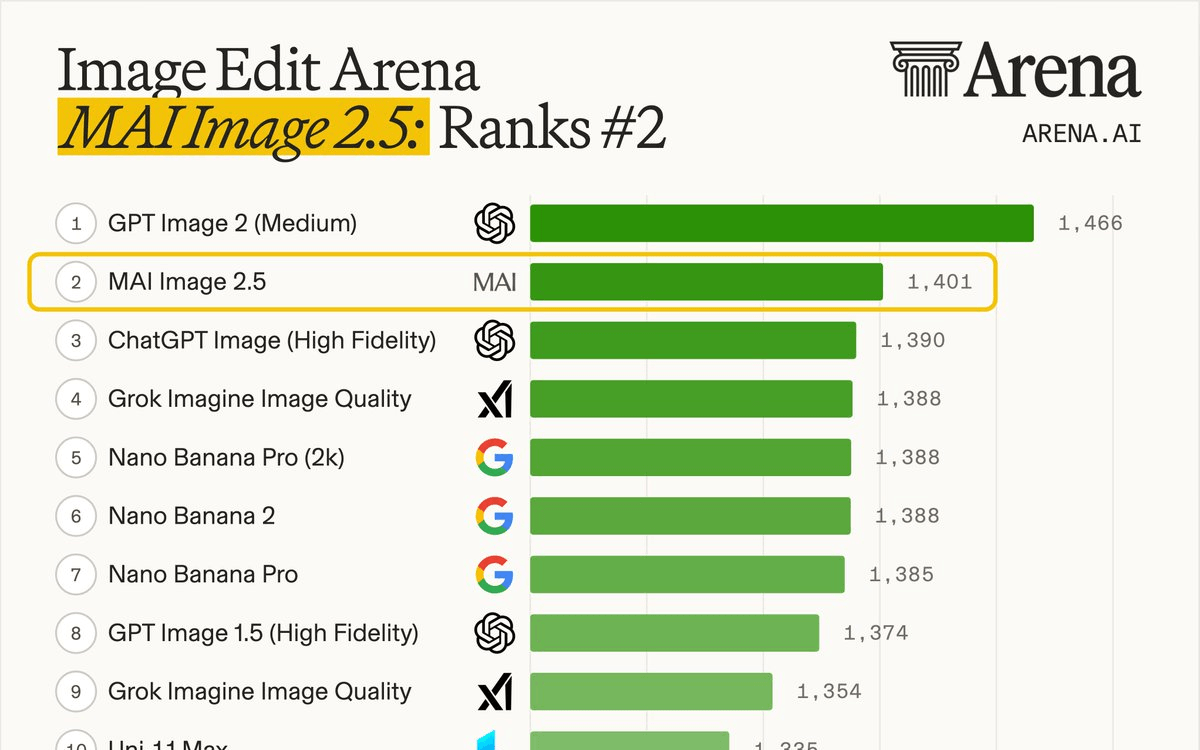
Microsoft's in-house MAI-Image-2.5 debuts at #2 on Arena's image editing leaderboard, beating GPT-Image-1.5 and Google's Gemini models with a 75-point ELO jump over its predecessor.
Takeaways
- MAI-Image-2.5 debuts at #2 on Arena's Image Edit leaderboard with a score of 1401, beating GPT-Image-1.5, Grok Imagine, and Google's Gemini Nano Banana models.
- +75 ELO points over MAI-Image-2, with the biggest gains in Text Rendering (+107) and Cartoon/Anime/Fantasy (+90) categories.
- Two variants launched: full-fidelity MAI-Image-2.5 ($47/1M image output tokens) and MAI-Image-2.5-Flash ($19.50/1M image output tokens) for high-volume workloads.
- Live in Microsoft products now -- PowerPoint for generation, OneDrive for precise photo editing, with billions of potential users.
- Available via Azure AI Foundry, MAI Playground, and OpenRouter through an OpenAI-compatible API.
- Built entirely in-house by Microsoft's MAI Superintelligence team using a diffusion-based architecture, without distillation from other frontier models.
Microsoft's MAI Superintelligence team just made a loud statement in the image generation race. MAI-Image-2.5 launched and immediately landed at #2 on Arena's Image Edit leaderboard with an ELO score of 1401, sitting just 64 points behind OpenAI's gpt-image-2 and beating out xAI's Grok Imagine, Google's Gemini Nano Banana 2, and OpenAI's own ChatGPT-Image-Latest. For a team that only shipped its first image model in October 2025, this is a remarkable trajectory.
What the Arena leaderboard actually measures
Before diving into the model, it's worth understanding why the Arena score matters. Arena.ai uses a head-to-head evaluation system where users see two images generated from the same prompt with no labels showing which model produced which, then vote for the one they prefer. Over thousands of votes, this produces an Elo-style leaderboard similar to chess rankings. Models can't game their own benchmark, and it captures what humans actually prefer, not pixel-level metrics. With over 27 million votes and 49 models on the image edit leaderboard, it's the most credible crowd-sourced signal in the field.
A 75-point jump in one generation
MAI-Image-2.5 is the third generation in the line, following MAI-Image-1 and MAI-Image-2. It posts a +75 point overall gain over MAI-Image-2 on Arena, with the largest jumps in Text Rendering (+107) and Cartoon, Anime & Fantasy (+90). Those are not incremental improvements. Text rendering has historically been a weak spot for diffusion models, and a 107-point jump in that category alone signals a meaningful architectural or training advance.
Developed internally by Microsoft's Superintelligence Team, MAI-Image-2.5 follows a diffusion-based generative approach and belongs to the broader MAI ecosystem, which prioritizes clean, appropriately licensed training data and high-efficiency inference. Critically, unlike many of Microsoft's previous image tools that relied on third-party foundations, MAI-Image-2.5 was built without distillation from other frontier models.
What it can actually do
MAI-Image-2.5 is a text-to-image generation and image-to-image editing model designed to create high-quality, visually rich images from natural language prompts and to perform precise, controllable edits on existing images. The editing side is where it gets interesting for production use cases:
- Image-to-image editing supports precise, localized changes -- replacing an object, updating text, or removing motion blur -- without altering the rest of the image.
- It preserves facial identity across edits, keeping a recognizable likeness through pose and expression changes.
- It introduces "control with preservation" capabilities including identity and character consistency across stylization, pose, and layout, and structured document and diagram generation that produces PowerPoint-ready visuals and slides.
- The model understands scene structure, lighting, scale, and spatial relationships, helping it make edits that fit the image context, such as adding an object with the right perspective and shadows.
Two tiers, one API
Microsoft ships two builds: MAI-Image-2.5 for maximum fidelity, and MAI-Image-2.5-Flash for faster, more cost-efficient production workloads. The pricing reflects that split clearly:
| Model | Text Input (per 1M tokens) | Image Input (per 1M tokens) | Image Output (per 1M tokens) |
|---|---|---|---|
| MAI-Image-2.5 | $5.00 | $8.00 | $47.00 |
| MAI-Image-2.5-Flash | $1.75 | $1.75 | $19.50 |
The model is available through Azure AI Foundry, the MAI Playground, and OpenRouter -- meaning you can call it through the same OpenAI-compatible API you're already using. No SDK changes required.
Already inside Microsoft's products
This isn't a research preview sitting behind a waitlist. MAI-Image-2.5 is live on PowerPoint for high-quality image generation and rolling out to OneDrive for precise editing. In PowerPoint, users can generate presentation-ready visuals and slides from prompts, turning ideas into polished decks faster. The OneDrive integration focuses on photo cleanup -- removing distractions, fixing backgrounds -- without touching the rest of the scene. With Office's user base in the billions, this is a massive distribution advantage that no startup competitor can replicate.
The bigger picture: Microsoft building its own stack
The speed of this release is the real story. Microsoft announced its first in-house voice model (MAI-Voice-1) and its first text model preview (MAI-1-preview) in August 2025. MAI-Image-1 followed in October. Now, five months later, the second image generation model is placing in the top three on the most widely cited crowd-sourced image leaderboard in the field.
That cadence suggests the superintelligence team is moving at a different pace from Microsoft's historically slower consumer product cycles, and doing so with hardware and infrastructure it increasingly owns rather than rents from OpenAI. The announcement also mentions that the team's next-generation GB200 compute cluster is now operational, a reference to NVIDIA's Blackwell-architecture hardware. That's the same chip generation powering the most capable training runs in the industry right now.
For developers evaluating image models, the practical question is whether #2 on Arena translates to #1 for your specific workload. MAI-Image-2.5's strongest categories are text rendering, product photography, and localized editing -- if those match your use case, this is worth a serious look. If you need the absolute ceiling on photorealism or complex multi-character scenes, the leaderboard shows gpt-image-2 still holds a 64-point lead. The Flash variant, at roughly 40% of the cost of the full model on image output, makes the cost-performance tradeoff particularly compelling for high-volume pipelines like e-commerce catalog generation or marketing asset automation.
You can try both variants today in the MAI Playground or deploy them directly via Azure AI Foundry.