
Microsoft's MAI-Thinking-1 Beats Claude Without Borrowing a Single Token
Microsoft launches seven in-house AI models at Build 2026, spanning reasoning, code, image, transcription, and voice — all built without distillation from other labs
Takeaways
- Seven new MAI models launched at Build 2026: reasoning, coding, image, transcription, and voice — all trained from scratch, no distillation from other labs. Read more
- MAI-Thinking-1 is a 35B-active MoE reasoning model that beats Claude Opus 4.6 on SWE-Bench Pro and scores 97% on AIME 2025, in private preview on Microsoft Foundry.
- MAI-Code-1-Flash outperforms Claude Haiku 4.5 on every coding benchmark tested, uses 60% fewer tokens, and is already rolling out in GitHub Copilot for VS Code users.
- MAI-Transcribe-1.5 transcribes 1 hour of audio in under 15 seconds, ranks #1 on FLEURS across 43 languages, and adds keyword biasing that cuts WER by 30%.
- MAI-Image-2.5 ranks #2 on Arena for image editing; Flash variant priced at $1.75/1M text tokens. Both are live in PowerPoint and rolling out on OneDrive.
- Frontier Tuning lets enterprises train MAI models on their own workflows via RL environments; a tuned Excel model matches GPT 5.4 at 10x lower cost.
Microsoft just made its most significant bet yet on building AI from scratch. At Build 2026, the company's MAI lab unveiled seven new models spanning every major modality: reasoning, coding, image generation, transcription, and voice. The headline is not just the models themselves , it is the philosophy behind them. Every single one was trained from the ground up on clean, traceable data, with zero distillation from third-party models like GPT or Claude.
The new MAI model family forms a multimodal ecosystem designed to work across the kinds of tasks that matter in the real world. And unlike most of the industry's recent launches, Microsoft does not distill from other labs and does not rely on unlicensed or opaque data , every component of the system, from architecture to training pipeline to post-training, was built in-house.
The flagship: a reasoning model that punches above its weight
MAI-Thinking-1 is a 35B-active, approximately 1-trillion-total-parameter sparse Mixture of Experts model , a smaller inference footprint than much larger models. Despite this, it is toe-to-toe with Claude Opus 4.6 on SWE-Bench Pro. Mixture of Experts (MoE) is an architecture where only a subset of the model's parameters are active for any given input, making it much cheaper to run than a dense model of equivalent total size.
MAI-Thinking-1 matches leading models on key software engineering benchmarks, demonstrates advanced mathematical reasoning capabilities, and is preferred to Sonnet 4.6 in blind human side-by-side evaluations. On math, it reaches 97.0% on AIME 2025 and 94.5% on AIME 2026, showing strong mathematical and scientific reasoning for its weight class.
MAI-Thinking-1 supports long context with a 256k token window , enough to fit a 600-page document , along with function calling and compatibility with the widely used Chat Completions API. It is available in private preview on Microsoft Foundry today, with a public preview on the MAI Playground coming soon.
The coding model already inside your IDE
MAI-Code-1-Flash is rolling out to GitHub Copilot individual users in Visual Studio Code in the model picker and under the default auto picker. This is the most immediately tangible part of the launch for most developers , you may already be using it without knowing it.
The benchmark numbers are striking. MAI-Code-1-Flash outperforms Claude Haiku 4.5 across all core coding benchmarks tested, with higher pass rates on all four evaluations, including a +16-point lead on SWE-Bench Pro (51.2% vs. 35.2%). More importantly, it solves harder problems with up to 60% fewer tokens on SWE-Bench Verified, proving that higher accuracy and greater efficiency are no longer a trade-off.
The efficiency story is worth unpacking. The model was trained with adaptive solution length control, which helps it adjust the depth of its response to the task , staying concise for simpler requests and spending more reasoning budget when a problem requires deeper analysis or broader code changes. In practice, this means faster responses and lower costs for high-volume agentic workflows.
One honest limitation: adversarial categories like Einstellung traps , where a familiar problem-solving approach blocks a better solution , remained below 50% accuracy. The model is strong at real-world coding tasks but still struggles with certain adversarial reasoning patterns.
Transcription that actually keeps up
MAI-Transcribe-1.5 is now being integrated into Copilot, Teams, GitHub, and Dynamics 365 Contact Centre , and it is also available in Foundry, where it is the fastest, most efficient and most cost-effective transcription model of any hyperscaler.
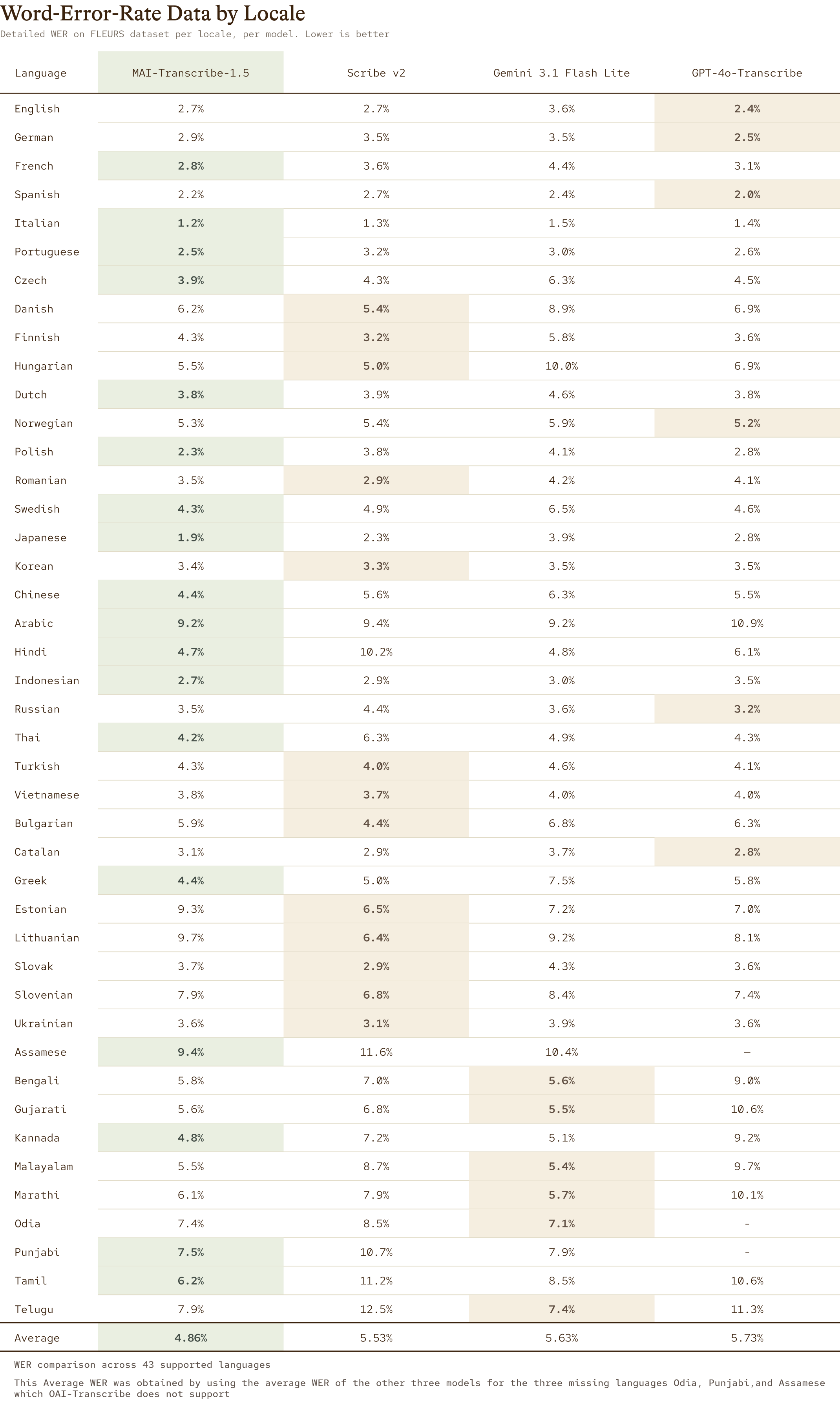
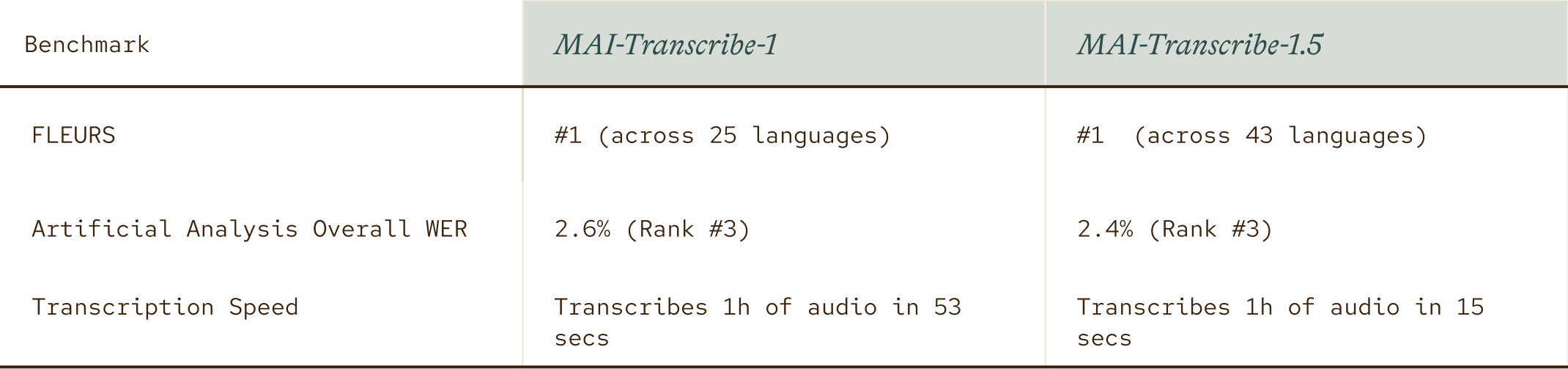
The speed numbers here are genuinely impressive. MAI-Transcribe-1.5 can transcribe an hour of audio in under 15 seconds , up to five times faster than Gemini 3.1, Scribe v2, and GPT-4o-Transcribe on long audio. It achieves best-in-class Word Error Rate across 43 languages on FLEURS, the standard multilingual benchmark, having expanded coverage from 25 to 43 languages without compromising accuracy.
The standout new feature is keyword biasing. MAI-Transcribe-1.5 can bias its predictions toward a list of domain-specific keywords provided by the user , the model does not blindly force matches, but uses shared context to decide when keyword biasing should apply. This results in a 30% reduction in Word Error Rate on the FLEURS multilingual benchmark. For enterprises dealing with product names, medical terminology, or internal acronyms, this is a meaningful practical improvement.
The rest of the family
The other four models round out a genuinely broad multimodal portfolio:
- MAI-Image-2.5 and its Flash variant support both text-to-image and image editing, ranking #2 on Arena for image editing and #3 for text-to-image. The Flash variant is priced at $1.75 per 1M text input tokens and $19.50 per 1M image output tokens. Both are live in PowerPoint and rolling out on OneDrive.
- MAI-Voice-2 brings expressive text-to-speech across 15 languages with emotion controls (excited, whispered, embarrassed, and more), stable speaker identity across long-form content, and code-switching for Hindi-English and Spanish-English. It was preferred over MAI-Voice-1 in 72% of internal evaluations. A Flash variant optimized for real-time agents is coming soon.
The real story: a lab built to keep climbing
The deeper narrative here is not any single model , it is the infrastructure Microsoft is building to keep improving. Microsoft calls this approach Frontier Tuning: reinforcement learning environments that allow MAI models to learn directly from your workflows, described as training gyms for AI, accessible only to you.
The early results are striking. Across Microsoft and with customers, Frontier Tuning is showing that a MAI-tuned model for Excel matches GPT 5.4 while being up to 10x more efficient. That is the core promise: custom models that are simultaneously better for your specific domain and cheaper to run.
Safety is trained with the same reinforcement learning infrastructure used for capability, so safety rewards are part of the same hill-climbing loop , ensuring safety is always aligned to the capabilities and not incidental. This is a meaningful architectural choice: rather than bolting safety on top of a capable model, it is baked into the same training loop from the start.
Where to access everything
All models are available on Microsoft Foundry, with multimodal models live on OpenRouter today. The Thinking model is coming soon to OpenRouter, Fireworks, and Baseten. Developers can also try models directly in the MAI Playground. MAI-Code-1-Flash requires no setup , it is already rolling out through GitHub Copilot's auto picker in VS Code. MAI-Transcribe-1.5 is available via the Foundry API with a full cookbook and model card published.
The "zero distillation" framing is a direct challenge to the rest of the industry. Most smaller labs and many larger ones have built on top of OpenAI or Anthropic outputs at some point. Microsoft is now explicitly positioning itself as one of the few players training frontier-quality models entirely on its own , and publishing the technical details to prove it.