
Nous Research's Hermes Agent Lets Anyone Schedule AI Automations Without Cron Syntax
Hermes Agent's new Automation Blueprints turn raw cron jobs into conversational, fillable workflows — no cron syntax needed, any platform supported.
Takeaways
- Automation Blueprints launched: Hermes Agent now offers ready-to-run automation templates — pick one, fill fields, Hermes schedules it.
- No cron syntax needed: Works via dashboard form,
/blueprint <name>in any messenger, or inline CLI flags. - 5 categories covered: Dev workflow, DevOps/monitoring, research intelligence, GitHub event automations, and business ops.
- 3 trigger types: Scheduled cron, GitHub webhook events, and external API calls — all delivering to 20+ platforms.
- Blueprints are extensible skills: Anyone can write and publish a Blueprint via the agentskills.io Skills Hub.
- Free and open-source: MIT license, model-agnostic, no telemetry — installs with one curl command on macOS, Linux, or WSL2.
Hermes Agent, the open-source self-improving AI agent from Nous Research, just shipped a feature that closes the gap between "I want to automate this" and actually having it running: Automation Blueprints. The idea is simple but impactful , instead of writing cron expressions and prompt strings from scratch, you pick a pre-built Blueprint, fill in a few fields, and Hermes schedules the whole thing for you.
The announcement landed with nearly 403K views on X, which signals this hit a nerve. Cron-based automation has always been powerful in theory, but the setup friction , writing self-contained prompts, remembering cron syntax, wiring up delivery targets , kept it squarely in power-user territory. Blueprints are Nous Research's answer to that.
Cron jobs, but make them conversational
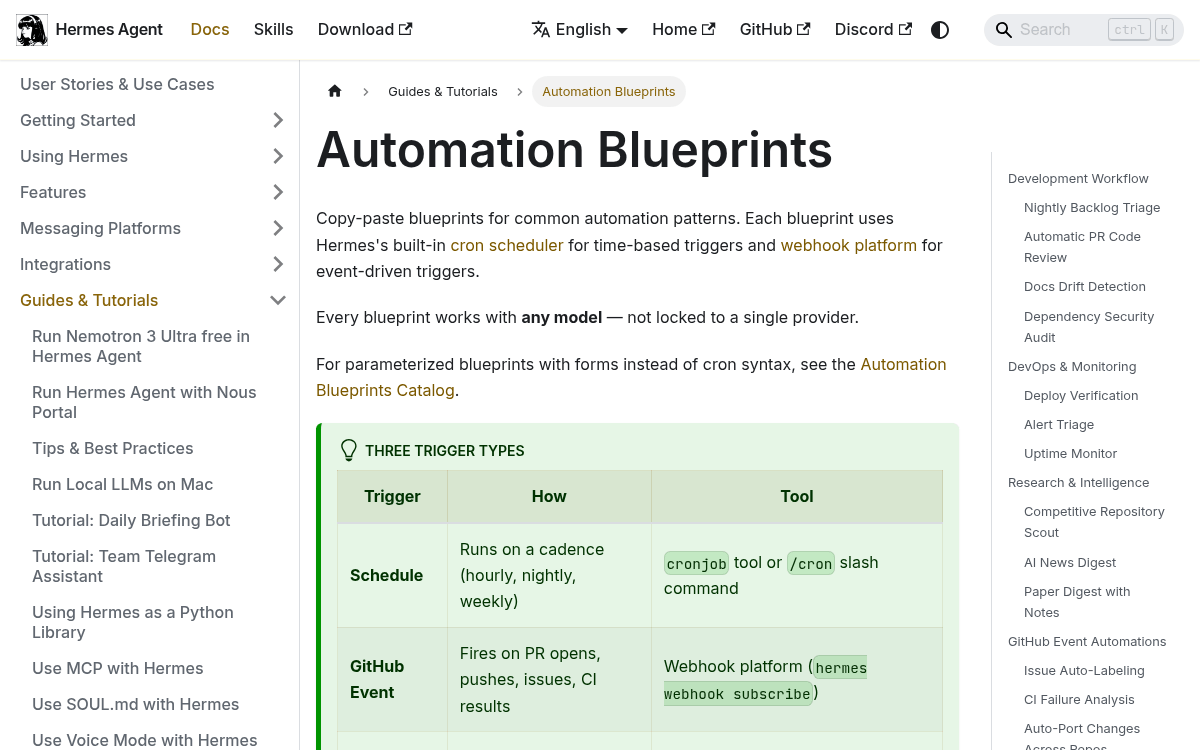
Automation Blueprints are ready-to-run automations: pick one, fill in a couple of fields, and Hermes schedules it as a cron job , no cron syntax required. The interface adapts to wherever you're working:
- In the dashboard or desktop app, open the Cron page, switch to the Blueprints tab, fill the form, and click "Schedule it."
-
From the CLI, TUI, or any messenger, type
/blueprint <name>(e.g./blueprint morning-brief) and Hermes asks you for what it needs, one question at a time, then schedules it. The name match is forgiving , a prefix or near-spelling resolves. -
Power users can skip the questions entirely by passing values inline:
/blueprint morning-brief time=08:00.
Blueprints never schedule anything silently , you always confirm before the job is created. That's a small but important detail: it's opt-in automation, not surprise automation.
What's actually in the catalog
The Blueprint catalog covers five major categories, each with copy-paste-ready recipes. Here's a breakdown of what's available:
- Development Workflow , nightly backlog triage, automatic PR code review posted as GitHub comments, docs drift detection, dependency security audits
- DevOps & Monitoring , deploy verification triggered by CI/CD webhooks, alert triage from Datadog/PagerDuty/Grafana, uptime monitoring every 30 minutes with
[SILENT]suppression on clean runs - Research & Intelligence , daily arXiv paper digests saved to Obsidian, weekly AI news roundups, competitive repo scouting across rival GitHub projects
- GitHub Event Automations , auto-labeling new issues, CI failure analysis posted to PRs, auto-porting changes across repos on merge
- Business Operations , Stripe payment monitoring, morning revenue briefings
Each Blueprint supports three trigger types: scheduled (cron cadence), GitHub event (webhooks on PRs, pushes, issues), and API call (any external service POSTing JSON to your endpoint). All three support delivery to Telegram, Discord, Slack, SMS, email, GitHub comments, or local files.
The [SILENT] pattern is the real UX win
One of the cleverest design choices here isn't the Blueprints themselves , it's the [SILENT] convention baked into every template. When a cron job's response contains [SILENT], delivery is suppressed entirely. So a monitoring job that runs every 30 minutes only pings you when something is actually wrong. No noise, no alert fatigue.
Here's what a minimal uptime monitor looks like in practice:
hermes cron create "every 30m" \
  "If the script reports OUTAGE DETECTED, summarize which services are down.
   If NO_ISSUES, respond with [SILENT]." \
  --script ~/.hermes/scripts/check-uptime.py \
  --name "Uptime monitor" \
  --deliver telegram
The Python script handles the mechanical HTTP checks; the agent only gets invoked to reason about the output. This separation , keeping execution clean and persistent , is central to how Hermes is architected.
Under the hood: Blueprints are just skills
A Blueprint is just a skill with a metadata.hermes.blueprint block in its SKILL.md frontmatter.
That means the same community infrastructure that powers the agentskills.io Skills Hub applies here , anyone can write and publish a Blueprint. The extensibility is built in from day one, not bolted on.
This also means Blueprints inherit everything Hermes already does well:
- Every template works with any model , not locked to a single provider.
- A closed learning loop with agent-curated memory, autonomous skill creation, and FTS5 cross-session recall with LLM summarization.
- Runs across 20+ messaging platforms from a single gateway , Telegram, Discord, Slack, WhatsApp, Signal, Matrix, Email, SMS, and more.
Who this is actually for
The honest answer is: anyone who has ever thought "I should automate this" and then didn't.
Natural-language scheduling for reports, backups, and briefings runs unattended through the gateway, focused every time.
The Blueprints lower the floor dramatically , you don't need to know what 0 9 * * 1 means to set up a Monday morning digest.
For teams, the GitHub event automations are particularly compelling. Automatic PR reviews, CI failure analysis posted directly as comments, and issue auto-labeling are the kinds of things that usually require dedicated bots or paid SaaS tools. Here they're a single /blueprint command away.
Hermes Agent is an open-source autonomous AI agent built by Nous Research. It's not a coding copilot tethered to an IDE or a chatbot wrapper around a single API , it lives on your server, remembers what it learns, and gets more capable the longer it runs. All data stays on your machine. No telemetry, no tracking, no cloud lock-in. Blueprints are free to use under the MIT license, and the agent itself installs with a single curl command.