
Singapore's Agnes AI Builds a Reasoning Model That Uses 72% Fewer Tokens
Agnes AI's new reasoning model scores 39 on the intelligence index with top-tier coding performance, at just $0.45/$0.90 per 1M tokens
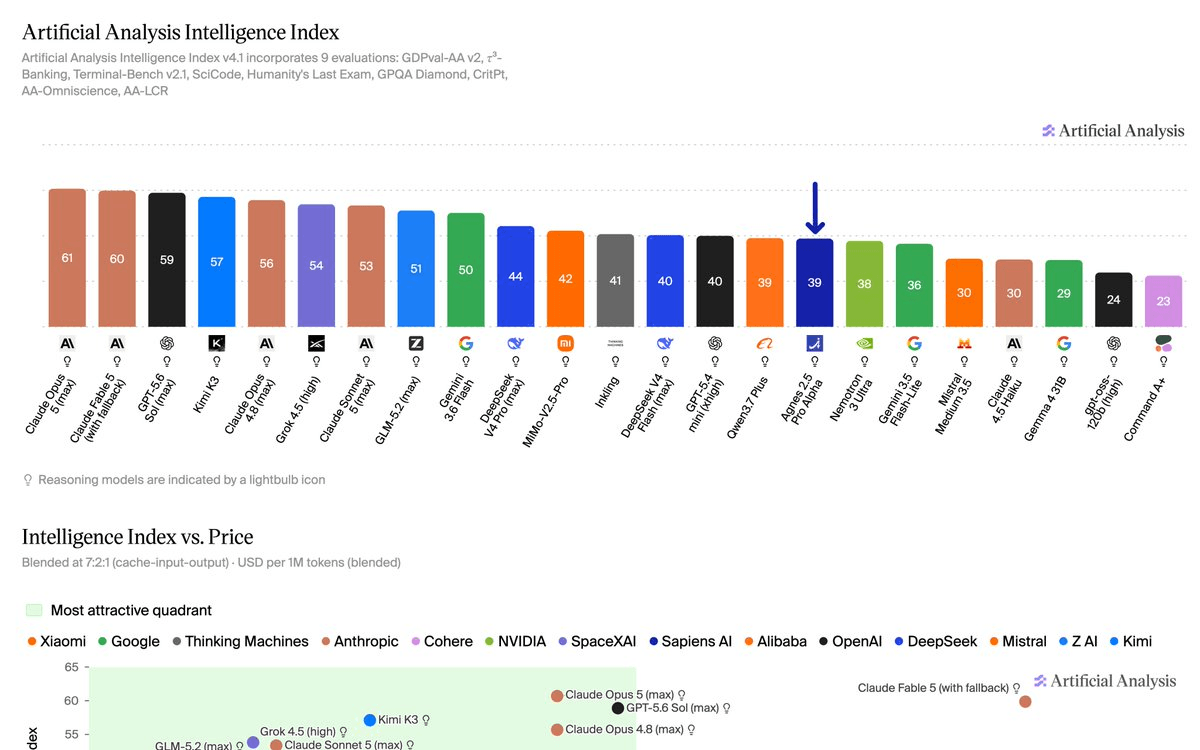
Takeaways
- Agnes 2.5 Pro Alpha launched from Singapore-based Agnes AI (Sapiens AI), a proprietary reasoning model built from scratch -- not a fine-tune of an open-source base.
- Scores 39 on the Artificial Analysis Intelligence Index, mid-pack among reasoning models, with a Coding Index of 58.8 that beats DeepSeek V4 Flash, GPT-5.4 mini, and Qwen3.7 Plus.
- Priced at $0.45/$0.90 per 1M input/output tokens, blending to $0.18/1M with caching -- second cheapest proprietary model at its intelligence tier.
- Uses 72% fewer reasoning tokens than GPT-5.4 mini (22k vs 78k per task), making per-task costs lower than raw pricing suggests.
- Weak on open-ended factual recall: AA-Omniscience score of -26.3 and 13.3% non-hallucination rate -- avoid unaugmented knowledge Q&A tasks.
- Available now via OpenAI-compatible API at platform.agnes-ai.com using model name
agnes-2.5-pro-alpha.
Singapore's Agnes 2.5 Pro Alpha is the latest model from Agnes AI (operating under Sapiens AI), a Singapore lab that has been building full-stack foundation models from scratch since mid-2025. Agnes built its own model architecture rather than fine-tuning an open-source base, and 2.5 Pro Alpha is the most capable result of that approach yet.
A new face on the reasoning leaderboard
Agnes 2.5 Pro Alpha scores 39 on the Artificial Analysis Intelligence Index, well above the median of 16 among reasoning models in a similar price tier. That index is a composite of nine evaluations spanning real-world agentic work, coding, scientific reasoning, and long-context tasks. A score of 39 places the model mid-pack across all reasoning models tested: below the current proprietary frontier, but solidly competitive for its price band.
Sapiens AI has not disclosed the model's size or parameter count. What they have published is a clean benchmark profile with a few clear strengths and one notable weakness.
Where it shines, and where it stumbles
Coding is the headline strength. Agnes 2.5 Pro Alpha's Coding Index of 58.8 sits above similarly priced models including DeepSeek V4 Flash (56.2), GPT-5.4 mini (56.1), and Qwen3.7 Plus (55.9), landing just behind Nex-N2-Pro (59.1). On real-world work tasks, it scores 1,168 on GDPval-AA v2, a benchmark that rates model performance against a human baseline of 1,000, putting it level with GPT-5.4 mini and ahead of Qwen3.7 Plus.
Academic reasoning holds up too. Agnes 2.5 Pro Alpha scores 32% on Humanity's Last Exam (HLE), a notoriously hard benchmark of expert-level questions, and 88% on GPQA Diamond, which tests graduate-level scientific reasoning. Its HLE result leads similarly priced proprietary models including GPT-5.4 mini (27%) and GPT-5.4 nano (26%).
The weak spots are harder to ignore. The full benchmark breakdown:
- AA-Omniscience: Scores -26.3 on the knowledge reliability index, with a non-hallucination rate of just 13.3%. It hallucinates more than it gets right on open-ended factual questions.
- Tau3-Banking: Scores 11.6% on agentic tool use in financial workflows, suggesting multi-step tool orchestration in structured domains is not yet a strength.
- CritPt: 10.9% on physics reasoning, well below frontier models.
The pattern is consistent: Agnes 2.5 Pro Alpha handles code and structured reasoning well, but struggles with open-ended knowledge retrieval and domain-specific agentic pipelines.
Token efficiency is the real competitive edge
Agnes 2.5 Pro Alpha used 22,000 output tokens per Intelligence Index task, with 16,000 of those being reasoning tokens. That is 51% fewer tokens than DeepSeek V4 Flash at max effort (45k) and 72% fewer than GPT-5.4 mini at extended thinking (78k). A model that reasons more concisely costs less per task before you even look at the headline price.
Agnes 2.5 Pro Alpha costs $0.45 per 1M input tokens and $0.90 per 1M output tokens. Blended at a 7:2:1 cache-input-output ratio, that comes to $0.18 per 1M tokens, making it the second cheapest proprietary model in the 38-40 Intelligence Index score band, behind only DeepSeek V4 Flash Reasoning at $0.06. Cache reads drop to $0.0038 per 1M tokens, a 99% discount off input price, which makes repeated long-context calls very cheap in practice.
Built in Singapore, trained from scratch
Agnes AI was founded by Bruce Yang, a PhD candidate at the National University of Singapore's School of Computing. The research and engineering team draws from NUS, Nanyang Technological University, MIT, Stanford, UC Berkeley, and UT Austin.
Agnes uses a clustered model architecture spanning text, vision, and multimodal reasoning, with Intelligent Routing and System-Level Orchestration to direct each request to the appropriate model. Earlier Agnes models used Chain-of-Thought reasoning combined with Direct Preference Optimization (DPO), a training method that aligns model outputs with human preferences by comparing good and bad responses, alongside quantization-aware training. The company has also published research on multi-agent systems, including papers on "Stable and Efficient Policy Optimization for Agentic Search and Reasoning (DSPO)" submitted to ICLR 2025, and "CodeAgents: A Token-Efficient Framework for Codified Multi-Agent Reasoning in LLMs." The token efficiency advantage visible in 2.5 Pro Alpha likely flows directly from that research.
Frontier AI beyond the US-China axis
Singapore's NAIS 2.0 strategy aims to establish the city-state as a global hub for AI innovation and governance. Agnes is one of the clearest examples of that strategy producing real technical output. A year ago, a model scoring 39 on a composite intelligence index would have cost multiples of what Agnes charges today. The cost of capable reasoning is collapsing, and the question for any team running workloads at scale is which model delivers the best output-per-dollar for their specific use case.
How to use it
The model is available through an OpenAI-compatible Chat Completions API. The base URL is https://apihub.agnes-ai.com/v1 and the model name is agnes-2.5-pro-alpha. A minimal Python call:
from openai import OpenAI
client = OpenAI(
    api_key="YOUR_AGNES_API_KEY",
    base_url="https://apihub.agnes-ai.com/v1"
)
response = client.chat.completions.create(
    model="agnes-2.5-pro-alpha",
    messages=[
        {"role": "user", "content": "Review this Python function for edge cases and suggest fixes."}
    ],
    temperature=0.2,
    max_tokens=2000
)
print(response.choices[0].message.content)
The model accepts image URLs in the message content array for multimodal tasks and supports tool calling with the standard OpenAI function-calling schema. Use Agnes 2.5 Pro Alpha where correctness and multi-step reasoning matter more than raw latency: scientific reasoning, complex policy analysis, long-form technical planning. Given the hallucination numbers, keep it away from open-ended factual Q&A without retrieval augmentation.
The practical sweet spot is coding assistance, agentic coding pipelines, long-document analysis, and structured reasoning tasks where you want GPT-5.4 mini-level output quality without the token burn. At $0.18 blended per million tokens with aggressive cache discounts, it is worth a serious evaluation run.