
Tencent's Hy-MT2 Beats Microsoft's Translation API at Just 440MB
Tencent open-sources Hy-MT2, a family of translation models that fits in 440MB on your phone while beating commercial APIs from Microsoft and Doubao
Takeaways
- Tencent open-sourced Hy-MT2, a family of 3 translation models (1.8B, 7B, 30B-A3B) under Apache 2.0 with no commercial restrictions.
- The 1.8B model compresses to 440MB via 1.25-bit quantization, runs fully offline on mobile (Apple, Qualcomm, MediaTek chips), and is 1.5x faster than its predecessor.
- The 7B and 30B-A3B variants outperform DeepSeek-V4-Pro and Kimi K2.6 in translation; the 1.8B beats Microsoft and Doubao commercial APIs overall.
- A new "fast-thinking" paradigm cuts reasoning overhead, trained via a 4-stage pipeline: pre-training, SFT, on-policy distillation, and reinforcement learning.
- All models support 33 languages plus 5 Chinese dialects, with strong instruction-following for style, terminology, delimiters, and structured data (e.g. JSON).
- Tencent also released IFMTBench, a new open benchmark for evaluating translation instruction-following, and partnered with WMT26 for a video subtitle translation competition.
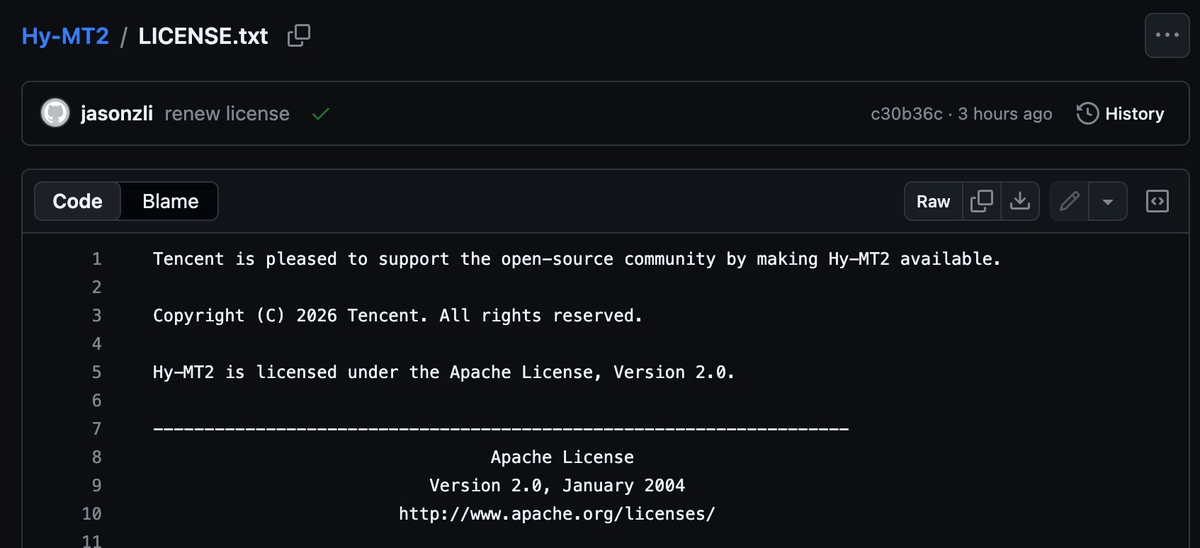
Tencent's Hunyuan team just dropped something that should make the machine translation world sit up: Hy-MT2, a family of open-source multilingual translation models that ranges from a 440MB on-device build to a 30-billion-parameter cloud flagship -- all under Apache 2.0, with no usage restrictions on commercial products, fine-tuning, or derivatives.
Hy-MT2 is billed as a family of "fast-thinking" multilingual translation models built for complex real-world scenarios, covering three sizes -- 1.8B, 7B, and 30B-A3B -- all supporting translation across 33 languages with strong instruction-following in multiple languages. The weights, quantized variants, training code, and a new evaluation benchmark called IFMTBench are all live on Hugging Face and ModelScope right now.
Three models, one story
This is not a single model release. Tencent built a tiered stack designed to cover every deployment surface from a phone to a data center.
- Hy-MT2-1.8B: The mobile-first variant. Using AngelSlim 1.25-bit extreme quantization -- a technique that compresses model weights to sub-2-bit precision -- the 1.8B model shrinks to just 440MB and runs 1.5x faster than its predecessor. It runs fully offline on Apple, Qualcomm, and MediaTek chips.
- Hy-MT2-7B: The balanced mid-tier option, optimized for server inference where you want strong quality without the compute cost of the flagship.
- Hy-MT2-30B-A3B: The flagship, built on a Mixture of Experts (MoE) architecture. MoE means the model has 30B total parameters but only activates roughly 3B of them per token -- so you get near-full-model quality at a fraction of the inference cost.
The models are optimized for various hardware platforms including ARM and Intel, and feature ultra-low-precision quantization for efficient on-device deployment. GGUF variants for llama.cpp and FP8 quantized versions for GPU inference are also available out of the box.
"Fast-thinking" -- what that actually means
The term "fast-thinking" is the key design philosophy here, and it's worth unpacking. Traditional LLM-based translation uses a "slow thinking" approach -- the model reasons through full semantics before generating output. Tencent's fast-thinking paradigm instead trains the model to react like a professional human translator, cutting unnecessary reasoning overhead.
The practical upshot: lower latency per translation, without sacrificing accuracy. The 7B and 30B-A3B models outperform open-source models such as DeepSeek-V4-Pro and Kimi K2.6 in fast-thinking mode, while the lightweight 1.8B model surpasses mainstream commercial APIs from providers such as Microsoft and Doubao overall.
The training pipeline follows a multi-stage approach inherited from the MT1.5 generation. The framework is designed to maximize performance of smaller-parameter models through knowledge transfer and rigorous alignment, running through four main stages: MT-oriented pre-training, supervised fine-tuning (SFT), on-policy distillation, and reinforcement learning (RL). That RL stage is what sharpens the instruction-following behavior.
Benchmarks that matter
Multi-dimensional evaluations show Hy-MT2 delivers outstanding performance across general, real-world business, domain-specific, and instruction-following translation tasks. On the FLORES-200 general multilingual benchmark, the numbers tell a striking story about the compression-quality tradeoff:
| Model | Parameters | Size (quantized) | FLORES-200 vs Gemini 3.1 Pro |
|---|---|---|---|
| Hy-MT2-1.8B | 1.8B | 440MB | 88.1% |
| Hy-MT2-7B | 7B | ~4GB | 96.9% |
| Hy-MT2-30B-A3B | 30B (3B active) | ~16GB | 98.1% |
The 30B-A3B also demonstrated strong performance on DomainMTBench across 8 vertical domains including finance, politics, and education -- areas where specialized terminology has historically tripped up general-purpose translation systems.
Instruction-following as a first-class feature
What separates Hy-MT2 from a standard translation model is how it handles instructions. Hy-MT2 isn't just a translator -- it follows complex translation instructions including terminology consistency (via reference translation examples), style control (formal/casual/literary tone), delimiter preservation for code and templates, structured data translation where JSON keys stay untouched, and personalized preferences.
To benchmark this capability formally, Tencent also released IFMTBench alongside the models -- a new open benchmark specifically for evaluating translation instruction-following. This fills a real gap: most existing MT benchmarks only measure translation accuracy, not whether the model actually did what you asked it to do.
Here's a minimal example of how to run the 30B-A3B model with the Hugging Face transformers library:
from transformers import AutoModelForCausalLM, AutoTokenizer
import torch
model_path = "tencent/Hy-MT2-30B-A3B"
tokenizer = AutoTokenizer.from_pretrained(model_path, trust_remote_code=True)
model = AutoModelForCausalLM.from_pretrained(
    model_path,
    dtype=torch.bfloat16,
    device_map="auto",
    trust_remote_code=True,
)
prompt = "Translate the following text into French. Output only the translation:\n\nThe weather is beautiful today."
messages = [{"role": "user", "content": prompt}]
inputs = tokenizer.apply_chat_template(messages, add_generation_prompt=True, return_tensors="pt").to(model.device)
with torch.no_grad():
    outputs = model.generate(**inputs, max_new_tokens=4096)
print(tokenizer.decode(outputs[0][inputs["input_ids"].shape[-1]:], skip_special_tokens=True))
Hy-MT2 also provides a complete model training pipeline, supporting both full-parameter fine-tuning and LoRA fine-tuning, as well as multiple DeepSpeed ZeRO configurations and LLaMA-Factory integration. The quantization toolkit, AngelSlim, is also open-sourced separately and covers common quantization algorithms, low-bit quantization, and speculative sampling.
The bigger picture
Model weights, code, and resources are available on Hugging Face, ModelScope, and GitHub. Tencent has also introduced the "Tencent Hy Translation" mini program, which includes features like voice input and customizable instructions. iOS and Android apps with offline translation support are reportedly on the way.
The Apache 2.0 license is the real unlock here. Previous open-source translation models often came with non-commercial clauses or required attribution in ways that made product integration painful. Hy-MT2 removes all of that friction -- you can fine-tune it on your domain data, ship it in a commercial product, and build derivatives without asking permission.
Tencent Hy is also officially partnering with WMT26 for the "Video Subtitle Translation Task," and participants who use the Hy-MT model series in the General Machine Translation Task or the Video Subtitle Translation Task will have the chance to win special awards sponsored by Hunyuan. That partnership signals Tencent is serious about positioning this model family as a research baseline, not just a product demo.
The real shift Hy-MT2 represents is about where translation intelligence lives. For years, high-quality translation has meant a round-trip to a cloud API -- with all the latency, cost, and privacy tradeoffs that entails. A 440MB model that beats Microsoft's commercial translation API, runs offline on a phone, and follows nuanced style instructions changes that calculus entirely for anyone building multilingual products.