
3DGSMR Brings 3D Gaussian Splatting to MRI Scans Without Pretraining
A self-supervised method borrows 3D Gaussian Splatting from graphics to reconstruct isotropic 3D MRI volumes from heavily undersampled k-space, no training data required.
Takeaways
- 3DGSMR adapts 3D Gaussian Splatting to reconstruct isotropic 3D MRI from undersampled k-space with no pretraining, published in IEEE TMI.
- Extends 3DGS to complex-valued density parameters so a single Gaussian cloud represents both real and imaginary channels of the MR volume.
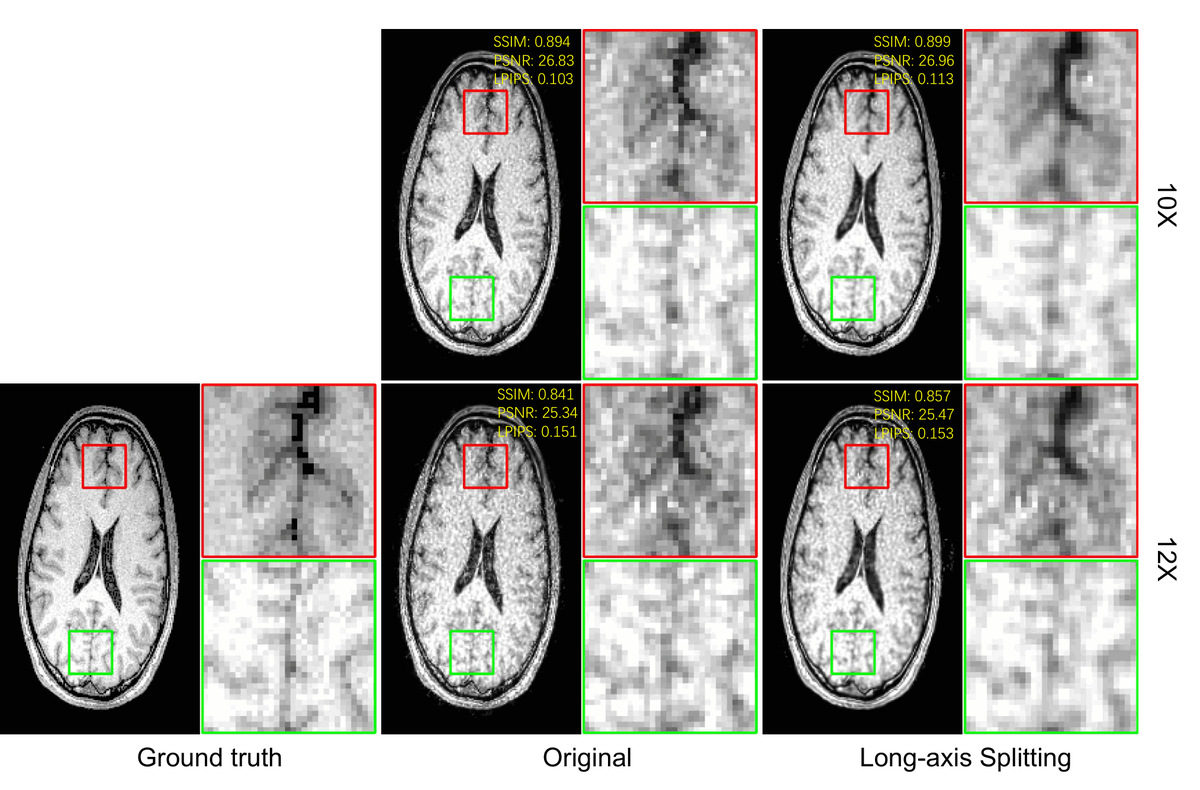
- New long-axis splitting rule replaces the graphics-style random-normal split, fixing blur at 10x and 12x acceleration.
- Matches or beats CS-TV, ConvDecoder, and INR on SSIM, PSNR, and LPIPS across 2x to 12x acceleration on 7 brain scans.
- Runs in a few minutes on a single A6000 with under 5 GB of GPU memory, using about 4.8M parameters versus 40M for a dense voxel grid.
- Breaks down beyond 12x with needle-like artifacts, and can overfit spatially clustered noise as anatomy in low-SNR inputs.
3D Gaussian Splatting has become the default trick for real-time radiance-field rendering, but it has barely touched medical imaging outside of X-ray. A new paper called 3DGSMR ports the idea into MRI reconstruction, using a cloud of learnable Gaussians as an explicit, complex-valued representation of a 3D volume that can be recovered from heavily undersampled k-space measurements without any pretraining.
The headline result: a scan-specific optimization built on 3DGS matches established 3D MRI reconstruction baselines, converges in a few minutes on a single GPU, and stays under about 5 GB of memory for a 400x303x165 volume. It also introduces a new splitting rule that keeps the method usable at 10x and 12x acceleration, where the vanilla 3DGS densification strategy blurs out fine detail.
Why 3D MRI needs a better prior
3D MRI produces isotropic volumetric datasets you can slice from any angle, which is why radiologists like it. The catch is scan time: acquiring a full k-space volume can take minutes, and any patient movement during that window forces a repeat. Parallel imaging and compressed sensing shorten the acquisition by undersampling k-space, but they leave characteristic aliasing and blurring once the acceleration factor climbs.
Deep-learning reconstructors like unrolled networks and diffusion models handle high acceleration well, but they need large curated training sets that hospitals rarely share. That has pushed the field toward scan-specific reconstruction, where a randomly initialized network is optimized only on the current subject's undersampled data. Two representative approaches are ConvDecoder, which exploits the implicit bias of a convolutional decoder as a prior, and implicit neural representations (INR), which map coordinates to signal values through an MLP with hash or sinusoidal encoding.
3DGSMR fits in this scan-specific camp, swapping the neural network for an explicit set of Gaussians. Each voxel intensity is the weighted sum of contributions from a cloud of 3D Gaussians, each parameterized by a center position, a covariance (as rotation quaternion plus scale), and a density value.