
A Physics-Driven GAN Beats FWIGAN at Reading What Lies Underground
Researchers Zhang and collaborators pair a U-Net with a wave-equation solver and a critic network to stabilize seismic velocity model inversion under noise and poor initial guesses.
Takeaways
- Zhang et al. propose a physics-driven GAN for seismic full-waveform inversion, published on arXiv.
- Learnable U-Net generator predicts an initial velocity map, then classical FWI refines it under wave-equation constraints.
- CNN discriminator with gradient penalty judges observed versus forward-modeled seismic traces adversarially.
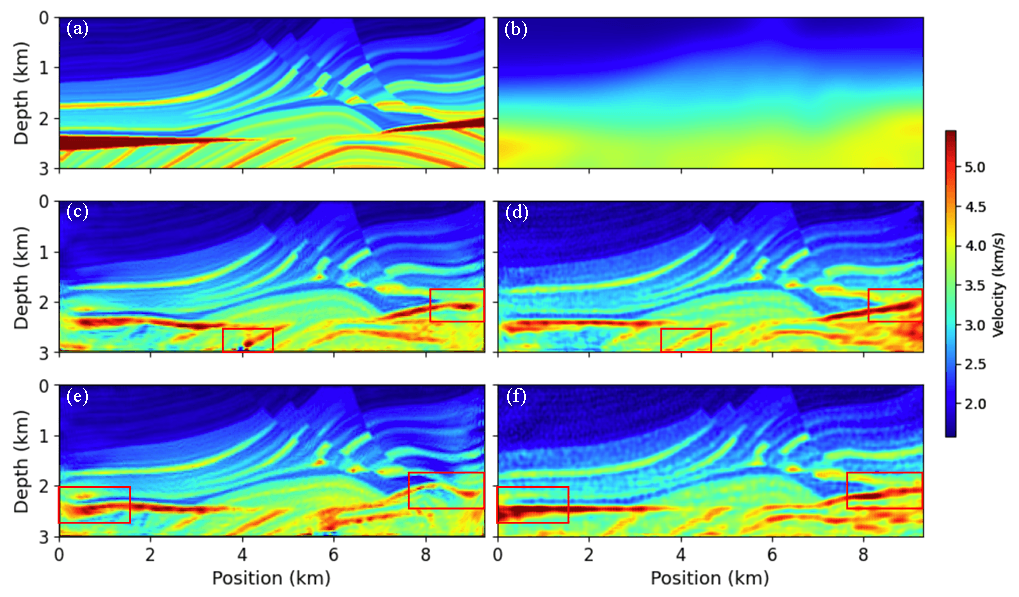
- Beats prior FWIGAN on Marmousi and Overthrust benchmarks in both SSIM and SNR.
- Larger gains appear when the initial velocity model is a crude linear ramp rather than smoothed.
- No code release; experiments limited to 2D acoustic synthetic data on a single Tesla P40 GPU.
A new paper on arXiv proposes a hybrid deep learning and physics approach to one of geophysics' most stubborn optimization problems: reconstructing subsurface velocity models from seismic recordings. The authors, Xinyi Zhang, Caiyun Liu, Jie Xiong, and Qingfeng Yu, build a physics-driven generative adversarial network that pairs a learnable U-Net generator with a traditional full-waveform inversion (FWI) solver, then trains the whole thing adversarially against a CNN discriminator.
The pitch is straightforward: neural networks can guess a reasonable starting velocity map from raw seismic data, and the wave equation can refine it. Chain them together, add a discriminator that spots when the predicted seismograms look fake, and you get a system that converges even when the initial guess is bad or the input traces are noisy.
The stubborn problem underneath the ground
Full-waveform inversion is the gold standard for imaging what lies beneath the surface, used for everything from oil and gas exploration to earthquake studies. It reconstructs subsurface velocity models by iteratively minimizing the misfit between predicted and observed seismic data. The catch is that the misfit surface is riddled with local minima.
Under complex geological conditions, conventional FWI suffers from strong dependence on the initial model and tends to produce unstable results when the data are sparse or contaminated by noise. Practitioners call the classic failure mode cycle skipping, where the solver locks onto a wrong seismic waveform cycle and never recovers. Global optimizers like simulated annealing and genetic algorithms can help but are painfully slow.