
AutoSearch Trains AI Agents to Stop Searching When They Already Know
A reinforcement learning framework teaches retrieval agents to stop searching the moment they have enough evidence, cutting redundant queries in half.
Takeaways
- AutoSearch is an RL framework from Meituan and CAS that adapts retrieval depth per question, detailed in the paper.
- Optimal search depth depends jointly on question complexity and agent capability, not a fixed cap.
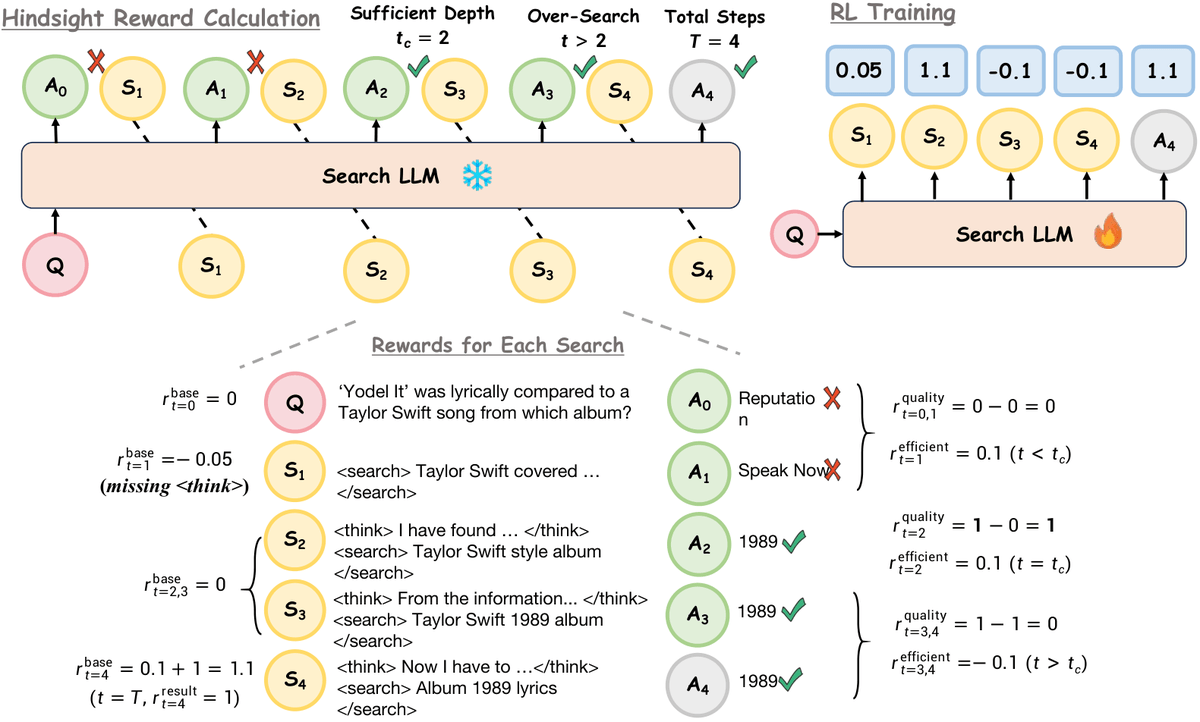
- Agents generate intermediate answers at each step to detect when they already have enough evidence.
- Three rewards combine format/outcome, search efficiency around a capability-aware depth, and F1 gain per step.
- Beats Search-R1, StepSearch and HiPRAG on 6 QA benchmarks with fewer searches and lower over-searching ratios.
- Code is public at github.com/bofusun/AutoSearch, works with both PPO and GRPO.
Agentic RAG systems have a nasty habit: once you let a language model loop through reason, search, reason, search, it tends to keep going long after it already has the answer. Every extra retrieval burns tokens, adds latency, and sometimes actively confuses the model. A team from the Chinese Academy of Sciences and Meituan just proposed AutoSearch, a reinforcement learning framework that trains agents to stop the moment they know enough, and their results suggest most current systems are wasting a lot of compute.
The over-searching tax nobody talks about
Retrieval depth is a Goldilocks problem. Too few steps and the agent underexplores complex multi-hop questions. Too many and you pay for redundant lookups that can actively degrade the final answer. Prior work tries to fix this with reward functions that penalize trajectory length, or with confidence-based and LLM-judged penalties on redundant steps. Those penalty-based methods tend to under-search complex questions in the rush to hit an efficiency target.
The authors ran a diagnostic first. Using Qwen2.5-14B-Instruct across single-hop (Natural Questions) and multi-hop (Bamboogle) benchmarks, they found that NQ reaches near-optimal performance with a single search step while additional steps provide little benefit, but Bamboogle requires up to three steps to peak, after which further searches reduce performance. The sweet spot also shifts with model size. A 3B model steadily improves with more searches, while 7B and 14B models peak at the second and third steps respectively, then degrade. The right depth depends jointly on question complexity and the agent's own capability.