
Center for Juris-Informatics Uses AI Agents to Auto-Formalize GDPR Into Machine-Readable Rules
A multi-agent pipeline turns GDPR articles into executable rules, but human reviewers still catch legal errors that pass every automated check.
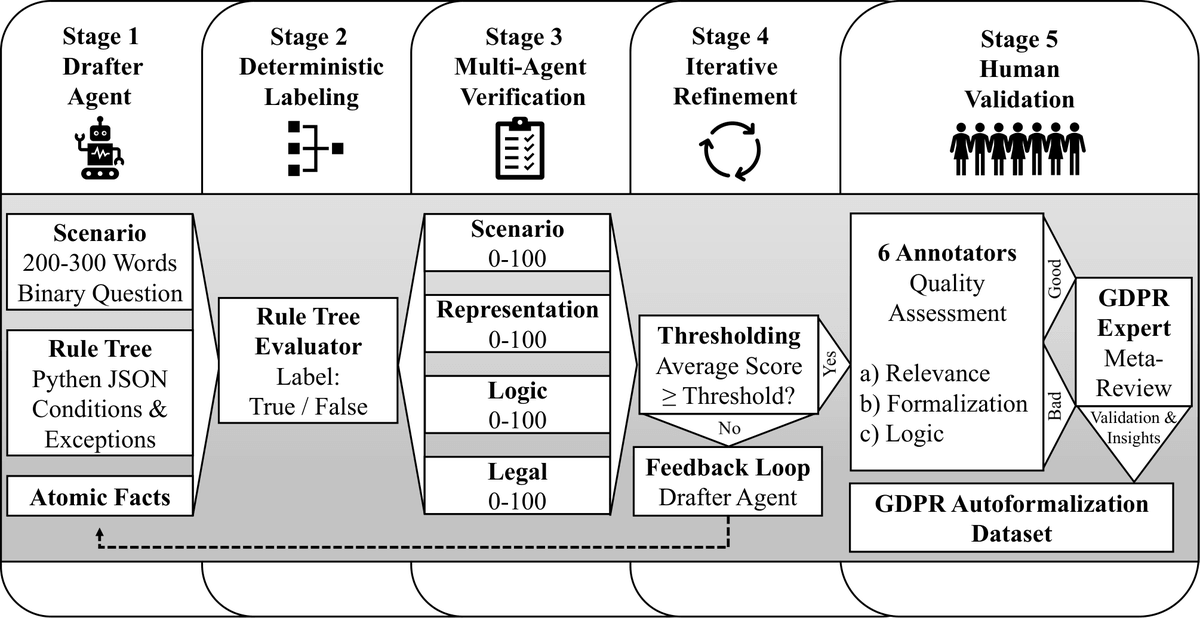
Takeaways
- Multi-agent LLM pipeline auto-formalizes GDPR articles into executable Pythen rule trees with human verification.
- One Drafter agent generates scenarios, rules, and facts; four Verifier agents score them 0-100.
- 400 samples cleared the automated threshold; humans curated 120 into a public dataset.
- LLMs succeed on trigger-based rights like Article 20 portability but fail on absolute rights and omissions.
- Failure modes trace to abstraction choices, not syntax: controller-agnostic modeling, procedural-substantive confusion.
- Paper documents reward-hacking behavior where fact-extraction agents omit facts to match labeled outcomes.
Translating laws into code has been a dream of legal informatics for decades. A new paper from the Center for Juris-Informatics and collaborators takes a fresh swing at it, using a squad of specialized language model agents to auto-formalize GDPR provisions into machine-executable rules, then routing every output through structured human review. The result is a curated dataset and a candid catalog of where automated legal reasoning still breaks down.
The main challenge lies less in generating syntactically valid rules than in ensuring legal faithfulness. Legal norms involve open-textured concepts, conditional obligations, role-dependent permissions, and a distinction between substantive rights and procedural safeguards, so outputs that look logically consistent may still be legally invalid or misleading. That gap between syntactic correctness and legal correctness is what the authors set out to measure.
Why GDPR is a nasty target
GDPR has become the canonical stress test for legal formalization because it packs rights, obligations, exceptions, and role-based constraints into a single regulation. Prior work has tackled it manually. The DAPRECO knowledge base contains hundreds of GDPR rules formalized using sophisticated logics, often Reified Input/Output (RIO) Logic, encoded in the standardized XML formalism LegalRuleML. Those efforts are authoritative but painfully slow to produce and expensive to maintain.
The authors argue that end-to-end autonomous formalization is the wrong goal. Every generated rule is treated as provisional and put through structured scrutiny, with role-separated agents surfacing disagreements before a human ever sees the sample.
One drafter, four critics
The process employs five AI agents: one Drafter responsible for initial generation and four Verifiers tasked with independent quality assessment. The Drafter produces three artifacts for each target GDPR article: