
CMU and NYU's Flux Matching Cracks Molecular Transitions With 0.98 Completion Rate
Flux Matching borrows the flow matching loss from generative AI to automatically extract reaction mechanisms and reaction coordinates from molecular simulation data
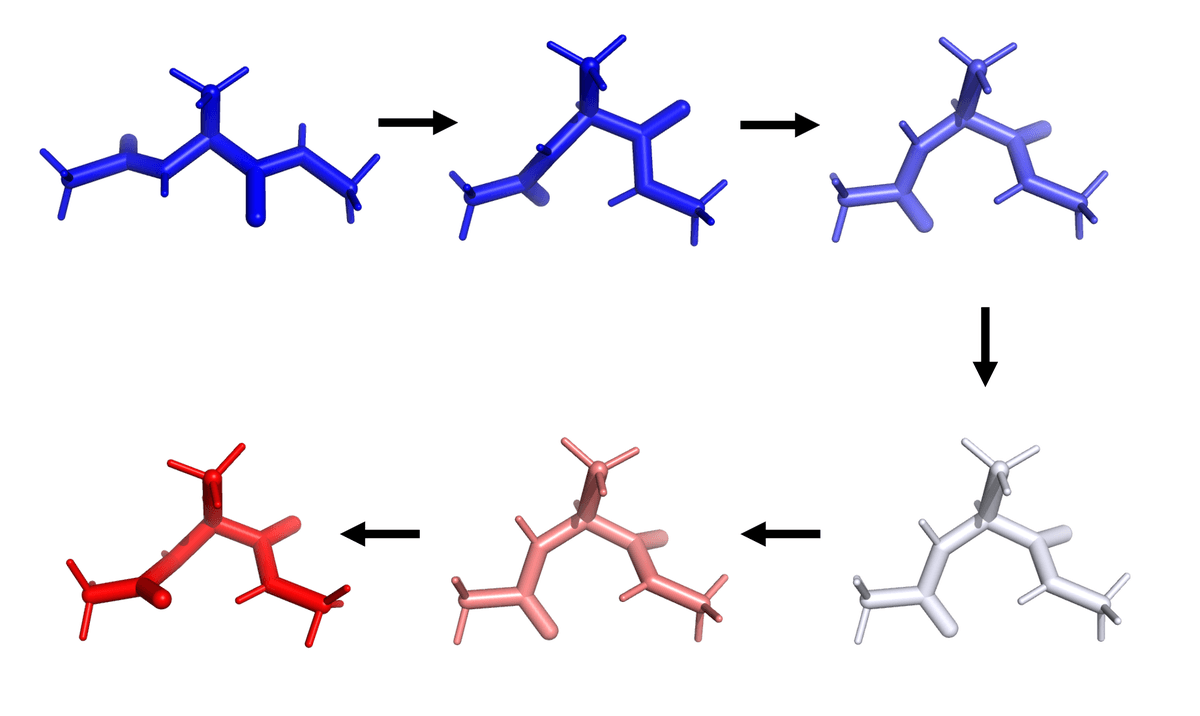
Takeaways
- Flux Matching learns reaction mechanisms directly from reactive trajectory data using losses identical to flow matching in generative models.
- Outputs two objects: a current velocity field
u(z)whose streamlines trace dominant transition pathways, and a scalar potentialh(z)as a data-driven reaction coordinate. - Unlike committor-based methods, both
uandhremain valid under non-Markovian projections onto collective variables — a fundamental theoretical advantage. - Validated on Alanine Dipeptide (98% trajectory completion rate) and AIB9 peptide using TPS-generated ensembles via OpenPathSampling.
- The learned potential
houtperforms hand-crafted dihedral CVs for rate constant estimation in Weighted Ensemble simulations, converging faster with tighter confidence intervals. - Framework is agnostic to the path sampling method used and enables an iterative loop: better sampling improves the current estimate, which improves sampling interfaces.
Simulating rare events in molecular dynamics , protein folding, chemical reactions, phase transitions , is one of the hardest problems in computational science. The timescale problem is brutal: a simulation might run for microseconds while the event of interest happens on millisecond timescales. Path sampling methods like Transition Path Sampling (TPS) and Weighted Ensemble (WE) exist to focus computation on the rare transitions themselves, generating ensembles of reactive trajectories that connect a reactant state A to a product state B. But once you have those trajectories, extracting mechanistic insight , what actually happens during the transition, and in what order , has remained a largely unsolved problem.
A new paper from researchers at Carnegie Mellon and NYU introduces Flux Matching, a framework that learns two complementary objects directly from reactive trajectory data: a current velocity u(z) that traces the dominant reaction pathways, and a scalar potential h(z) that serves as a data-driven reaction coordinate. The key insight is that both can be learned by minimizing quadratic loss functions structurally identical to the flow matching loss used in generative modeling , no knowledge of the underlying dynamics or stationary distribution required.
The problem with the committor
The standard tool for analyzing rare transitions is the committor function q(x) , the probability that a trajectory starting at position x reaches state B before returning to A. The committor is the ideal reaction coordinate for this purpose, but calculating it for high-dimensional, nonlinear systems has long been considered intractable. Neural network approaches have made progress, but they carry a fundamental limitation: training neural networks to approximate the committor function needs to sample transition data from straightforward simulations of rare events, which is very inefficient, and the scarcity of transition data makes it challenging to approximate the committor function.
There is a deeper issue. When you project a high-dimensional system onto a small set of collective variables (CVs) , say, a few dihedral angles of a protein , the projected dynamics are generally