
CUHK's EI-Part Blows 3D Objects Apart to Build Editable Game-Ready Assets
A new framework called EI-Part cracks part-level 3D generation by first exploding shape components outward for completion, then imploding them back for detail refinement.
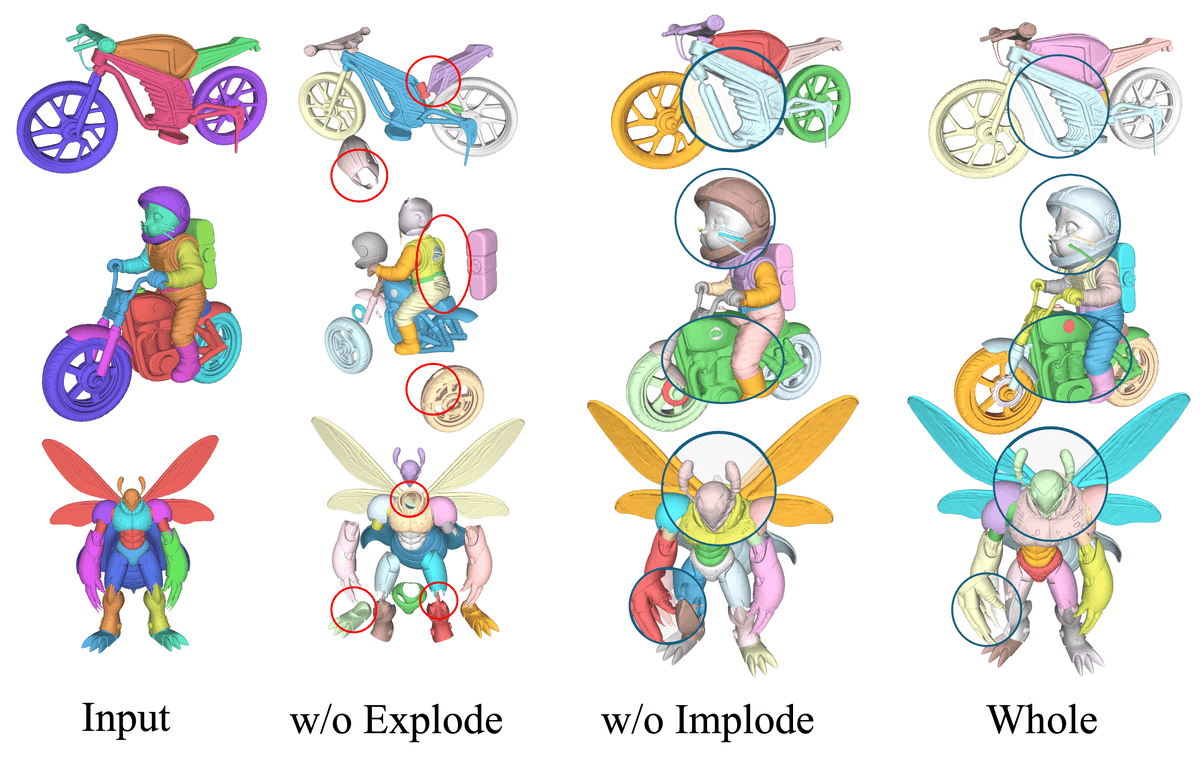
Takeaways
- EI-Part introduces an explode-implode strategy for part-level 3D generation, achieving state-of-the-art results on PartVerse.
- Parts are pushed radially outward as sparse voxels, completed with a rectified-flow DiT, then imploded for detail refinement.
- Reports Voxel IoU of 0.7981 and Chamfer Distance of 0.0194, beating X-Part, HoloPart, OmniPart, PartCrafter, and PartPacker.
- Uses SAM plus a multi-view diffusion segmenter, DINOv2 conditioning, and a Sparc3D VAE at 64³ latent resolution.
- Training required roughly 64 GPUs for two weeks on the completion stage alone; no code released yet.
- Targets game, film, and CAD workflows where meshes need to be edited part by part after generation.
Generating a 3D asset as a single blob is easy. Generating it as a set of clean, editable parts that you can actually rig, animate, or swap in a game engine is much harder. A new paper called EI-Part from CUHK-Shenzhen and Math Magic proposes an unusual trick to make that work: blow the object apart, complete each piece in the extra breathing room, then squish everything back together to refine the fine details.
The results look strong. On the PartVerse benchmark, EI-Part reports a Voxel IoU of 0.7981 and a Chamfer Distance of 0.0194, beating X-Part (0.7478 IoU), HoloPart (0.6106), OmniPart (0.2861), PartPacker (0.2586), and PartCrafter (0.0742). That is a large gap on a task where the leading methods have been trading places for months.
Why part-level 3D generation keeps breaking
Modern text- and image-to-3D systems like TRELLIS, TripoSG, and Hunyuan3D produce impressive geometry, but the outputs are monolithic and lack the part-level decomposition needed for detailed manipulation and editing. If you want to animate a chair's drawers, retexture only the wheels of a car, or replace a character's head, you need parts that are individually complete, geometrically plausible, and structurally consistent with each other.
Prior work has tried several approaches, and each has a distinct failure mode:
- Shared latent codes (BANG, PartPacker): Embedding all parts into a single or dual set of latent codes constrains the representation capability of each part and results in poor geometric details.
- Independent generation (HoloPart): Represents each part as its own latent set, but ignores relationships between parts, hurting structural coherence.