
EDNO Beats Diffusion Models at Satellite Imaging With 32x Fewer Parameters
A frequency-domain neural operator uses Euler's formula to split satellite image fusion into phase and magnitude, hitting top accuracy with 264K parameters.
Takeaways
- EDNO reframes pansharpening as a continuous mapping in the polar frequency domain using Euler's formula.
- Two decoupled modules handle phase (geometry) and magnitude (spectrum) separately inside each layer.
- Just 264.9K params and 2.4 GFLOPs, roughly 1/40 the compute of diffusion baseline NODiff.
- Reaches 41.65 dB PSNR on WorldView-2 and 45.13 dB on GaoFen-2, competitive with heavier models.
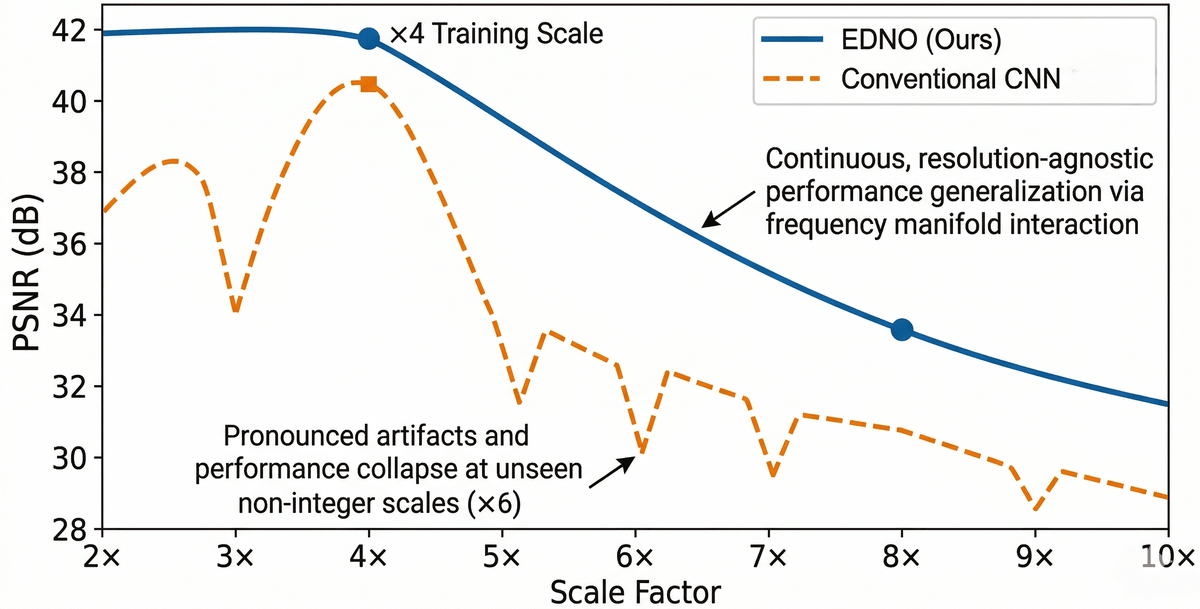
- Zero-shot generalization across x2 to x10 scales where CNN baselines collapse at non-integer factors.
- Related work: PINO uses sensor physics priors; EDNO is sensor-agnostic.
Satellite sensors face an annoying tradeoff: they can capture either sharp black-and-white images or blurry color ones, but rarely both. Pansharpening merges those two modalities into a single high-resolution multispectral image, and it has become a proving ground for architectures ranging from CNNs to transformers to diffusion models. A new paper proposes a much lighter approach called the Euler-inspired Decoupling Neural Operator (EDNO) that skips pixel-space processing entirely and does the fusion in the frequency domain using polar coordinates.
The result is a model with roughly 265K parameters and 2.4 GFLOPs that competes with, and often beats, transformer and diffusion baselines that are 5x to 40x heavier.
Why pixel-space fusion keeps hitting a wall
Pansharpening takes a low-resolution multispectral (LR-MS) image with rich color information and a high-resolution panchromatic (PAN) image with sharp textures, and produces a high-resolution multispectral (HR-MS) output. The goal is to combine the spatial textures of the PAN input with the spectral information of the LR-MS input.
Dominant approaches lean on deep networks operating over the pixel grid. Early CNN methods like PNN and PanNet used residual learning to capture spatial details, and more recent transformer models such as PanFormer and generative approaches like NODiff pushed performance boundaries by leveraging long-range dependencies and iterative refinement. These models primarily operate in the Cartesian pixel domain, where spatial and spectral features are deeply coupled, which requires massive parameter counts to resolve modal conflicts and leads to high computational overhead.