
ETH Zürich's MATCH Builds Photorealistic 3D Head Avatars 10x Faster
A new transformer-based pipeline reconstructs photorealistic 3D head avatars from multi-view images in half a second, skipping the day-long optimization loop.
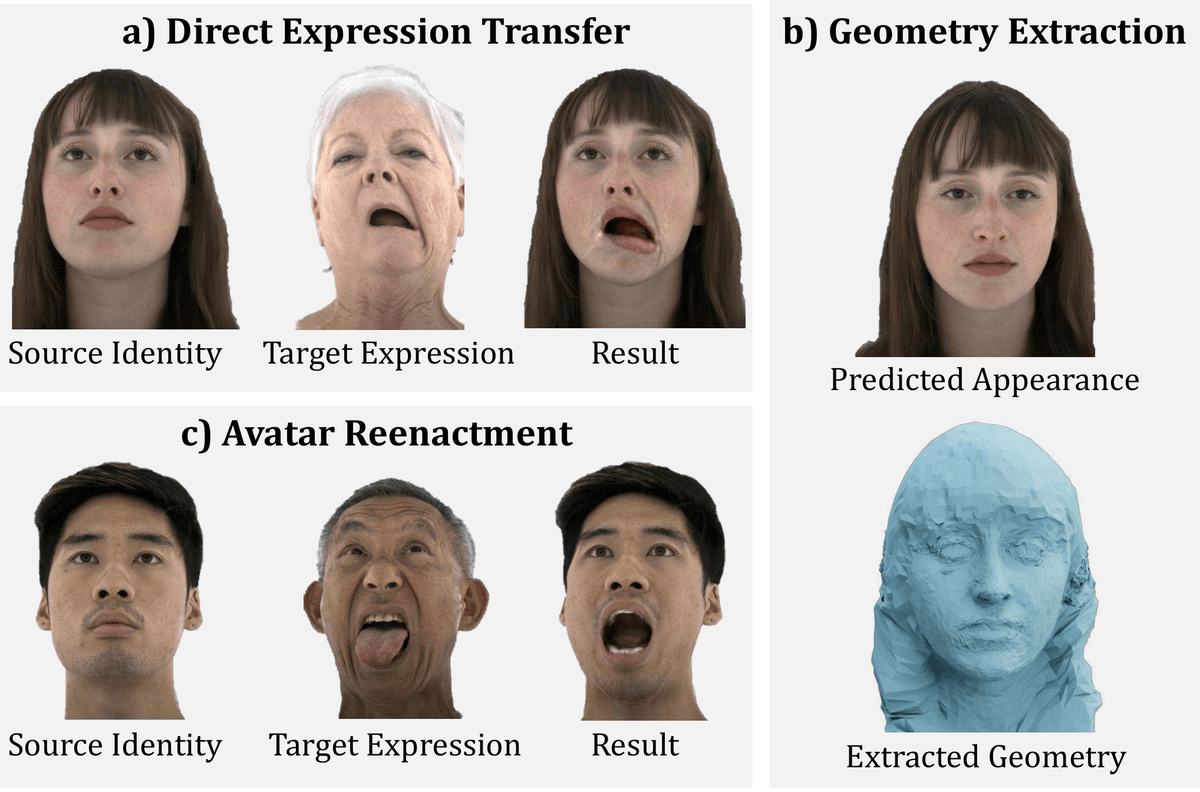
Takeaways
- MATCH reconstructs 3D Gaussian head avatars from multi-view images in 0.5 seconds per frame.
- A transformer with registration-guided attention predicts Gaussians directly in a template UV layout.
- Animatable avatar creation runs 10x faster than the closest baseline by skipping mesh tracking.
- Semantic correspondence enables expression transfer, identity interpolation, and semantic editing out of the box.
- Built on an adapted TEMPEH coarse mesh estimator and Sapiens semantic features.
- Code and weights are on GitHub; paper accepted at CVPR 2026.
Building a high quality 3D head avatar from a camera rig has traditionally been a weekend project, not a real-time operation. A new method called MATCH, from researchers at ETH Zürich and Google, collapses that timeline by predicting Gaussian splat textures directly from calibrated multi-view images in a single forward pass.
State-of-the-art multi-view head avatars require time-consuming head tracking followed by expensive per-subject optimization, often pushing total creation time past a full day. MATCH replaces that pipeline with a feed-forward transformer that runs in 0.5 seconds per frame and outputs Gaussians already in dense semantic correspondence across identities and expressions.
The registration bottleneck
To understand why this matters, it helps to know what makes existing methods slow. High-fidelity avatar systems typically use 3D Gaussian Splatting, where the head is represented as thousands of small colored ellipsoids that get rasterized into images. To animate that representation, you first need to know which Gaussian corresponds to which part of the face across frames and subjects. That mapping is normally established through per-subject mesh tracking and long optimization loops against captured video.
A large body of work reconstructs detailed 3D heads by optimizing Gaussians against dense, high-resolution studio-captured video sequences such as RenderMe-360 and NeRSemble. Those approaches set an upper bound on quality but scale poorly due to expensive capture and per-subject optimization. MATCH sidesteps both stages by learning correspondence directly.