
ETH Zurich's ReSplat Beats 3D Gaussian Splatting by 4.2 dB Running 100x Faster
ETH Zurich, Tübingen, and Microsoft researchers propose a recurrent feed-forward model that iteratively refines 3D Gaussians using rendering error, without gradients.
Takeaways
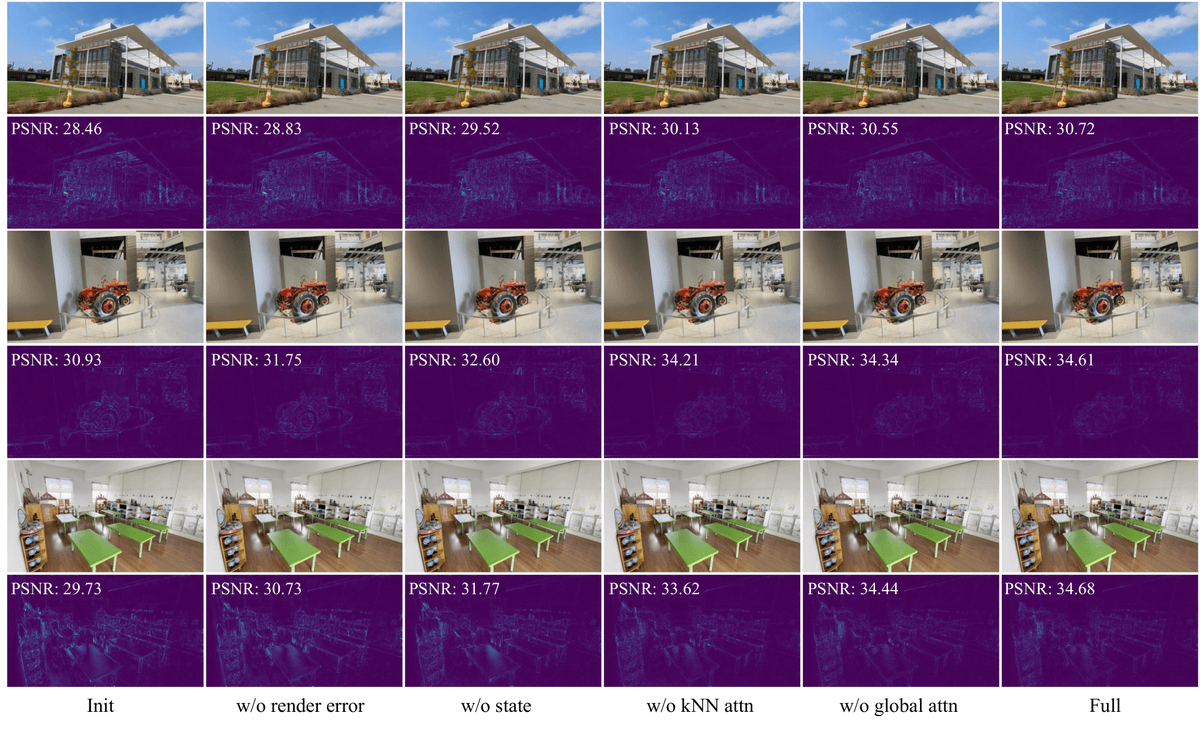
- ReSplat introduces recurrent, gradient-free refinement of 3D Gaussians using rendering error as the feedback signal.
- Beats 3DGS optimization by 4.2 dB PSNR on DL3DV while running about 100x faster on 8 input views.
- Compact initializer predicts Gaussians in a 16x subsampled space, cutting Gaussian count 16x versus per-pixel baselines.
- Generalizes across datasets, view counts (2 to 32), and resolutions despite training on a single configuration.
- 77M recurrent model outperforms 559M and 1.26B parameter single-step baselines, showing iteration beats scale.
- Code and models released at github.com/cvg/resplat and Hugging Face.
A team from ETH Zurich, the University of Tübingen, and Microsoft has introduced ReSplat, a novel view synthesis model that borrows the iterative refinement idea from per-scene optimization but delivers it in a purely feed-forward network. The work, an ECCV 2026 Oral led by Haofei Xu with Daniel Barath, Andreas Geiger, and Marc Pollefeys, tackles a persistent ceiling in generalizable Gaussian splatting: single forward passes cannot keep improving, and per-scene optimization is too slow to be practical.
The headline numbers are striking. On the DL3DV benchmark with 8 input views at 512x960, ReSplat beats optimization-based 3D Gaussian Splatting by 4.2 dB PSNR while running roughly 100 times faster, and it uses 16 times fewer Gaussians than pixel-aligned baselines like MVSplat and DepthSplat.
The bottleneck feed-forward splatting kept hitting
Gaussian splatting represents a scene as a cloud of tiny 3D blobs that get rasterized into images. The original approach optimizes those blobs per scene with thousands of gradient steps, which is expensive. Feed-forward Gaussian splatting aims to directly predict 3D Gaussian parameters from input images, eliminating the need for expensive per-scene optimization and enabling high-quality sparse-view reconstruction and view synthesis.
The catch: most current methods learn a single-step mapping from images to 3D Gaussians, an approach inherently limited by network capacity in complex scenes. You get one shot at predicting the geometry, and if the network is wrong, there is no mechanism to fix it. On top of that, most existing feed-forward models predict one or multiple Gaussians for each pixel, which produces millions of Gaussians when handling many input views and/or high-resolution images and thus limits scalability.
Rendering error as a feedback signal
ReSplat's central insight is that the model can look at its own mistakes. The rendering error provides a valuable feedback signal, informing the model about the quality of its prediction. This allows the network to adapt to the test data, reducing the dependence on the training distribution and leading to robust generalization.