
GAI-NeRF Predicts Indoor Wi-Fi Signals 11 dB Better Without Retraining
A new NeRF variant blends geometric algebra with attention-based ray tracing to predict wireless signal strength across rooms and frequencies with under 2 dB error.
Takeaways
- GAI-NeRF adapts neural radiance fields for wireless channel prediction using geometric algebra attention.
- Uses sandwich products to model reflection, diffraction, and penetration as learnable transformations inside the network.
- Switches from point-in-point-out to ray-in-ray-out inputs, better matching how RF waves actually propagate.
- Achieves 1.75 dB MAE at 5 GHz on real indoor RSSI data, beating NeRF2's 2.87 dB.
- Cuts cross-frequency generalization error by 15 to 17 percent versus the strongest baseline.
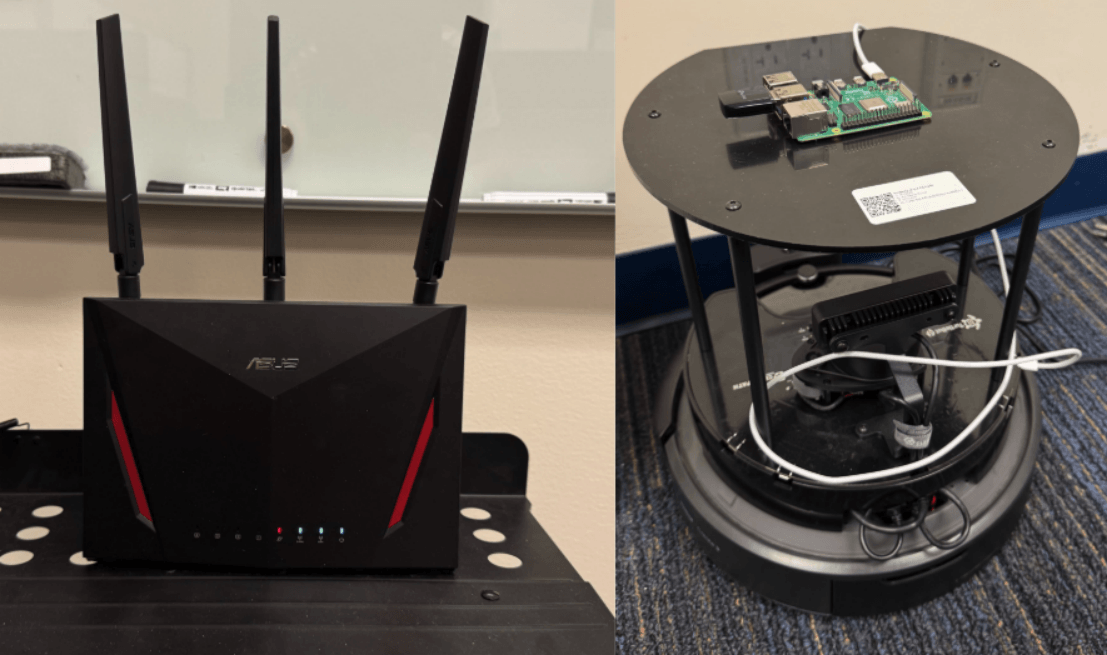
- Authors will release a custom indoor RSSI dataset collected with a TurtleBot robot over 18 days.
Neural radiance fields have moved well beyond rendering pretty pictures. A group of researchers from Florida International University and Auburn University just released GAI-NeRF, a framework that repurposes NeRF machinery to predict how radio signals travel through indoor environments. It uses geometric algebra to model the physics of reflection, diffraction, and penetration inside the network itself.
The resulting model outperforms the strongest baseline NeRF2 by improvements approaching 1 dB in several cases, and beats a plain MLP by nearly 9 to 11 dB on real indoor RSSI measurements, while generalizing across frequency bands and furniture rearrangements without retraining.
Why wireless needs its own NeRF
Predicting signal strength inside a building is harder than it sounds. Walls, columns, furniture, and human bodies all bend, absorb, and reflect radio waves in ways that depend on frequency and material. Traditional statistical methods and deterministic ray tracing struggle to balance computational efficiency with modeling accuracy, particularly in complex indoor and urban environments.
NeRF variants like NeRF2 adapt the original neural radiance field formulation to RF signals, predicting attenuation and phase instead of color and density. The catch is that NeRF was built for visual light, not electromagnetic wave physics. It doesn't explicitly model reflection coefficients or diffraction patterns, generalizes poorly to new environments, and lacks interpretability that would let researchers validate predictions against electromagnetic theory. Retraining a fresh model for every room is not a viable deployment story.
Geometric algebra as a physics-shaped prior
The core trick is representing ray-object interactions using