
Imperial College's DSG Makes Curved Surface Deep Learning Finally GPU-Ready
A new CUDA library from Imperial College brings differentiable geodesics to 3D meshes, unlocking geometry-aware neural networks, flow matching, and second-order optimisation on surfaces.
Takeaways
- Imperial College CIRCLE group introduces DSG, a CUDA library making the exponential map on 3D meshes differentiable and parallel.
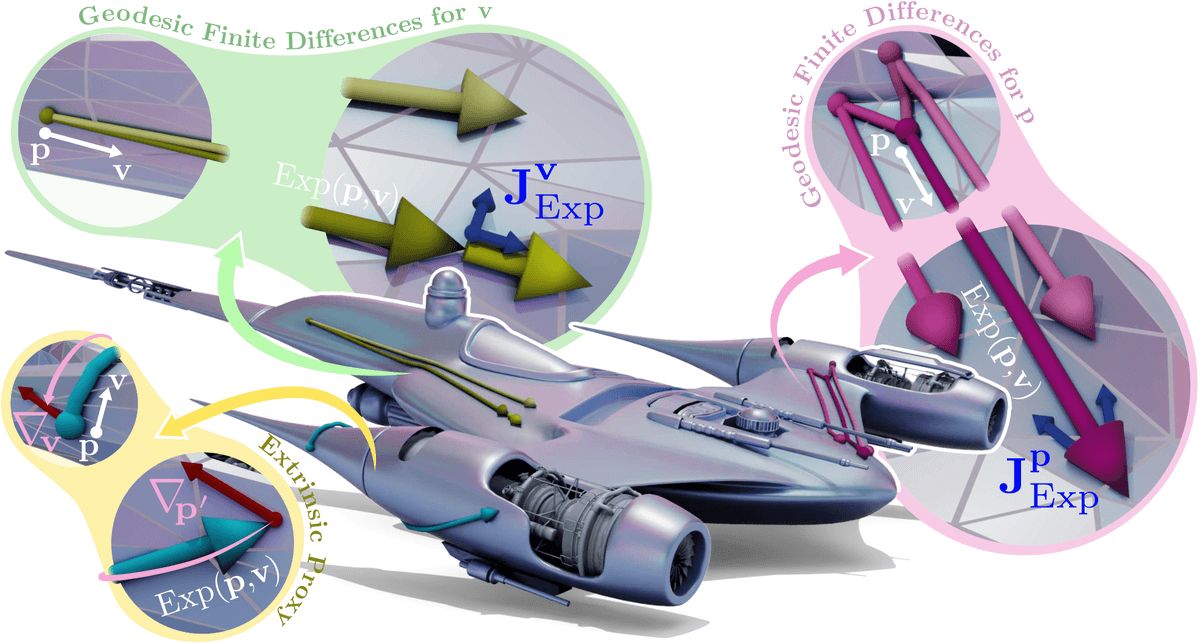
- Two backprop schemes are proposed: fast Extrinsic Proxy and higher-accuracy Geodesic Finite Differences using barycentric perturbations.
- Available as pip install digeo, with source on GitHub. Accepted to CVPR 2026.
- Adaptive Geodesic Convolution learns receptive-field sizes per channel and beats fixed-patch GCNNs on body part segmentation.
- MeshFlow does flow matching directly on the surface, removing the ODE-plus-projection loop of prior manifold generative models.
- Mesh-LBFGS, a quasi-Newton optimiser using parallel transport, outperforms Lloyd's algorithm on geodesic centroidal Voronoi tessellation.
Deep learning on curved surfaces has always been the awkward cousin of deep learning on grids. Convolutional networks assume regular pixel neighbourhoods, transformers assume ordered tokens, and diffusion models assume Euclidean noise. Meshes have none of these luxuries, and the mathematical tools that describe motion on curved surfaces have historically been non-differentiable, hard to parallelise, or both. A new paper from Imperial College London's CIRCLE group, accepted to CVPR 2026, introduces DSG (Differentiable Straightest Geodesics), a CUDA library that finally makes the core operator of Riemannian geometry, the exponential map, both parallel on the GPU and differentiable end-to-end.
The authors ship the whole thing as a pip-installable package called digeo, and use it to build three concrete pieces of machinery: an adaptive geodesic convolution layer, a flow-matching generative model that lives on the mesh, and a quasi-Newton optimiser that beats Lloyd's algorithm on Voronoi tessellation.
Why meshes have resisted deep learning
To move a point in a straight line on a curved surface, you follow a geodesic. The operator that takes a point p and a tangent vector v and returns the endpoint of the geodesic is called the exponential map, and it is the workhorse of Riemannian optimisation, parallel transport, and geometric flows. The paper lays out the three reasons this operator has been a nightmare on meshes: there is no closed form for it on general Riemannian surfaces, the discrete versions are non-differentiable, and existing implementations do not parallelise well on GPUs.
The classical fix on a triangle mesh is the