
Imperial College Study Reveals When Deep Learning Beats Classical Wind Mapping
Deep learning models reconstruct rooftop wind fields from as few as 5 sensors, cutting inference time 13x versus Kriging and boosting structural similarity by up to 32.7%.
Takeaways
- Benchmarks UNet, ViTAE, and Conditional Wasserstein GAN against Kriging for rooftop wind reconstruction from 5 to 30 sensors.
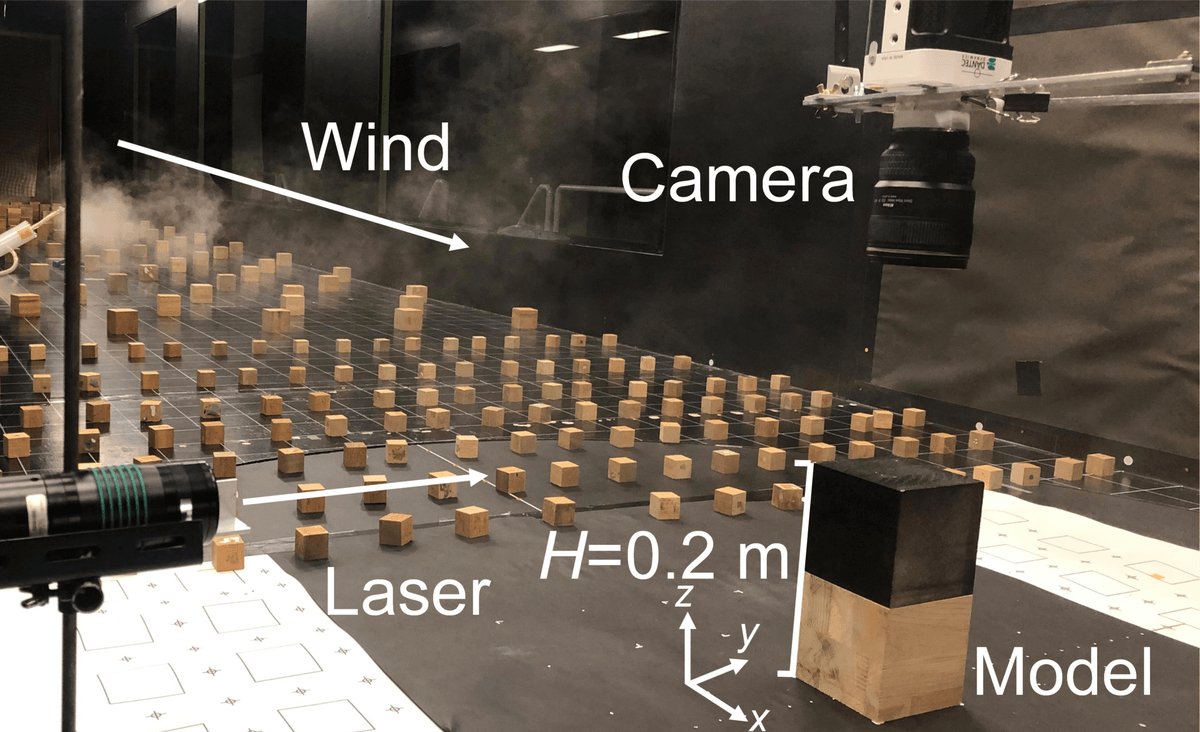
- Trained on PIV wind tunnel data, not CFD, capturing real turbulence noise and variability.
- Deep learning beats Kriging by up to 32.7% SSIM and 27.8% NMSE when trained on mixed wind directions.
- UNet runs ~13.7x faster than Kriging per snapshot; CWGAN needs 45x more compute for marginal SSIM gains.
- QR-based sensor placement using POD modes boosts robustness by up to 27.8% under sensor perturbations.
- Code and trained models released at github.com/Yng314/windreconstruction.
Predicting how wind swirls over the top of a building sounds niche until you consider what wants to land there: delivery drones, air taxis, HVAC intakes, and solar arrays that all depend on knowing the local flow field in real time. A new study from Imperial College London, the University of Tokyo, and ENPC benchmarks four methods for reconstructing that field from a handful of sensors, and the results reshape the usual assumptions about when deep learning actually beats classical interpolation.
Why rooftops break traditional methods
Rooftop flows are messy. The spatiotemporal variations are highly complex due to building geometry effects and aerodynamic interactions characterized by separation flows and conical flows under different wind directions, and these uneven flow patterns directly threaten the safe utilization of rooftop spaces. Full-field Computational Fluid Dynamics (CFD) simulations can capture this in principle, but they are slow, sensitive to boundary conditions, and struggle with realistic turbulence, ruling them out for real-time decisions.
The alternative is to sprinkle a few anemometers on the roof and reconstruct the full field. Classical Kriging interpolation assumes spatial stationarity, which is exactly what a separation bubble or a corner vortex violates. That is where learned models come in.
The setup: wind tunnel, not simulation
The authors ran