
Johns Hopkins Team Fixes Diffusion Models That Cheat by Seeing the Future
Researchers from Johns Hopkins, Northwestern, and Stanford propose a diffusion framework that generates time series one step at a time, without peeking at the future.
Takeaways
- Researchers from Johns Hopkins, Northwestern, and Stanford propose a diffusion model that generates time series causally, step by step, without future look-ahead.
- Standard diffusion models fail on sequential data because they implicitly use future information during generation, violating the non-anticipativity requirement.
- The method uses a sequential forward-backward diffusion process conditioned on previously generated history, with a novel parallel-trainable score-matching objective.
- Rigorous statistical guarantees are derived covering score approximation, score estimation, and distribution estimation with ReLU networks.
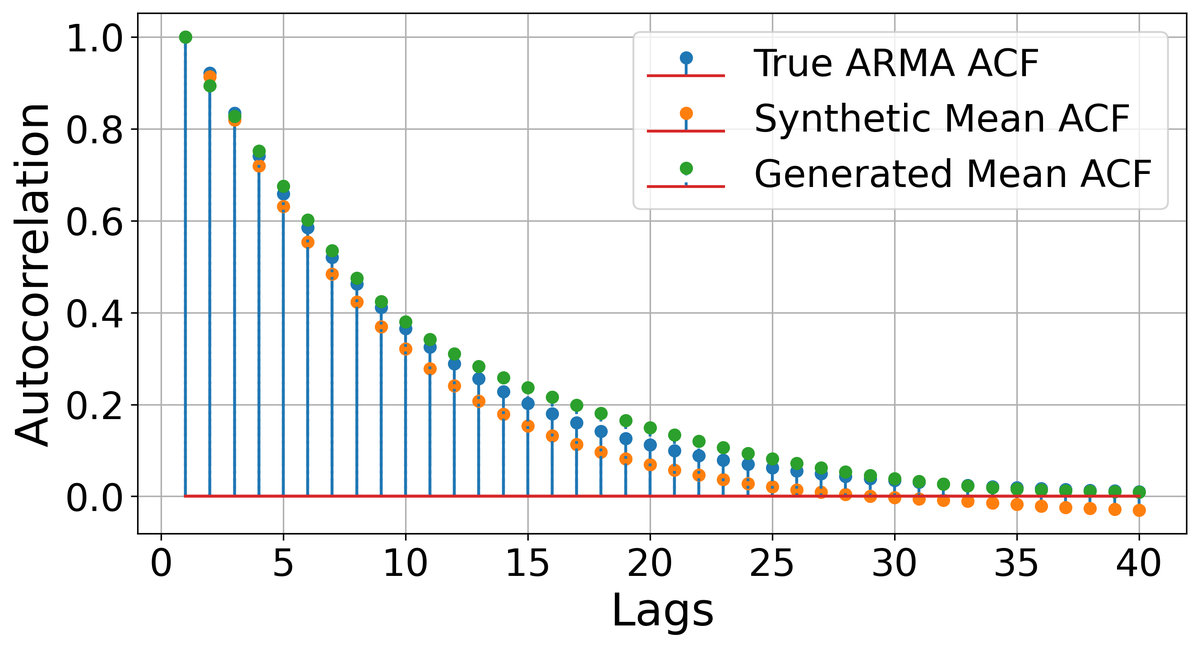
- Validated on ARMA models, Gaussian processes, and mean-variance portfolio construction -- showing accurate recovery of temporal dependence structure.
- No code has been released; empirical validation is currently limited to synthetic benchmarks and a single finance application.
Standard diffusion models are spectacular at generating images, audio, and other static data. But ask them to generate a realistic financial return series, a patient vital-sign trajectory, or an energy demand curve, and they quietly fall apart. The reason is subtle but fundamental: most diffusion architectures treat the entire sequence as a single object to denoise, which means they implicitly use information from the future when generating the past. That violates a basic rule of how real sequential processes work.
A team of researchers from Johns Hopkins University, Northwestern University, and Stanford University has now published a paper on arXiv proposing a framework that fixes this. Their method, called a sequential forward-backward diffusion, generates time series step by step, conditioning each new value only on what has already been produced, never on what comes next.
Why existing diffusion models break on time series
The core problem is what researchers call adaptiveness (also called non-anticipativity): a valid model of a sequential process must only use information available up to the current time step. Think of it as the no-look-ahead rule. Generating realistic synthetic sequential data is critical in applications like operations research and finance, but diffusion models that achieve remarkable success on static data often fail to capture temporal dependencies and information structure when extended to sequential settings.
Designing diffusion models that can simulate sequential data in an adaptive, non-anticipative manner therefore remains an open challenge. Existing approaches typically flatten a time series into a vector and apply standard diffusion, which means the denoising network sees the whole sequence at once and can implicitly exploit future values during generation. The resulting synthetic data looks statistically plausible in aggregate but fails the adapted-process test that matters for downstream tasks like simulation, risk assessment, and decision-making.