
Khalifa University's AI Pipeline Writes Expert Art Defect Reports From Heat Scans
A new research framework fuses three thermal imaging techniques with a vision-language model to produce standardized, uncertainty-aware condition reports for paintings.
Takeaways
- Research framework fuses PCT, TSR, and PPT thermography with a VLM for automated painting condition reports (paper).
- Consensus segmentation keeps only anomalies detected across multiple modalities, suppressing boundary and heat-loss artifacts.
- Structured prompt forces the VLM into a three-section schema with explicit uncertainty statements.
- Validated on two nineteenth-century Italian marquetries with consensus masks covering under 10% of ROI.
- Implementation used Qwen-VL-Chat but the framework is architecture-agnostic across VLMs.
- No public code release; future work will add XRF, hyperspectral inputs, and domain-adapted VLMs.
A team spanning Khalifa University, Tomsk Polytechnic, the Academies of Fine Arts of Naples and Sassari, and the University of L'Aquila has proposed something conservators have been quietly waiting for: an automated pipeline that turns raw thermal imaging data of paintings into structured, expert-style condition reports, without a specialist sitting between the sensor and the page. The paper, titled Vision-Language Based Expert Reporting for Painting Authentication and Defect Detection, threads three complementary thermography techniques into a single consensus map and hands the fused evidence to a vision-language model that writes the diagnosis.
Why thermography needs a translator
Paintings are layered systems: support, ground, paint, varnish, and often decades of overpaint from previous restorations. Pulsed Active Infrared Thermography (AIRT) works by applying a thermal stimulus to the surface and recording how heat diffuses through those layers over time, revealing voids, delaminations, and past interventions that are invisible optically.
The catch is interpretation. Boundary heat loss, non-uniform excitation, and environmental reflections introduce artifacts, particularly near edges, that can bias defect detection, and every lab tunes parameters differently. Two conservators looking at the same thermogram can walk away with different conclusions, which makes cross-collection comparison nearly impossible.
Three views of the same heat, then a vote
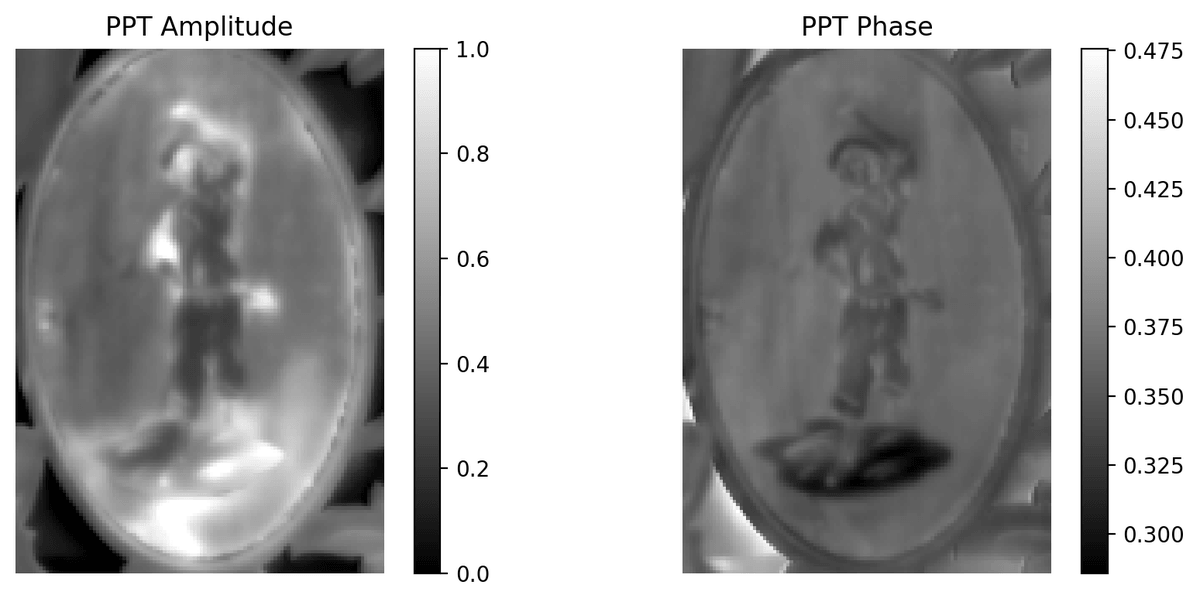
Rather than betting on a single processing method, the framework runs the thermal sequence through three transforms that each emphasize different physics: