
Khalifa University's BladeChain Puts AI Aircraft Inspections on a Tamper-Proof Ledger
BladeChain ties AI defect detection, blockchain consensus, and cryptographic image hashing into a single auditable trail for aircraft engine blade inspections
Takeaways
- BladeChain is a Hyperledger Fabric prototype that creates a tamper-evident, multi-party audit trail for aircraft engine blade inspections.
- It is the first system to record AI model name and version on-chain alongside cryptographic hashes of inspection images, enabling regulator re-audits.
- A chaincode state machine automatically triggers inspections when flight hours (500), cycles (500), or calendar days (180) thresholds are exceeded.
- Tested on 100 blades with 100% lifecycle completion at ~26 ops/min; tamper detection runs in under 18 ms via SHA-256 hash verification.
- Blockchain consensus costs ~140x throughput vs. a PostgreSQL baseline, but the 2-second write latency is operationally irrelevant for maintenance workloads.
- No public code yet; paper and full architecture available at arxiv.org/abs/2603.08288.
Every time an aircraft engine blade gets inspected, a chain of trust has to hold: the right technician, the right AI model, the right image, the right approval -- all traceable by regulators who may audit the record years later. Today, that chain is mostly held together with spreadsheets, siloed databases, and paper forms. A new research prototype called BladeChain, out of Khalifa University, proposes fixing that with a permissioned blockchain that locks every inspection event into a tamper-evident ledger shared across all four parties in the aviation maintenance ecosystem.
A $125 Billion Problem Nobody Has Solved
The global Maintenance, Repair, and Overhaul (MRO) market is projected to exceed $125 billion by the early 2030s, with engine maintenance alone accounting for 46% of civil aviation MRO spending. Despite that scale, much of the associated evidence -- images, annotations, findings, approvals -- remains fragmented across paper forms, spreadsheets, and organization-specific databases, making it difficult to reconcile. These traditional systems are characterized by centralized storage, information lag, and high error rates.
Regulatory frameworks such as EASA Part-145 mandate Occurrence Reporting Systems, yet many implementations function as passive repositories rather than comprehensive systems capable of enforcing traceability across organizational boundaries. The AI side of the problem is equally unresolved: most AI deployments remain point solutions -- findings are confined to local QA tools without cross-organization provenance, model-version accountability, or cryptographic bindings to the artifacts reviewed. Even when an AI model flags a defect, there is no verifiable proof linking that output to the specific image, model version, and subsequent approval decision.
What BladeChain Actually Does
BladeChain is built on Hyperledger Fabric 2.5, a permissioned blockchain framework designed for enterprise consortiums. The key word is permissioned: unlike public blockchains, every participant is identified by an X.509 certificate issued by their organization's Certificate Authority. No anonymous actors, no gas fees -- just four known parties with cryptographically enforced roles.

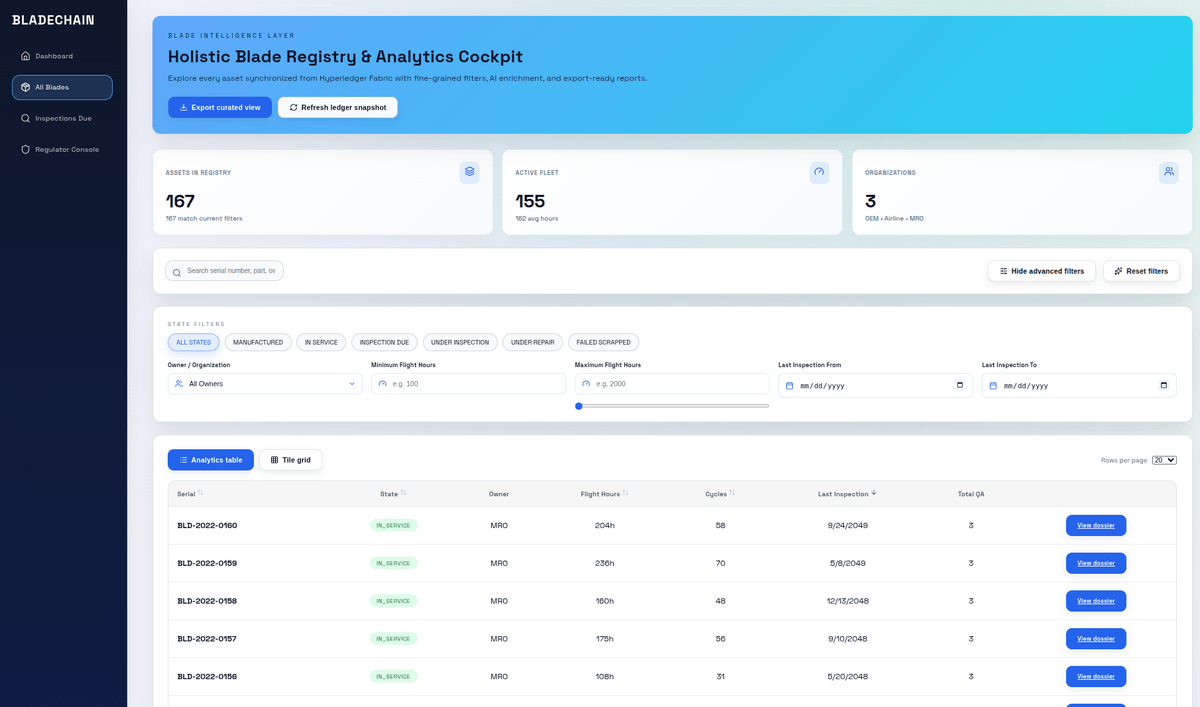
BladeChain employs a four-layer architecture that separates client applications, the API gateway, the blockchain network, and off-chain services. Here is how each layer works:
- Layer 1 -- Dashboards: Role-specific web UIs for OEM, Airline, MRO technicians, and Regulators. Each sees only what their role permits.