
Korea's MGMAR Tops CT Benchmark by Beating 40-Year-Old Metal Artifact Problem
A new metal-guided pipeline combines implicit neural representations with normalized MAR, topping the AAPM-MAR benchmark with a 0.89 final score.
Takeaways
- MGMAR posts a 0.89 final score on the AAPM CT-MAR benchmark, topping the compared methods.
- Combines a conditioned implicit neural representation prior with the classical normalized MAR projection-completion framework.
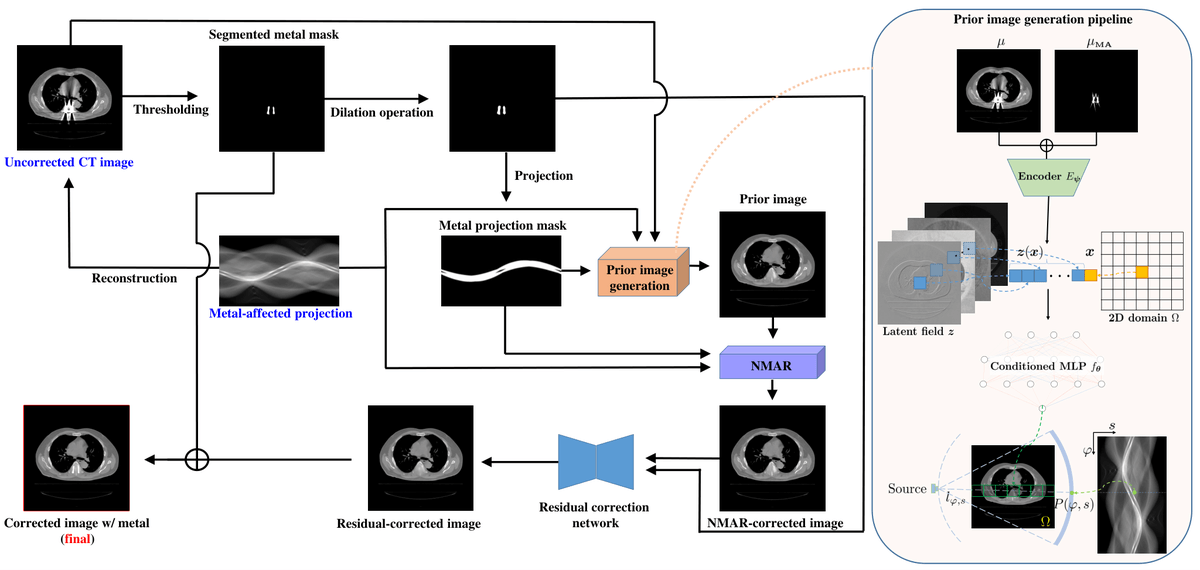
- Encoder is pretrained on paired corrupted and clean CT scans, cutting sensitivity to random initialization.
- A metal-conditioned residual network uses adaptive instance normalization to target secondary artifacts near implants.
- Wins on CT number accuracy, noise, SSIM, and PBR influence but slightly reduces sharpness.
- Paper extends the authors' second-place AAPM challenge submission; no public code released yet.
Metal artifacts have haunted CT imaging for four decades. Dental fillings, hip prostheses, spinal screws, and surgical clips absorb X-rays so aggressively that they violate the assumptions built into standard reconstruction math, splashing streaks and shadows across scans and sometimes rendering them useless for diagnosis. A new method called MGMAR, from researchers at Korea's National Institute for Mathematical Sciences, has just posted the top score on the field's most rigorous public benchmark by rethinking how neural priors should be woven into the classical reconstruction pipeline.
Why streaks appear, and why they are hard to remove
CT reconstruction assumes the X-ray beam is monochromatic and that tissue absorbs it linearly. Metal breaks both assumptions. The AAPM CT-MAR challenge organizers describe the situation bluntly: in the presence of highly attenuating objects such as dental fillings, hip prostheses, spinal screws/rods, and gold fiducial markers, CT images are corrupted by streak artifacts, often making the images non-diagnostic. Classical fixes like linear interpolation of the metal-affected sinogram tend to swap one problem for another, introducing secondary artifacts due to inconsistencies. Normalized MAR (NMAR), the community's long-standing workhorse, does better by first building a rough prior image via tissue segmentation and using it to guide interpolation, but its priors are only as good as the thresholding that produced them.
The core idea: let a network learn the prior, but keep the physics
MGMAR keeps NMAR's projection-completion machinery and replaces the segmentation-based prior with something far richer. MGMAR first generates a high-quality prior image by training a conditioned implicit neural representation (INR) using metal-unaffected projections, and then incorporates this prior into a normalized MAR (NMAR) framework for projection completion. An INR here is a small neural network that maps pixel coordinates to attenuation values, fit to each individual scan so it acts as a continuous, self-consistent representation of the underlying anatomy.