
LCD-GS Beats HDR 3D Reconstruction With Just One Extra Number per Pixel
A one-scalar tweak to 3D Gaussian Splatting fixes the bright-bias failure mode when reconstructing scenes directly from HDR imagery.
Takeaways
- LCD-GS trains HDR 3D Gaussian Splatting directly, dropping the dual-branch multi-exposure pipeline used by prior work.
- Standard 3DGS fails on HDR because spherical harmonics entangle luminance and chromaticity, biasing toward bright regions.
- The fix: give each Gaussian a separate luminance scalar while keeping SH for chromaticity, adding one parameter per primitive.
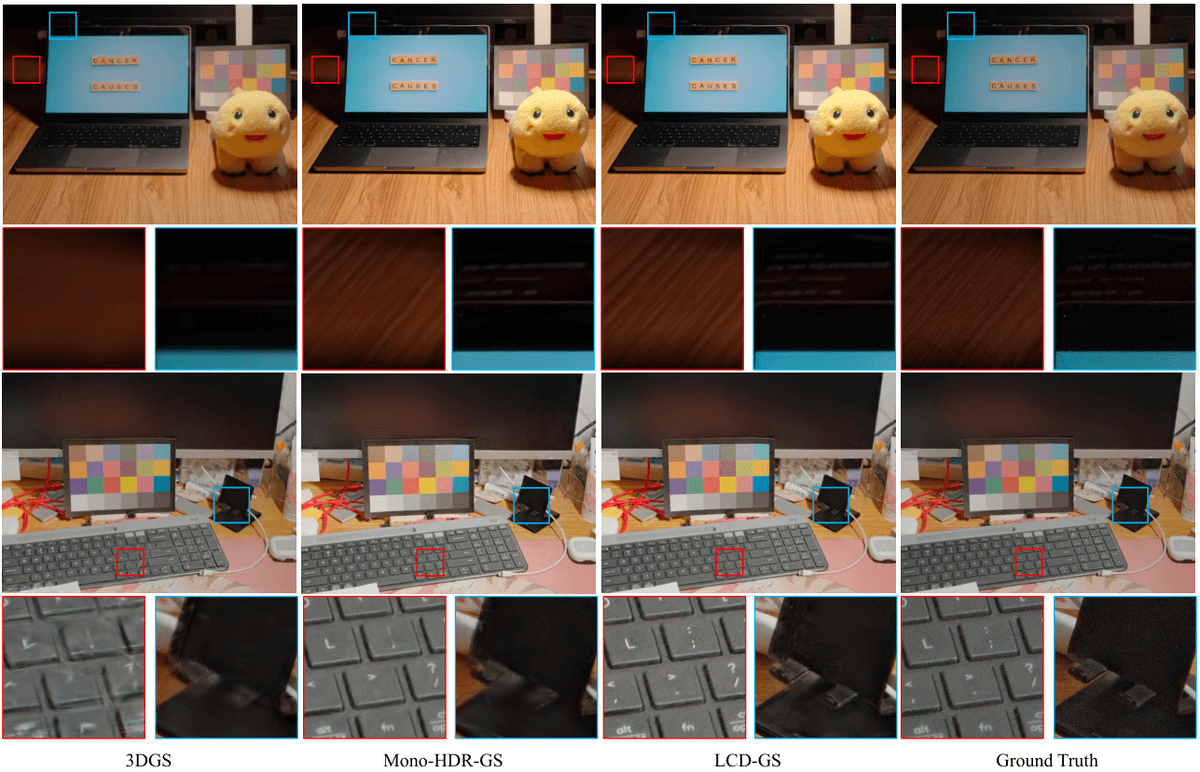
- Reports state-of-the-art fidelity and dynamic-range preservation on synthetic and real HDR datasets.
- Enables clean global and local exposure editing since brightness is now an explicit, disentangled parameter.
- Paper; code and datasets promised but not yet released.
HDR 3D reconstruction has been stuck with clunky, dual-branch architectures that fuse multiple low dynamic range exposures to fake the wide brightness range needed for film and virtual production. A new paper from researchers at Nanjing University of Science and Technology, Imperial College London, and the University of Surrey argues that this complexity is unnecessary. Their method, Luminance-Chromaticity Decomposition 3DGS (LCD-GS), trains a Gaussian Splatting model directly on HDR data by adding a single extra scalar to each Gaussian, and beats existing state of the art in both fidelity and dynamic-range preservation.
Why vanilla 3DGS breaks on HDR
Standard 3D Gaussian Splatting represents each primitive's view-dependent color with a set of spherical harmonics (SH). Typically that means degree-3 SH, or 16 coefficients per RGB channel, which is plenty for the compressed 0-255 range of LDR images where radiance and pixel intensity are roughly linearly related.
HDR breaks that assumption. Radiance can span many orders of magnitude across viewpoints, and the paper shows that when you feed HDR imagery to 3DGS, the SH coefficients simply cannot express such extreme view-dependent variation. The optimizer collapses toward fitting the brightest observations, and darker regions get flattened into noise. The resulting radiance field looks blown out in bright zones and loses detail entirely in shadows.

The obvious fix, cranking SH up to degree 4 or 5, does help fit the training views but explodes the parameter count and causes severe overfitting. Novel views degrade even as the training loss keeps dropping. That is the trap the authors set out to escape.