
LUT University's CRAN-PM Maps Europe's Air Quality at Street Level in 2 Seconds
A dual-branch Vision Transformer forecasts European PM2.5 at 1 km resolution by fusing coarse meteorology with fine local data through cross-resolution attention.
Takeaways
- CRAN-PM is a dual-branch Vision Transformer forecasting European PM2.5 at 1 km resolution across 29 million pixels.
- Cross-resolution attention lets 1 km local tiles query a cached 25 km global meteorology encoding, keeping memory under 2 GB per tile.
- Elevation-aware self-attention and wind-guided cross-attention inject physics as soft biases with essentially zero extra parameters.
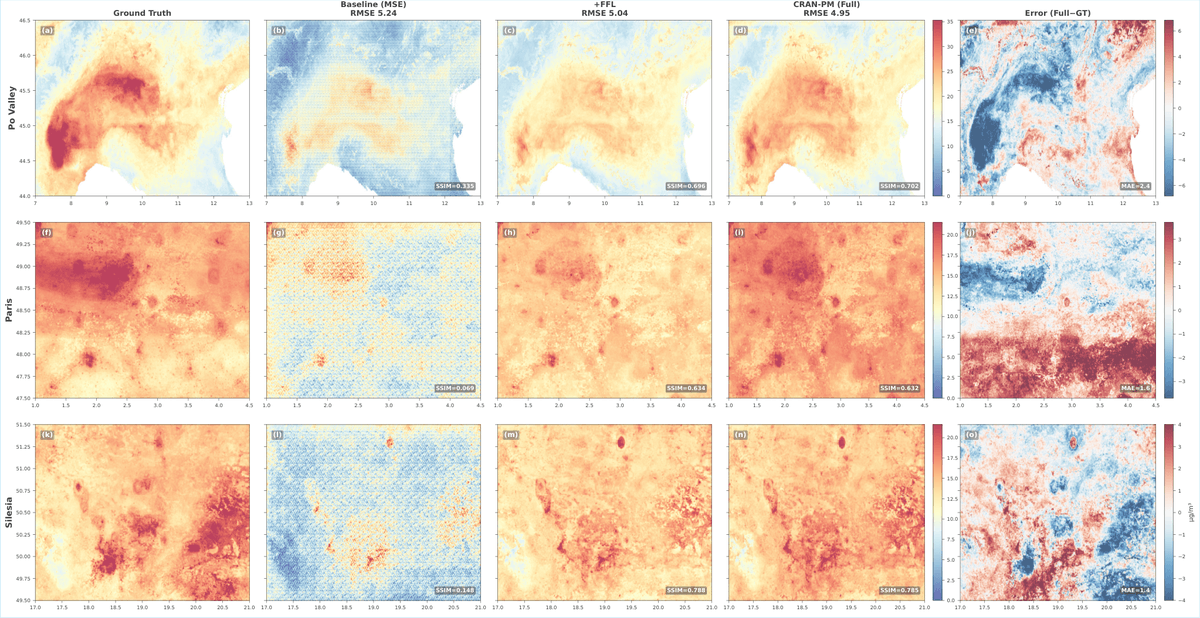
- Beats the best baseline by 4.7% RMSE at T+1 and 10.7% at T+3, cutting complex-terrain bias by 36%.
- Full 4,000 by 8,000 pixel European map generated in 1.8 seconds on a single AMD MI250X GPU.
- Code and paper available at GitHub and on arXiv.
Forecasting air quality across an entire continent at street-block resolution has been one of those problems where the math just does not cooperate with the hardware. A 1 km European PM2.5 map is roughly 4,000 by 8,000 pixels, and once you tokenize it for a Vision Transformer, you get around 115,000 tokens and a memory bill north of 300 GB. A team from LUT University, the University of Helsinki, and AMD has now published CRAN-PM, a dual-branch Vision Transformer that sidesteps that wall and produces the full 29-million-pixel map in under two seconds on a single GPU.
Why continent-scale ViTs keep breaking
Vision Transformers have transformed spatio-temporal analysis, but they all share a fundamental limitation: they operate at a single, fixed spatial resolution. When the target domain is large and the required resolution is fine, the token count explodes and the model becomes intractable. That is not just an engineering annoyance for air quality work. Existing weather and pollution models either maintain global consistency at coarse resolutions of 10 to 40 km, or provide retrospective 1 km estimates without forecasting capabilities. Neither is enough when you are trying to warn a city about tomorrow's smog.
PM2.5, the fine particulate matter linked to respiratory and cardiovascular disease, does not spread uniformly. It piles up in valleys, gets flushed by wind, and forms sharp gradients around industrial hotspots. Coarse-resolution models bilinearly upsampled to 1 km smear all of that away.
Splitting the problem across two branches
The core idea in CRAN-PM is divide-and-conquer. A global branch encodes large-scale meteorology over the full domain at 25 km resolution, while a local branch processes overlapping 1 km tiles on the current high-resolution PM2.5 data. The branches communicate via cross-resolution attention, enabling the local branch to query the global branch for long-range context.