
Microsoft's AutoAdapt Beats Top AutoML Agents by 25% on Domain Fine-Tuning
Microsoft's AutoAdapt uses multi-agent debate and a novel LLM-guided optimizer to automate the entire LLM fine-tuning pipeline, beating AutoML baselines by 25% across 10 tasks
Takeaways
- AutoAdapt is a Microsoft framework that fully automates LLM domain adaptation, from strategy selection to hyperparameter tuning, with no manual code fixes required.
- It achieves a 25% average relative accuracy improvement over state-of-the-art AutoML baselines across 10 tasks including medical QA, legal, coding, and cloud incident diagnosis.
- A multi-agent debate system (proposal + critic agents) traverses a structured decision graph to select techniques like RAG, SFT, or DPO and narrow hyperparameter ranges.
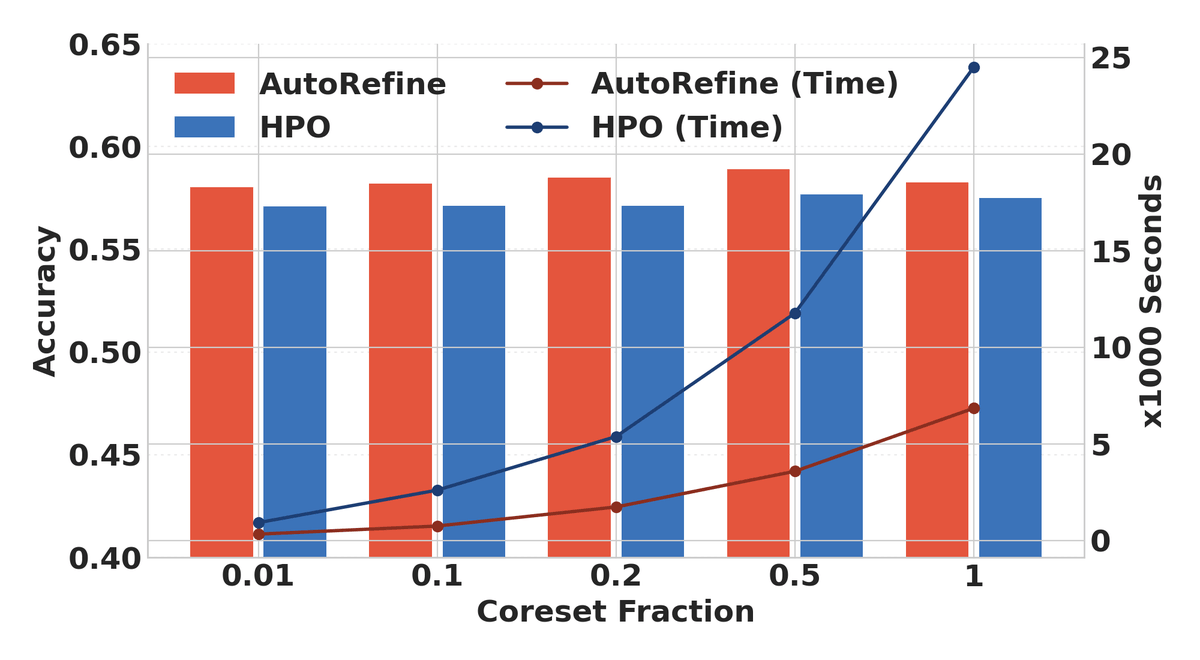
- AutoRefine combines LLM-based univariate trend prediction with Gaussian Process surrogate modeling to find optimal hyperparameters in ~5-10 training runs instead of hundreds.
- The system achieves 100% pipeline execution success rate; competing baselines like AutoMLAgent required 6-8 manual code corrections per run to even execute.
- The overhead is minimal: ~15 minutes and ~$4 per task on average; no public code release has been announced yet. Read the paper | Microsoft Research page
Adapting a general-purpose LLM to a specialized domain, think medical Q&A, legal reasoning, or cloud incident diagnosis, is one of the most frustrating workflows in applied ML. The process is largely manual, assumes a one-template-fits-all approach, and the combinatorial explosion of possible configurations means even experienced teams spend weeks or months in trial-and-error. Researchers at Microsoft have now published AutoAdapt, an end-to-end automated framework that replaces that grind with a structured, agent-driven pipeline.
Why this is harder than it looks
Existing domain adaptation practices rely heavily on manual trial-and-error, incur significant hyperparameter complexity, and are highly sensitive to data and user preferences. The interactions and transferability of hyperparameter choices across models and domains remain poorly understood, making adaptation gains uncertain even with substantial effort.
The problem is not just picking a learning rate. A full LLM adaptation pipeline involves a cascade of decisions:
- Strategy selection: Should you use RAG, supervised fine-tuning (SFT), or preference alignment (DPO)? Each has different infrastructure requirements and data assumptions.
- Architecture choices: Full fine-tuning vs. parameter-efficient methods like LoRA or Prefix Tuning, which themselves have their own hyperparameters (rank, alpha, dropout).
- Training configuration: Learning rate, batch size, gradient accumulation, quantization, schedulers, and more.
- Multi-stage pipelines: Some tasks need SFT followed by DPO, or RAG layered on top of a fine-tuned model.
AutoML is already transforming LLM fine-tuning by automating hyperparameter selection and optimization, speeding up the process and expanding its accessibility. But existing AutoML agents were built for classical ML, not for the unique complexity of LLM adaptation. Recent work has explored automating general ML pipelines using agent-based frameworks, but existing methods rely on the pretraining knowledge or in-context learning ability of LLMs, which is insufficient for the task of LLM adaptation.
The AutoAdapt architecture
AutoAdapt is built around three interlocking components that work sequentially: a structured decision graph, a multi-agent debate planner, and a hyperparameter optimizer called AutoRefine. The user provides a task description, a dataset, and any constraints (GPU budget, latency targets, model size limits), and the system delivers a trained, domain-adapted model.